
Chanel Revolutionizes Beauty with Industrial-Scale 3D Printed Mascara Brushes
Chanel, a globally recognized leader in luxury fashion and beauty, has made a groundbreaking entry into the realm of 3D printing. This strategic move aligns with a growing trend where additive manufacturing technologies are empowering both established fashion houses and independent designers to innovate in product creation, from intricate jewelry to diverse fashion accessories. Chanel’s venture into this advanced manufacturing technique signifies a pivotal moment, pushing the boundaries of what is possible in high-end cosmetic production and setting a new precedent for the industry.
Innovation has always been a cornerstone of Chanel’s philosophy, making its embrace of 3D printing a logical and anticipated step. The journey began over a decade ago when Chanel filed a patent for a 3D printed mascara brush in 2007. This long-term commitment underscores the brand’s dedication to meticulous research and development, ensuring that when the product eventually launched, it would be nothing short of revolutionary. This patience and foresight have now culminated in the world’s first industrial-scale production of a 3D printed cosmetic item, poised to disrupt traditional manufacturing methods and set new industry standards.
To bring this ambitious vision to fruition, Chanel forged a decade-long partnership with Erpro Factory 3D, a renowned specialist in the mass production of 3D printed objects. This collaboration was instrumental in transforming a visionary concept into a tangible, commercially viable product. Pascale Marciniak-Davoult, Director of Packaging Innovation at Chanel Parfums Beauté, highlighted the significance of this collaboration in a recent press release:
” Together we have taken up a number of technological challenges to push the boundaries of 3D printing and offer a revolutionary product. For the first time in the world, in all sectors of activity, 3D printing will be massively industrialized by Chanel Parfums Beauté. “
This statement emphasizes not only the technological hurdles overcome but also the pioneering nature of Chanel’s achievement. Industrializing 3D printing on such a massive scale for a consumer product marks an unprecedented milestone, not just for the cosmetics sector but for global manufacturing across all industries. This move positions Chanel at the forefront of additive manufacturing adoption, demonstrating its potential for high-volume, precision-driven production.
Le Volume Révolution mascara brush. Image via Chanel Parfums Beauté
Introducing “Le Volume Révolution”: A Breakthrough Mascara Brush Powered by 3D Printing
The star of this innovation is the “Le Volume Révolution” mascara brush, meticulously engineered using advanced Selective Laser Sintering (SLS) technology. This cutting-edge process involves using a laser to selectively fuse powdered material, layer by layer, until the final complex geometry is achieved. For the “Le Volume Révolution,” Chanel opted for polyamide, a durable and flexible material perfectly suited for creating the brush’s unique features.
Chanel’s commitment to industrialization is evident in its ambitious production capabilities. The French brand proudly states it can manufacture an impressive 50,000 brushes daily, translating to 250,000 per week and an astonishing 1 million brushes monthly. This high-volume production is facilitated by a sophisticated high-tech line comprising six industrial 3D printers operating continuously. This scale of production demonstrates that 3D printing is no longer confined to prototyping or niche applications but is a viable and powerful method for mass market consumer goods.
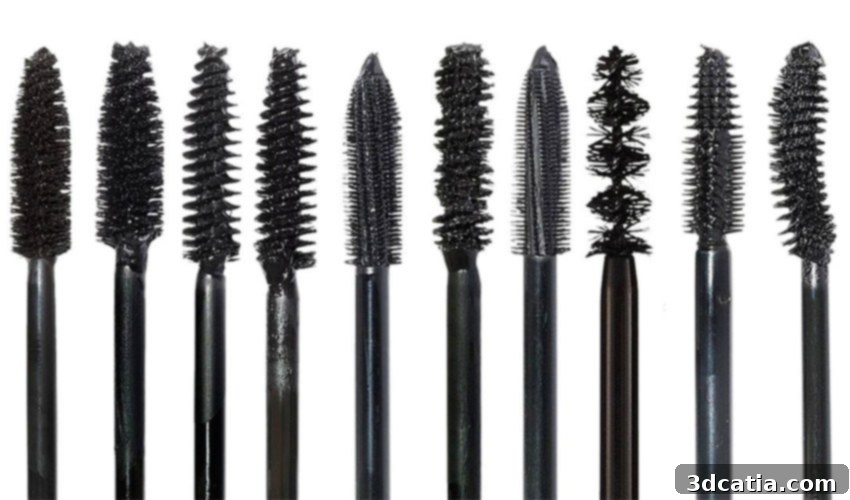
What truly sets “Le Volume Révolution” apart is its intricate design, made possible solely through 3D printing. The brush head is equipped with thousands of microscopic cavities designed to optimize the absorption and distribution of mascara. These micro-cavities ensure that the perfect amount of product is captured and transferred to the lashes with a single application, eliminating the need to re-dip the brush multiple times. This innovative feature guarantees an even and consistent application, contributing to a superior user experience and flawless results.
Beyond manufacturing, 3D printing played a critical role during the initial design and development phases of the brush. Unlike traditional manufacturing methods that rely on expensive and time-consuming mold creation, 3D printing allowed Chanel’s designers unparalleled freedom and agility. This process enabled rapid prototyping, allowing the team to iterate through over 100 different prototypes to perfect the final model. This iterative approach not only accelerated the design cycle but also significantly reduced costs associated with traditional tooling. The ability to quickly test and refine designs meant that every curve, bristle, and cavity could be precisely optimized for performance and aesthetics.
Chanel explicitly stated that the unique and complex shape of the “Le Volume Révolution” brush would have been impossible to achieve with standard manufacturing techniques, such as plastic injection molding. 3D printing provided the necessary flexibility and precision to create a brush geometry that facilitates the homogeneous distribution of mascara on the eyelashes, promising extreme volume without product overdose or clumping. This intricate design ensures that each lash is perfectly coated, delivering an impactful and defined look that was previously unattainable.
The Transformative Future of Cosmetics with 3D Printing
The success of “Le Volume Révolution” highlights the immense potential of 3D printing in the cosmetics sector. This additive manufacturing method has allowed Chanel to produce a mascara brush that is not only intricate in its design but also offers an optimal balance of complexity and flexibility. This manufacturing approach opens doors for the luxury brand to explore and design an even broader range of mascara iterations and other cosmetic tools, far exceeding the limitations imposed by conventional molding techniques.
The implications extend far beyond mascara. Imagine personalized makeup compacts, custom-fit skincare applicators, or even bespoke fragrances with uniquely printed atomizers. 3D printing promises a future of hyper-customization, where beauty products can be tailored precisely to individual needs and preferences. It fosters innovation in material science, allowing for the development of new textures and product forms. Furthermore, the on-demand production capabilities of 3D printing could lead to more sustainable practices, reducing waste and inventory. Chanel’s bold step into industrial-scale 3D printing serves as a powerful testament to this technology’s transformative power, paving the way for a more innovative, personalized, and efficient beauty industry. This pioneering effort signals a paradigm shift, where luxury and high technology converge to redefine the standards of cosmetic excellence.
Discover more about this groundbreaking innovation and other offerings on the official website of the French luxury brand.
What are your thoughts on the future of 3D printing in the cosmetics sector? Share your insights and join the conversation by leaving a comment below or by connecting with us on our Facebook and Twitter pages! Don’t miss out on the latest advancements in additive manufacturing—sign up for our free weekly Newsletter to receive all the crucial 3D printing news directly in your inbox!