
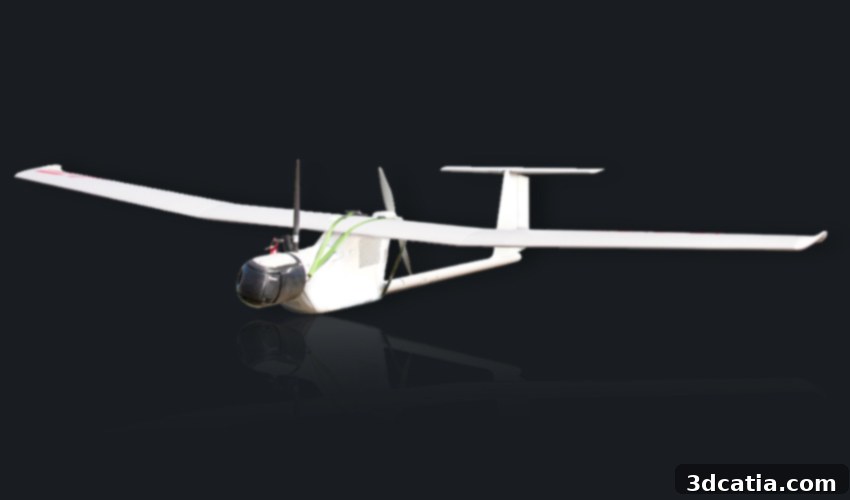
Revolutionizing Maritime Surveillance: TEKEVER’s Strategic Adoption of SLS 3D Printing for Advanced Drone Components
TEKEVER, a pioneering Portuguese company established in 2001, stands at the forefront of designing and manufacturing sophisticated maritime surveillance drones for the demanding defense and security sectors. With over two decades of expertise, TEKEVER has consistently pushed the boundaries of unmanned aerial systems (UAS) development, offering a versatile product line including the AR3, AR4, and AR5 platforms. Among these, the AR4 has garnered particular attention for its innovative integration of advanced manufacturing techniques, specifically incorporating a critical 3D printed component. By leveraging the power of Selective Laser Sintering (SLS) technology, utilizing XYZprinting’s state-of-the-art MfgPro230 xS 3D printer, TEKEVER successfully engineered the body of its drone’s turret. This strategic adoption of additive manufacturing not only led to significant reductions in production costs and lead times but also ensured that the part met stringent mechanical requirements and structural properties essential for high-performance aerial operations. This case study illustrates a compelling example of how industrial 3D printing is transforming the aerospace and defense industries, enabling greater design flexibility, material optimization, and accelerated product development cycles.
The development and deployment of Unmanned Aerial Systems (UAS) like those produced by TEKEVER are inherently complex, facing a multitude of design and manufacturing constraints. Key among these are the imperative for components to exhibit exceptional strength and resistance to impacts, while simultaneously maintaining minimal weight and optimal rigidity. These seemingly contradictory requirements are crucial for ensuring superior flight performance, extended operational range, increased payload capacity, and enhanced maneuverability. Traditional manufacturing processes often struggle to efficiently balance these attributes, frequently involving compromises between part complexity, material usage, and production efficiency. However, additive manufacturing, or 3D printing, has emerged as a transformative solution, offering unprecedented capabilities to meet these high expectations. The technology has already demonstrated its immense value and reliability across various applications within the aerospace field, proving its ability to produce complex geometries with optimized weight-to-strength ratios. By precisely depositing and fusing only the necessary material, and selecting the right performance-grade polymers, companies like TEKEVER can achieve lightweight yet robust parts, significantly reducing manufacturing time and waste. It was this potential for optimization and performance enhancement that initially drew TEKEVER’s attention to 3D printing technologies. Their initial foray involved Fused Deposition Modeling (FDM), a common and accessible form of 3D printing. However, the inherent limitations of FDM, particularly concerning support structures, surface finish, and anisotropic mechanical properties, prompted TEKEVER to explore alternative, more advanced additive manufacturing processes. This exploration ultimately led them to embrace a Selective Laser Sintering (SLS) solution, specifically from XYZprinting, recognizing the superior mechanical properties and design freedom that SLS technology offered compared to FDM for their critical drone components.
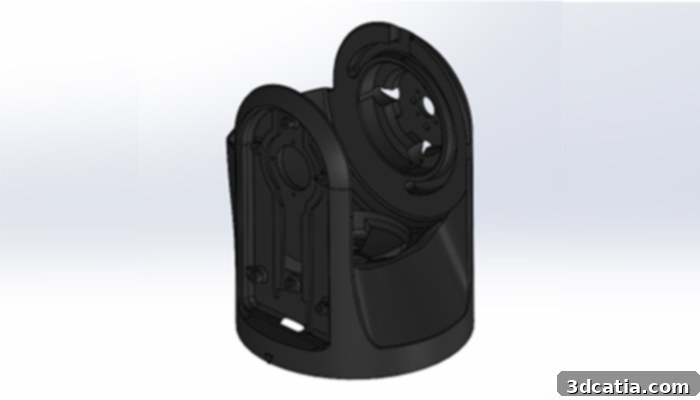
The body of the drone’s turret (photo credits: XYZprinting)
From FDM to SLS: A Strategic Technology Shift for Drone Manufacturing
TEKEVER’s primary objective in exploring advanced additive manufacturing was to rigorously evaluate the effectiveness of SLS technology, focusing on its capacity to deliver superior surface quality and enhanced mechanical resistance for critical drone components. To conduct this assessment, they selected the turret body of their AR4 drone as a prime candidate for 3D printing. This particular component presented significant manufacturing challenges due to its highly complex geometry, characterized by a delicate interplay of exceptionally thin and thick wall sections, numerous small-diameter holes, and intricately rounded edges. Such intricate designs are often problematic for conventional manufacturing methods or even less advanced 3D printing techniques. Initially, TEKEVER experimented with manufacturing this turret body using an FDM machine, employing ULTEM, a high-performance thermoplastic renowned for its excellent weight-to-strength ratio and thermal stability. While ULTEM offered desirable material properties, the FDM process itself introduced several limitations. A major drawback of FDM is the absolute necessity of support structures to fabricate overhangs and complex geometries. These supports consume additional material, extend post-processing times significantly, and frequently compromise the final surface quality and dimensional accuracy of the part. The laborious removal of supports can also introduce micro-fractures or surface imperfections, which are unacceptable for precision aerospace components. Recognizing these impediments, TEKEVER sought a more advanced solution. The inherent advantage of SLS technology, which entirely eliminates the need for support structures—as the unsintered powder acts as a self-supporting medium—made it an exceedingly attractive and logical alternative to FDM. This fundamental difference promised cleaner parts, reduced post-processing, and greater design freedom, critical factors for the success of their drone development program.
Beyond the critical aspect of eliminating support structures, TEKEVER faced several other non-negotiable criteria for the drone turret. The part absolutely had to maintain extreme lightness to ensure optimal drone performance and efficiency, minimize printing time to accelerate development and production cycles, and possess robust water resistance given the AR4’s intended maritime surveillance applications. These three stringent requirements were all successfully met and exceeded through the implementation of XYZprinting’s comprehensive SLS solution, underscoring the versatility and advanced capabilities of this additive manufacturing technology.
XYZprinting’s SLS Technology Meets Industry’s Rigorous Constraints
The AR4 UAV is engineered as an indispensable solution for both military and commercial applications, where rapid mobile deployment is paramount. Consequently, every component within the system must be as lightweight as possible to maximize operational range, extend flight duration, and enhance overall agility. To achieve this crucial weight minimization for the turret component, it was essential to strategically reduce the amount of material used. This is where the advanced design capabilities of SLS technology truly shine. In SLS, if an object features a closed internal geometry, evacuation holes must be strategically incorporated into the design. These vents allow for the effective removal of unsintered powder from the part’s interior after the printing process, enabling the creation of genuinely hollow and lightweight structures. TEKEVER’s engineers had two primary approaches to achieve this: either modify the original CAD design of the part itself to integrate these holes and internal structures, or employ specialized software tools to intelligently modify the internal filling geometry, creating a lattice or honeycomb structure. In the case of the AR4 turret, TEKEVER opted for a direct and effective strategy: they added specific vent holes and meticulously hollowed out the interior of the part, significantly reducing its overall weight without compromising structural integrity. This meticulous design optimization, made possible by SLS, demonstrates a key advantage over conventional manufacturing, which would struggle to produce such intricate internal structures efficiently.
In addition to optimizing the part’s design for weight, a critical factor for TEKEVER was the optimization of the printing time for each component. The SLS process is uniquely well-suited for this, offering a significant advantage over other additive manufacturing technologies. Its ability to create parts without supports means that components can be efficiently nested and stacked within the build chamber, maximizing the utilization of the printer’s volume. This capability allows for the simultaneous production of multiple components in a single print cycle, drastically improving throughput and efficiency. XYZprinting’s MfgPro230 xS 3D printer, with its generous build volume of 230 x 230 x 230 mm, further enhances this capability, providing ample space for numerous iterations and batches of parts. Moreover, the MfgPro230 xS is renowned for its exceptional repeatability, ensuring consistent quality across all printed parts. To put this efficiency into perspective: a single turret component, if printed on a conventional FDM 3D printer, would typically require approximately 16 hours. In stark contrast, the same part could be produced on the MfgPro230 xS SLS printer in a mere 10.5 hours – a significant time saving of over 30%. The true power of SLS becomes even more evident when scaling production. To manufacture four such components using an FDM machine, the printing time would need to be multiplied by four, resulting in a staggering 64 hours. However, with the SLS machine’s stacking capability, these four components could be simultaneously printed in an astonishingly short period of just 18 hours and 15 minutes. This dramatic reduction in production time per batch underscores the economic and operational advantages of SLS for industrial applications, particularly for projects requiring rapid iteration and production scalability.
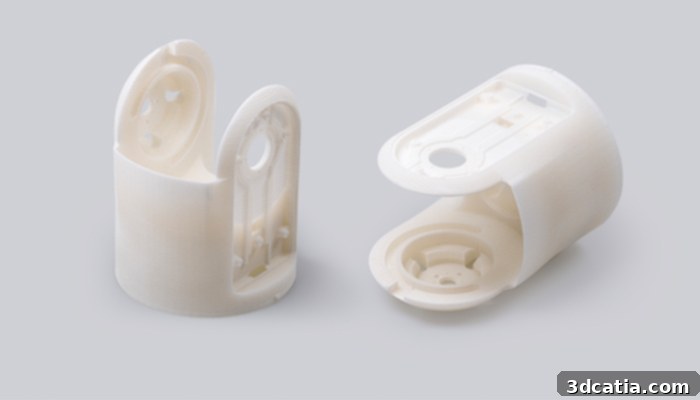
The final 3D printed parts (photo credits: XYZprinting)
Finally, the operational environment of the AR4 drone presented a unique and critical challenge: its role as a maritime surveillance solution means it consistently operates over vast oceans, where exposure to extremely high humidity levels, saltwater spray, and variable weather conditions is constant. Consequently, every component of the AR4 must exhibit exceptional water and moisture resistance to ensure long-term reliability and performance. The drone’s turret body, being a primary external component, was no exception and had to be 3D printed with a material specifically engineered for low water and moisture absorption. Recognizing this stringent requirement, XYZprinting rose to the occasion by developing a specialized Nylon 12 material tailored precisely for such demanding applications. This particular formulation, known as sPro12w, is characterized by a suite of superior properties. It boasts excellent chemical resistance, making it highly resilient to corrosive elements like saltwater. Crucially, its remarkably low moisture absorption rate ensures dimensional stability and prevents material degradation in humid environments, directly addressing a core challenge for maritime drones. Furthermore, the sPro12w offers outstanding surface resolution, which is vital for aerodynamic efficiency and the seamless integration of complex parts. These combined attributes made XYZprinting’s sPro12w Nylon 12 the definitive choice for TEKEVER, solidifying its position as the preferred SLS material for the AR4 drone’s critical components, guaranteeing durability and consistent performance in the harshest marine conditions.
Satisfactory Results and a Future for Additive Manufacturing in Aerospace
The strategic integration of the XYZprinting MfgPro230 xS printer, coupled with the advanced Nylon 12 sPro12w material, proved to be an unequivocally ideal choice for the manufacturing of critical parts for TEKEVER’s AR4 UAV. The combination of the machine’s generous build volume and the material’s high-performance properties empowered TEKEVER’s engineering teams to not only significantly optimize their printing times but also to consistently produce superior quality components. These parts exhibit enhanced structural integrity, precise dimensional accuracy, and the crucial environmental resistance required for maritime operations. The successful implementation of this technology underscores the tangible benefits of industrial 3D printing in the aerospace and defense sectors, moving beyond mere prototyping to full-scale functional part production. TEKEVER’s experience was further bolstered by an exceptional partnership, as highlighted by their concluding remarks: “The XYZprinting team gave great customer support by helping us throughout the process of printing this part, from the adequate choice of material to the correct orientation for optimal results, clearing any doubts which might have risen.” This collaborative approach, combining cutting-edge technology with expert guidance, was instrumental in TEKEVER achieving their ambitious manufacturing goals. The successful deployment of SLS technology for the AR4 drone component represents more than just a single project success; it paves the way for broader adoption of additive manufacturing in the design and production of future unmanned systems, offering unprecedented agility, cost-efficiency, and performance capabilities for next-generation aerospace applications. This ongoing evolution signifies a transformative shift in how complex, high-performance components are brought to life, ensuring that advanced drones remain at the cutting edge of surveillance and security technology.
What are your thoughts on the revolutionary use of Selective Laser Sintering (SLS) for the creation of advanced drone components, particularly in demanding maritime environments? We invite you to share your insights and opinions in a comment below, or engage with us on our LinkedIn, Facebook, and Twitter pages! Don’t miss out on the latest advancements and breaking news in the additive manufacturing world – be sure to sign up for our free weekly Newsletter here, delivering the most current 3D printing news straight to your inbox! You can also find all our comprehensive videos and exclusive content on our YouTube channel, offering deeper dives into the innovative applications of 3D printing technology!