
NASA’s GRX-810: The 3D Printed Superalloy Revolutionizing Aerospace and Beyond
A year ago, the National Aeronautics and Space Administration (NASA) unveiled a groundbreaking new alloy, GRX-810, which promised unprecedented levels of resistance and durability. This material was specifically engineered to excel in the most demanding aerospace applications, where extreme temperatures, pressures, and stresses are commonplace. Developed through a sophisticated combination of advanced 3D printing techniques and oxide dispersion strengthening, GRX-810 represents a significant leap forward in material science, offering dramatically improved performance characteristics compared to existing superalloys.
The development of GRX-810 was a collaborative effort involving expert teams from NASA and Ohio State University. Their intensive research focused on meticulously characterizing this novel superalloy, which relies heavily on additive manufacturing for its unique structure. The commercial validation of GRX-810’s exceptional properties was further solidified when leading additive manufacturing company, 3D Systems, rigorously tested the material on its advanced metal 3D printing platforms. These tests not only confirmed the alloy’s superior attributes but also demonstrated its potential for repeatable production, a crucial factor for industrial adoption in critical sectors like aerospace.
The Genesis of a Superalloy: Oxide Dispersion Strengthening and Additive Manufacturing
The core innovation behind GRX-810 lies in its unique manufacturing process, which leverages oxide dispersion strengthening (ODS). This technique involves strategically embedding minuscule oxide particles within a metal matrix. These particles act as obstacles to dislocation movement at high temperatures, significantly enhancing the material’s strength, creep resistance, and ductility. For GRX-810, NASA’s researchers pioneered a method to accelerate this complex dispersion process, transforming how such advanced materials are conceived and created.
To achieve the ideal composition and uniform distribution of these oxide particles, the team utilized advanced computer modeling and simulation. This computational approach allowed them to rapidly explore various material combinations and microstructures in a fraction of the time traditionally required for extensive experimental trials. Complementing this, laser powder bed fusion (LPBF) 3D printing played a pivotal role. This additive manufacturing technique enabled the layer-by-layer creation of the alloy, precisely dispersing nanometric oxide particles within a robust nickel and cobalt-chromium based alloy matrix. The unparalleled precision offered by LPBF is instrumental in controlling the microstructure at a microscopic level and ensuring uniform distribution of the strengthening oxides, which is absolutely critical for the alloy’s enhanced high-temperature performance.
The ability to use 3D printing for this process is nothing short of revolutionary. Traditional ODS alloys are often created through laborious mechanical alloying and hot consolidation methods, which can be time-consuming, expensive, and severely limit design complexity. By seamlessly integrating 3D printing, researchers can not only rapidly iterate on material compositions and optimize processes but also fabricate parts with highly intricate geometries that were previously impossible to achieve with conventional manufacturing. This groundbreaking approach opens up entirely new avenues for optimizing component designs for significant weight reduction, improved thermal management, and superior performance in extreme environments, directly benefiting cutting-edge applications such as advanced rocket engines, hypersonic flight vehicles, and next-generation turbine systems.
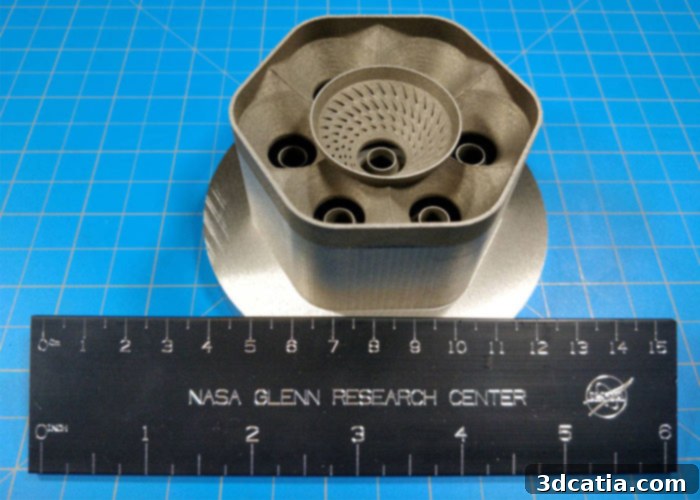
A component fabricated using the revolutionary GRX-810 superalloy, showcasing NASA’s innovative material science capabilities and the potential of additive manufacturing. (Photo Credits: NASA)
Unprecedented Properties for Extreme Environments
The performance metrics of GRX-810 are truly impressive, establishing new benchmarks for materials in high-stress, high-temperature applications that are characteristic of modern aerospace. Tim Smith, a dedicated materials research scientist at NASA’s Glenn Research Center in Cleveland, eloquently highlighted the profound impact of this innovation, stating, “This superalloy has the potential to dramatically improve the strength and toughness of components and parts used in aviation and space exploration.” His statement underscores the broad implications of GRX-810, from enhancing the reliability of commercial airliners to enabling more ambitious deep-space probes and advanced propulsion systems.
Specifically, GRX-810 demonstrates performance characteristics that significantly surpass those of current state-of-the-art 3D printed superalloys. It is reported to be twice as strong, meaning it is capable of withstanding extreme forces and loads far beyond what conventional materials can endure. Furthermore, its durability is astonishingly high, estimated to be over 1,000 times more resistant to damage and degradation under cyclical loading and fatigue conditions. This means that components made from GRX-810 will have vastly extended operational lifetimes, drastically reducing maintenance costs, improving operational efficiency, and significantly increasing reliability in critical systems where failure is not an option.
Perhaps one of the most crucial advancements for aerospace applications is its significantly enhanced oxidation resistance. GRX-810 is twice as resistant to oxidation at elevated temperatures, which can routinely reach up to 2000˚F (approximately 1093˚C) in certain operational environments. In contexts such as rocket engine nozzles, gas turbine hot sections, or the leading edges of hypersonic flight vehicles, where components are subjected to scorching hot gases, intense thermal cycling, and aggressive chemical environments, superior oxidation resistance is absolutely paramount. This property ensures that the material maintains its structural integrity, mechanical properties, and overall performance even under prolonged exposure to highly aggressive, oxidizing atmospheres, thereby preventing premature material degradation and ensuring mission success.
The synergistic combination of exceptional strength, unparalleled durability, and superior oxidation resistance makes GRX-810 an ideal and transformative candidate for a wide array of next-generation aerospace components. Imagine turbine blades operating at significantly higher efficiencies due to increased temperature tolerance, rocket engine components enduring more rigorous and prolonged firing cycles, or structural parts of supersonic jets facing considerably less wear and tear throughout their operational lifespan. These profound material improvements translate directly into the development of more powerful, more fuel-efficient, more resilient, and ultimately safer aircraft and spacecraft. The ability to push operating temperatures higher also offers unprecedented opportunities for engineers to design more thermally efficient and compact systems, potentially leading to reduced fuel consumption, lower emissions, and overall performance enhancements across the entire aerospace sector.
Collaborative Validation and Future Prospects
To rigorously verify its impressive properties and suitability for demanding real-world applications, NASA has been actively collaborating with 3D Systems, a global leader in additive manufacturing solutions. This crucial partnership focuses on extensive testing and validation of various components manufactured from the GRX-810 superalloy under simulated operational conditions. The primary objective is to ascertain whether the material can indeed be reliably used to produce high-performance parts that can consistently withstand the extreme operational conditions encountered in applications like advanced rocket engines and high-temperature turbine sections, which are absolutely critical for future space missions and commercial aviation advancements. Initial test results have been overwhelmingly positive and highly promising, consistently indicating that GRX-810 is performing as expected and meeting the incredibly stringent requirements for aerospace certification and deployment.
Michael Shepard, Vice President of 3D Systems’ Aerospace and Defense segment, expressed profound optimism and excitement regarding the alloy’s transformative potential. He remarked, “The successful verification of the reported NASA GRX-810 properties is a testament to the incredible potential of this new super alloy, not only in its performance but in its capability to be produced repeatably. Our work with this material provided by NASA underscores our commitment to pushing the boundaries of additive manufacturing and enabling the production of next-generation aerospace components. We are thrilled to be part of the early stages of this exciting development and look forward to unlocking new possibilities with GRX-810.” Shepard’s comments emphatically highlight the dual success of GRX-810: its truly outstanding intrinsic material properties and its demonstrated manufacturing viability through advanced additive processes, which is an indispensable factor for scalable and cost-effective industrial production.
The implications of GRX-810 extend far beyond just NASA’s immediate needs and ambitions. This breakthrough material could catalyze a fundamental paradigm shift in how high-performance components are designed, engineered, and manufactured across a diverse range of industries. From commercial aviation, where improved fuel efficiency, reduced emissions, and minimized maintenance are perpetual goals, to power generation in high-temperature environments, and even advanced defense applications, materials with GRX-810’s superior characteristics could lead to significant and far-reaching advancements. The inherent ability to 3D print such an advanced alloy also offers unparalleled design freedom, allowing engineers to create complex, optimized geometries that maximize performance while simultaneously minimizing weight – a critical advantage in aerospace where every gram truly counts and directly impacts payload capacity and mission costs.
Further comprehensive details on the scientific underpinnings, the meticulous experimental results, and the detailed characterization concerning GRX-810 can be found in the authoritative article published in the prestigious journal Nature. This publication provides in-depth technical data, methodologies, and rigorous analysis for researchers, material scientists, and engineers seeking to understand the full scope of this monumental achievement in material science and additive manufacturing. Access the full scientific article HERE.
Shaping the Future of Materials and Manufacturing
NASA’s GRX-810 superalloy stands as a luminous beacon of innovation at the dynamic intersection of advanced material science and cutting-edge additive manufacturing. It powerfully demonstrates how interdisciplinary research, fueled by collaborative spirit and coupled with revolutionary technological processes, can yield materials that not only meet but profoundly exceed the escalating demands of modern engineering. As humanity continues its relentless pursuit to push the boundaries of aviation and space exploration, from the nearest stratospheres to the farthest reaches of our solar system, the development of robust, high-performance materials like GRX-810 will be absolutely essential for success. Its superior strength, unparalleled durability, and extraordinary oxidation resistance promise to enable more ambitious and complex missions, facilitate the creation of more efficient and sustainable aircraft, and ultimately contribute to a safer, more reliable future for critical technologies across various sectors. The exemplary collaboration between esteemed government research institutions like NASA and innovative industry leaders such as 3D Systems also exemplifies a powerful and effective model for accelerating the crucial translation of groundbreaking scientific discovery into tangible, practical, and highly impactful applications that benefit society at large.
What are your thoughts on NASA’s revolutionary GRX-810 superalloy and its immense potential to transform not only the aerospace industry but also other critical sectors? We sincerely encourage you to share your valuable insights, perspectives, and questions in the comment section below or engage with us on our vibrant social media platforms. Join the conversation and connect with us on our LinkedIn, Facebook, and Twitter pages! For the very latest updates, breaking news, and in-depth analyses in the dynamic world of 3D printing and additive manufacturing, don’t forget to sign up for our free weekly Newsletter here, conveniently delivered straight to your inbox. You can also explore our extensive library of insightful videos, expert interviews, and technology showcases on our dedicated YouTube channel, where we delve deeper into these fascinating and rapidly evolving topics.
*Cover Photo Credits: NASA