
Exploring the Future: This Week’s Top 5 Transformative 3D Printing Videos
Welcome to our exclusive roundup of this week’s most fascinating and impactful 3D printing videos. Each selection offers a unique glimpse into how additive manufacturing is not only reshaping industries but also directly improving lives and pushing the boundaries of what’s possible. From revolutionary advancements in healthcare and nutrition to cutting-edge industrial collaborations and impressive engineering feats, these videos showcase the dynamic and diverse landscape of 3D printing. Join us as we explore how these innovations are creating smarter, more efficient, and often more compassionate solutions across various sectors.
This compilation kicks off with a heartwarming look at 3D printed food designed to enhance the dining experience for individuals with dysphagia, addressing a critical need with technological ingenuity. Following this, we delve into a pivotal partnership between SCANLAB and Autodesk Fusion, highlighting the integration of advanced laser technology with powerful design software for industrial applications. Next, we gain invaluable insights from an interview with Tom Kelly of Automation Alley, discussing the challenges and opportunities within Industry 4.0 and additive manufacturing adoption. The journey continues with a deep dive into the revolutionary potential of stem cell therapy and 3D bioprinting in organ transplantation and regenerative medicine. Finally, we conclude with an exciting demonstration of a 3D printed air cannon, showcasing the power of rapid prototyping in custom engineering. Let’s explore these remarkable developments!
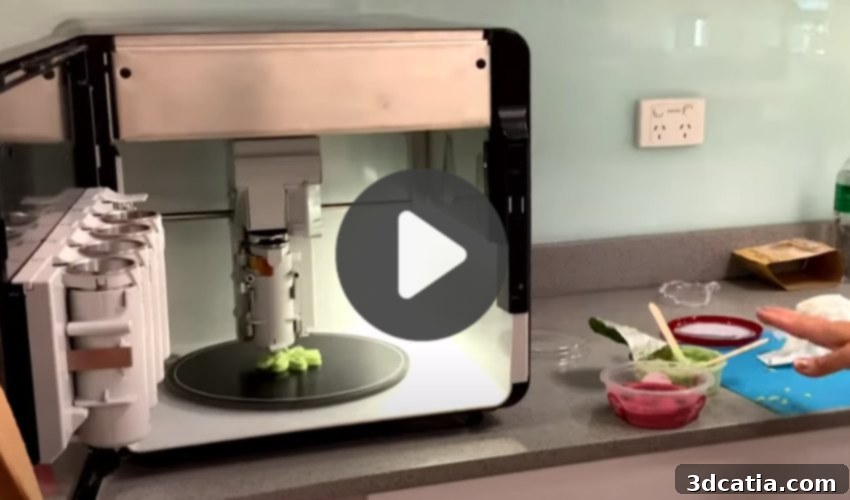
Top 1: Revolutionizing Nutrition with 3D Printed Food for Dysphagia Patients
Our first compelling video introduces us to the innovative world of 3D printed food, specifically tailored for individuals suffering from dysphagia, or swallowing difficulties. The team at Create Digital takes us through a unique taste test and exploration, demonstrating how this technology is poised to significantly enhance the quality of life and dining experience for those who often struggle with traditional meals. Dysphagia affects millions worldwide, often leading to malnutrition, dehydration, and a reduced enjoyment of food. Conventional solutions typically involve pureed diets that, while safe, can often be unappealing in appearance and texture.
The process showcased in the video involves meticulously preparing pureed food and loading it into specialized canisters within a 3D food printer. This ensures that the food meets stringent texture standards – smooth enough for safe swallowing but firm enough to hold its printed shape. Users can then select from a variety of easy-to-swallow, aesthetically pleasing shapes, transforming what was once an unappetizing meal into an enjoyable culinary experience. The Create Digital team noted a remarkable smoothness in texture and enhanced flavor compared to traditional purees, describing the experience as something straight out of a science fiction movie, reminiscent of Star Trek’s replicators. While acknowledging the ongoing need for refinement, the video powerfully emphasizes the immense potential of 3D printing technology to provide dignity and joy back to dining for individuals with dysphagia and other eating disorders, offering not just nutrition but also a much-needed psychological boost through improved meal presentation and variety. This innovation promises to open new avenues for personalized nutrition and dietary management in healthcare settings and at home.
Top 2: Advancing Industrial Manufacturing with SCANLAB and Autodesk Fusion Partnership
Next, we turn our attention to a significant collaboration that is set to redefine precision and efficiency in industrial manufacturing: the strategic partnership between SCANLAB and Autodesk Fusion. This insightful video highlights the seamless integration of SCANLAB’s advanced SCANmotionControl SDK with the robust capabilities of Autodesk Fusion software. This collaboration is more than just a technological handshake; it represents a unified ecosystem designed to empower engineers and manufacturers with unparalleled control and precision in laser-based additive manufacturing processes.
Through this innovative partnership, users gain access to a suite of advanced technologies that streamline workflows and optimize results. Key features include CAD-driven toolpathing, which allows for direct generation of laser paths from design models, eliminating complex manual programming steps. Precise timing predictions ensure that laser operations are perfectly synchronized with motion, leading to superior part quality and repeatability. Enhanced hatching strategies enable more uniform material deposition and reduced thermal stress, critical for high-performance applications. Furthermore, real-time synchronization of lasers and motion control systems ensures dynamic adjustments during the manufacturing process, maximizing accuracy and minimizing errors. The video elaborates on the profound benefits of this integrated approach, such as significantly improving laser beam programming efficiency, fostering the creation of comprehensive end-to-end product solutions from design to production, and accelerating research and development in sophisticated 3D printing applications. This partnership is a testament to the ongoing evolution of additive manufacturing, driving greater accessibility to advanced tools and fostering a new era of innovation in industries ranging from aerospace and automotive to medical devices and consumer electronics.
Top 3: Navigating Industry 4.0: An Interview with Automation Alley’s Tom Kelly
Our third highlight brings us an illuminating interview from the Michigan Business Beat series, where Chris Holman sits down with Tom Kelly, the esteemed President and CEO of Automation Alley. This conversation focuses on their highly regarded Integr8 series, specifically delving into the multifaceted challenges and immense opportunities presented by Industry 4.0. Industry 4.0, often referred to as the fourth industrial revolution, encompasses the integration of advanced technologies such as IoT, AI, cloud computing, and additive manufacturing into industrial processes, promising greater automation, data exchange, and smart factories.
In this insightful discussion, Kelly and Holman dissect Automation Alley’s recently released playbook on additive manufacturing. They explore its transformative potential for businesses of all sizes, from prototyping to end-use parts, while also addressing the significant hurdles companies encounter when attempting to integrate these advanced manufacturing techniques into their existing operations. These challenges often include high initial investment costs, the need for specialized skills, and navigating complex design for additive manufacturing principles. A key takeaway from their conversation is the importance of a phased, manageable approach – encouraging companies to “start small” rather than attempting a complete overhaul. To further support this adoption, they shed light on Automation Alley’s groundbreaking Project DIAMOnD program. This initiative is designed to democratize access to additive manufacturing technology, providing qualifying manufacturers with free 3D printers and training, enabling them to experiment, innovate, and gradually transition into this cutting-edge field. Project DIAMOnD not only fosters technological adoption but also creates a resilient network of manufacturers capable of producing critical supplies during times of crisis, showcasing a forward-thinking approach to economic development and industrial preparedness.
Top 4: The Synergistic Future of Stem Cell Therapy and 3D Bioprinting
Delving into the frontiers of medical innovation, our fourth video by the NanoTriz Innovation Academy provides an in-depth and captivating look at the revolutionary potential of stem cell therapy, particularly when combined with the transformative power of 3D bioprinting. This video masterfully showcases the broad applications of stem cells in modern medicine, from repairing damaged organs and tissues to treating chronic diseases and driving advancements in regenerative medicine. The narrative spans the historical discovery of stem cells in the mid-20th century, tracing their journey through foundational research to the sophisticated, cutting-edge technologies of today, such as CRISPR-Cas9 gene editing and, critically, 3D bioprinting.
The discussion then pivots to the ethical, legal, and social dimensions that necessarily accompany such groundbreaking research, acknowledging the responsibilities that come with altering human biology. A significant portion of the video is dedicated to elucidating the profound implications of bioprinting for organ transplantation. Traditional organ transplantation faces monumental challenges: chronic shortages, lengthy waiting lists, and the persistent risk of immune rejection, which necessitates lifelong immunosuppressive drug regimens. 3D bioprinting offers a radical solution by enabling the creation of patient-specific organs and tissues using the patient’s own cells. This groundbreaking approach could entirely eliminate the problem of immune rejection, as the bio-printed organ is genetically identical to the recipient. Furthermore, it holds the promise of drastically reducing, if not eliminating, long waiting lists, thereby saving countless lives. The video explains the fundamental principles of bioprinting, where living cells are precisely deposited layer-by-layer, often suspended in biocompatible hydrogels, to construct functional tissue structures. This convergence of stem cell biology and additive manufacturing promises to unlock unprecedented avenues for treating complex diseases, personalizing medicine, and ultimately, extending and improving human life on an unimaginable scale.
Top 5: Engineering Innovation: Launching High-Explosive Rounds with a 3D Printed Air Cannon
Concluding our weekly roundup, Ordnance Lab brings us a truly engaging demonstration of bespoke engineering with their video showcasing the construction and live test-firing of a 3D printed air cannon. This project is a vivid illustration of how additive manufacturing can be utilized for rapid prototyping and creating complex, functional devices. The air cannon, designed specifically to launch 3D printed high-explosive rounds, utilizes compressed air as its propellant, highlighting an ingenious application of pneumatics combined with customized additive manufacturing.
Throughout the video, the hosts take viewers through the intricate details of the cannon’s construction, discussing material selection for structural integrity, design considerations for pressure containment, and the iterative process involved in perfecting such a device. The demonstration features a series of target practice sessions, revealing both the initial successes and the inevitable setbacks encountered during the refinement phase. These real-world challenges, such as optimizing projectile stability, increasing firing accuracy, and reducing the cycle time between shots, provide valuable insights into the practical aspects of engineering design and testing. Beyond the exciting practical application, the video also thoughtfully delves into the crucial discussion of regulatory considerations. Projects involving the launch of projectiles, even with compressed air, necessitate careful adherence to safety protocols and local regulations. This segment underscores the responsibility that comes with innovative engineering, emphasizing the importance of legal and ethical considerations in the design and use of such custom-fabricated devices. This video serves as an inspiring example of how 3D printing empowers individuals and small teams to bring complex mechanical designs to life, pushing the boundaries of what can be achieved through accessible manufacturing technologies.
We hope you enjoyed this week’s journey through some of the most compelling and innovative developments in the world of 3D printing. The sheer diversity of applications—from enhancing human health and nutrition to revolutionizing industrial processes and enabling custom engineering—truly underscores the transformative power of additive manufacturing. Which video captivated you the most this week? What are your thoughts on the compassionate use of 3D printing to support individuals with dysphagia, or the industrial advancements highlighted by SCANLAB and Autodesk? Perhaps the insights into Industry 4.0 from Automation Alley or the medical marvels of 3D bioprinting resonated most with you. We’d love to hear your perspectives! Let us know your thoughts in a comment below or join the conversation on our LinkedIn, Facebook, and Twitter pages! Don’t forget to sign up for our free weekly newsletter here to receive the very latest 3D printing news straight to your inbox. You can also find all our compelling videos and more inspiring content on our YouTube channel. Stay curious and keep innovating!
*Cover Photo Credits: [Please insert appropriate cover photo credit if available, otherwise consider removing this line or replacing with a placeholder.]