

Revolutionizing Healthcare: 3D Printing and AI Lab Pitched at Lion’s Den Medical Innovation Competition
Innovation is the lifeblood of progress, especially in the critical field of healthcare. In Canada’s picturesque province of New Brunswick, an annual event known as The Lion’s Den serves as a vibrant crucible for medical breakthroughs. This prestigious competition is designed to catalyze significant improvements in local healthcare, offering substantial backing to pioneering ideas. On September 10th, the spotlight shone brightly on 3D technology, as one of three promising innovations vying for a grand prize of $500,000. Beyond the monetary award, the winning team also stands to receive a coveted $100,000 research grant from the New Brunswick Innovation Foundation, further cementing the region’s commitment to advancing medical science. Given recent advancements, such as Seattle Children’s Hospital’s successful integration of 3D printing to enhance surgical care, the potential of this particular project in the competition is undeniably strong.
The Lion’s Den isn’t just a competition; it’s a strategic investment in the future well-being of New Brunswick’s residents. It provides a platform for medical professionals, researchers, and entrepreneurs to bring their most transformative ideas to fruition, addressing real-world healthcare challenges with innovative solutions. The significant financial incentives underscore the province’s dedication to fostering an environment where cutting-edge medical technologies can thrive and directly impact patient lives. This year’s focus on diverse innovations highlights the multidisciplinary approach required to truly push the boundaries of modern medicine. The competition aims to identify, nurture, and scale ideas that can make a tangible difference, from improving diagnostic accuracy to enhancing surgical precision and ultimately, optimizing patient recovery.
Pioneering the Future: Canada’s First 3D Artificial Intelligence Lab
Among the contenders, a team composed of Dr. Darren Ferguson, Zach Kilburn, and Dr. Ian Maxwell presented a truly visionary concept: a 3D artificial intelligence lab. This ambitious project, provisionally named the “Imaging Enhancement Center,” aims to fundamentally transform pre-surgical planning. By integrating advanced 3D printing capabilities with sophisticated artificial intelligence algorithms, the lab promises to equip surgeons with an unprecedented level of insight into each specific surgery and individual patient anatomy before even stepping into the operating room. Should their pitch prove successful, this team would embark on building what could be Canada’s very first dedicated 3D artificial intelligence lab, marking a significant milestone in national medical innovation and setting a new benchmark for advanced surgical preparation.
The core philosophy behind the Imaging Enhancement Center is to empower medical professionals with enhanced visualization and predictive analytics. Imagine a surgeon facing a complex procedure; instead of relying solely on 2D images or mental reconstructions, they could hold a precise, patient-specific 3D printed model of the affected anatomy. This tangible model, generated with the help of AI from various diagnostic scans, would allow them to physically interact with the problem area, identify potential complications, and meticulously plan every incision and maneuver. This proactive approach dramatically reduces uncertainties and allows for a higher degree of precision. Zach Kilburn, Regional Director of Diagnostic Imaging for Horizon Health Network, eloquently articulated the profound benefits: “They would be in the operating room for less period of time, there’s less chance of errors in the operating room, and it usually leads to better patient outcomes at the end of it.” This statement encapsulates the triple win – efficiency for the medical team, increased safety for the patient, and superior health outcomes across the board.
Reducing operative time is not merely about efficiency; it directly translates to less time under anesthesia, which carries fewer risks for the patient, particularly those with pre-existing conditions. Minimizing the chances of errors in the operating room has obvious and critical safety implications, preventing complications, reducing the need for revisional surgeries, and improving overall success rates. Ultimately, these factors combine to yield significantly better patient outcomes, leading to faster recovery times, reduced hospital stays, and an overall improvement in the quality of life post-surgery. The Imaging Enhancement Center isn’t just a technological upgrade; it’s a paradigm shift towards truly personalized and predictive medicine, designed to enhance every stage of the surgical journey from preparation to recovery.
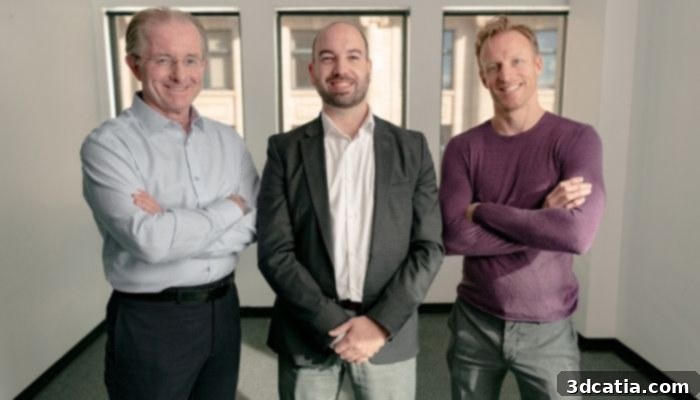
The visionary team behind the 3D artificial intelligence lab: Dr. Darren Ferguson, Zach Kilburn, and Dr. Ian Maxwell (Photo Credit: Lion’s Den)
The Growing Impact of 3D Printing in Medical Innovation
The proposed 3D artificial intelligence lab emerges against a backdrop of explosive growth in the medical 3D printing market. According to comprehensive reports from the Research & Markets website, the 3D Printing Medical Devices market is projected to skyrocket from USD 2.4 billion in 2021 to an estimated USD 5.1 billion by 2026. This impressive growth trajectory underscores the increasing recognition and adoption of additive manufacturing across various segments of the healthcare industry, including specialized equipment, advanced materials, and sophisticated software and services. This exponential expansion is driven by the technology’s inherent ability to deliver patient-specific solutions with unparalleled precision and efficiency, fundamentally reshaping how medical products are conceived and created.
The primary goal for key players in this dynamic sector is to manufacture medical devices and tools quickly and cost-effectively, all while rigorously adhering to stringent medical standards, particularly concerning sterilization, biocompatibility, and regulatory compliance. 3D printing enables the creation of complex geometries and custom designs that would be impossible or prohibitively expensive with traditional manufacturing methods. This personalization is particularly crucial in fields like orthopedics, dentistry, and prosthetics, where each patient’s anatomical variations and unique needs demand tailored solutions. From patient-matched implants and intricate surgical guides to bespoke prosthetic limbs and even experimental bioprinted tissues for regenerative medicine, the applications are vast and continuously expanding. The convergence of 3D printing with artificial intelligence, as proposed by the Lion’s Den team, represents the next frontier in leveraging these capabilities for even greater clinical impact, moving beyond just creation to intelligent design and application.
Furthermore, 3D printing fosters innovation by accelerating research and development cycles. Medical researchers can rapidly prototype new instruments, test different material compositions, and develop novel drug delivery systems with unprecedented speed. This agility not only brings new solutions to market faster but also enables continuous refinement based on clinical feedback. The ability to produce on-demand, patient-specific devices also holds immense potential for localized manufacturing, reducing supply chain complexities and ensuring access to critical medical tools even in remote areas. This democratizing effect of 3D printing, combined with AI’s analytical power, paves the way for a more resilient and responsive healthcare system worldwide.
The Imaging Enhancement Center: A Detailed Vision and Implementation
With the “Imaging Enhancement Center,” medical professionals will harness the power of diverse diagnostic imaging modalities. Services such as CT scans, MRI, and nuclear medicine, which provide crucial insights into internal anatomy and physiological functions, will be central to the lab’s operations. The true innovation lies in how these individual diagnostic images are then processed and interpreted. Advanced AI algorithms will meticulously analyze and synthesize this multi-modal data, transforming disparate 2D slices into a cohesive, highly accurate, and interactive 3D dataset. This comprehensive 3D model will then serve as the foundation for both detailed medical planning and precise execution of surgical procedures, offering a level of understanding previously unattainable.
The financial award from the Lion’s Den competition is absolutely critical to bringing this ambitious vision to life. The $500,000 grand prize, coupled with the $100,000 research grant, would enable the team to procure state-of-the-art 3D printers – machines capable of producing highly detailed, medically accurate anatomical models from various biomaterials. Beyond hardware, a substantial portion of the funding would be allocated to hiring a specialized multidisciplinary team. This includes skilled technicians to operate the sophisticated equipment, data scientists to manage, refine, and continuously improve the AI algorithms, and administrative staff to facilitate seamless operations and collaborate effectively with referring practitioners across the entire Horizon Health Network and beyond. The team has set an ambitious yet achievable goal: to print the first functional 3D image within an impressive six months of securing the funding, demonstrating their readiness to rapidly implement and scale this vital technology for immediate clinical benefit.
Transforming Pre-Surgical Planning and Medical Education
The benefits of the Imaging Enhancement Center extend far beyond immediate surgical applications. These patient-specific 3D models and the sophisticated insights gleaned from AI analysis can revolutionize medical education and surgeon training. Junior surgeons, residents, and even seasoned professionals can practice complex procedures on models that precisely replicate the challenges of an actual patient, reducing the learning curve and significantly improving preparedness for the operating room. This hands-on, highly realistic training environment minimizes risks in the actual operating theatre and builds confidence across surgical teams, ensuring that every member is familiar with the unique anatomical landscape of the patient. Experienced surgeons, too, can use the models to brainstorm and refine approaches for particularly tricky or rare cases, fostering a collaborative environment for optimal patient care and outcomes.
Furthermore, the detailed 3D visualizations and interactive models can significantly enhance patient communication. Individuals can better understand their condition, visualize the affected area, and comprehend the proposed treatment plan, leading to increased patient satisfaction, reduced anxiety, and greater engagement in their own healthcare journey. This clarity empowers patients to make more informed decisions about their care. By establishing the Imaging Enhancement Center in New Brunswick, the province stands to become a beacon of medical innovation, attracting top talent, fostering further research and development in advanced medical technologies, and potentially sparking a new wave of healthcare entrepreneurship. This local initiative has the potential for global implications, setting a precedent for how integrated 3D printing and AI solutions can be implemented to elevate healthcare standards everywhere. The long-term vision is to create a self-sustaining hub of excellence that continually pushes the boundaries of what is possible in diagnostic imaging, surgical preparation, and personalized medicine, contributing to a healthier, more technologically advanced future for all Canadian citizens and beyond.
Join the Conversation on Medical Technology Advancement
The prospect of a 3D artificial intelligence lab represents an incredibly exciting frontier in medical innovation. This groundbreaking project holds the potential to profoundly impact healthcare delivery, patient safety, and educational paradigms. We are eager to hear your thoughts on this visionary initiative and the broader implications it could have on the future of medicine. What are your expectations for such integrated technologies in clinical practice? How do you envision AI and 3D printing further shaping the landscape of diagnostics, surgical interventions, and personalized patient care in the coming years? Share your valuable insights and comments below, or engage with us on our Facebook and Twitter pages to join a wider discussion. Stay informed about all the latest developments in 3D printing, artificial intelligence, and advanced manufacturing by signing up for our free weekly newsletter, delivered directly to your inbox!