
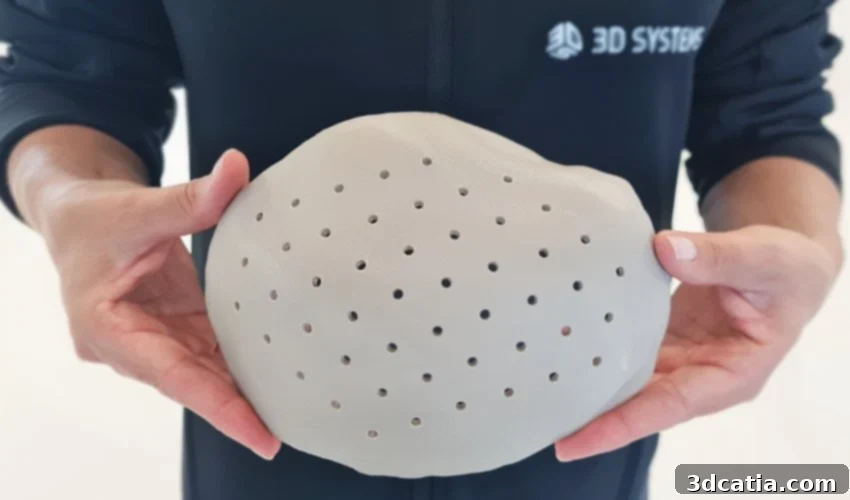
3D Systems Revolutionizes Cranial Reconstruction with FDA-Cleared VSP PEEK Cranial Implants
In the constantly evolving landscape of medical technology, significant advancements continue to redefine patient care, particularly in complex surgical fields like cranial reconstruction. For decades, conventional methods in this intricate area have often relied on the use of standardized implants or those meticulously crafted through manual processes. While effective to a degree, these approaches frequently presented inherent limitations, notably in terms of precise patient customization. The challenges associated with achieving a perfect anatomical fit, coupled with potential complications arising from less-than-ideal implant contours, have long underscored the urgent need for more sophisticated, personalized solutions. Patients undergoing cranial reconstruction often face lengthy recovery periods and, in some cases, the need for revision surgeries, further highlighting the imperative for innovation that enhances both surgical outcomes and patient well-being.
However, a new era in personalized medicine has dawned with a groundbreaking development that promises to reshape this critical surgical domain. 3D Systems, a global leader in additive manufacturing solutions, has recently achieved a monumental milestone by securing FDA clearance for the world’s first 3D printed VSP PEEK Cranial Implant. This pioneering solution is not merely an incremental improvement; it represents a profound leap forward in the field of cranial reconstruction. By integrating cutting-edge 3D printing technology with advanced material science, 3D Systems is poised to offer unparalleled levels of patient-specific care, addressing many of the limitations that have historically challenged surgeons and patients alike. This FDA clearance not only validates the safety and efficacy of the technology but also paves the way for its widespread adoption in clinical practice, ushering in an age where custom-fit, high-performance implants become the standard rather than the exception.
The VSP PEEK Cranial Implant: An Innovative Workflow for Precision
The VSP PEEK Cranial Implant solution stands out due to its comprehensive and fully FDA-cleared workflow, meticulously designed to ensure precision, reliability, and optimal patient outcomes. This innovative process begins with advanced medical imaging, typically CT or MRI scans, which capture the unique anatomical data of the patient’s skull defect. This data then undergoes a crucial stage of **segmentation**, where specialized software precisely delineates the exact contours and dimensions of the cranial defect. Following this, sophisticated **3D modeling software** is utilized to virtually design an implant that perfectly matches the patient’s anatomy, ensuring an ideal fit and restoring the natural cranial shape. Surgeons can actively participate in this virtual design phase, collaborating closely with engineers to refine the implant’s geometry and ensure it meets specific surgical requirements, further enhancing the personalized nature of the treatment.
The designed implant then moves to the manufacturing phase, powered by 3D Systems’ state-of-the-art **EST 220 MED 3D printer**. This industrial-grade additive manufacturing system is specifically engineered for medical applications, operating in a controlled environment to produce implants of exceptional quality and consistency. The material of choice for these implants is **Evonik VESTAKEEP i4 3DF PEEK**, a high-performance polymer renowned for its excellent mechanical properties and biocompatibility. This combination of advanced software, specialized hardware, and premium material allows for the creation of truly patient-specific cranial implants. A key benefit of this additive manufacturing approach is its remarkable material efficiency: the process utilizes up to 85% less material compared to traditional subtractive machining methods. This not only translates into significant **cost reductions** for healthcare providers and patients but also dramatically accelerates **production times**, allowing for quicker access to life-changing surgical solutions. The ability to precisely tailor each implant ensures superior aesthetic and functional outcomes, minimizing complications and improving the quality of life for patients undergoing cranial reconstruction.
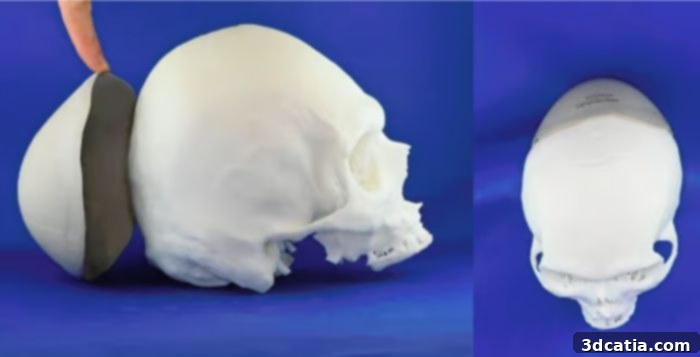
A PEEK Cranial Implant is precisely placed directly onto the top of the skull during a surgical procedure.
Transforming Surgical Logistics and Patient Outcomes
The advantages of this pioneering 3D printed solution extend far beyond mere cost-efficiency and faster production, ushering in a new paradigm for surgical logistics and patient care. 3D Systems highlights a critical innovation: the ability to produce these custom implants directly on-site at hospitals. This is made possible by the printer’s sophisticated **cleanroom environment** and a highly **streamlined post-processing workflow**, which ensures the implants meet the stringent sterility requirements for medical devices. The implications of on-site production are profound. It effectively eliminates numerous logistical hurdles traditionally associated with specialized medical implants, such as complex shipping arrangements, customs delays for international orders, and the inherent risks of supply chain disruptions. By bringing manufacturing closer to the point of care, hospitals can achieve greater control over their inventory and dramatically reduce the lead times for custom implants.
For patients in need of cranial reconstruction, this means potentially **significantly reduced wait times**. In conventional scenarios, the interval between diagnosis, implant design, manufacturing, and delivery can span weeks, or even months, causing considerable anxiety and delaying essential surgical interventions. On-site 3D printing accelerates this process, making implants available much more quickly, which can be critical in trauma cases or for patients requiring urgent surgery. This efficiency not only alleviates patient distress but also enhances hospital bed management and overall operational efficiency. The benefits are not theoretical; this innovative system has already demonstrated remarkable success in key international markets. Just under 40 successful cranioplasties have been performed using this technology in Switzerland, Austria, and Israel, serving as powerful testaments to its clinical efficacy and the positive impact it has on patient recovery and quality of life. These real-world applications underscore the global potential of 3D printed PEEK cranial implants to standardize advanced personalized care.
A Surgeon’s Perspective: Revolutionizing Clinical Practice
The enthusiasm for the VSP PEEK cranial implants is perhaps best articulated by those on the front lines of patient care. Dr. Johannes Pöppe, a distinguished surgeon at University Hospital Salzburg, offered a compelling endorsement of the technology, emphasizing its transformative potential. He stated, “This solution is revolutionizing the field. The combination of 3D Systems’ printing technology that is uniquely engineered for sterile environments and PEEK’s mechanical properties are helping surgeons push boundaries. Within our hospital, we have already completed several successful surgeries using these technologies. I believe the potential for customized PEEK cranial plates is significant to integrate 3D printing into routine clinical practice.” Dr. Pöppe’s insights highlight several critical aspects. Firstly, the “revolutionizing” nature refers to the paradigm shift from generic or manually fabricated implants to truly patient-specific, precision-engineered solutions. This level of customization was previously unattainable, offering surgeons tools that conform perfectly to each individual’s anatomy, which is paramount for both functional and aesthetic restoration.
Secondly, the synergy between 3D Systems’ specifically designed sterile environment printing technology and the inherent mechanical advantages of PEEK material is crucial. Operating within a sterile cleanroom ensures the highest standards of safety and implant integrity, a non-negotiable requirement for medical devices. Concurrently, PEEK’s properties, which closely mimic natural human bone, provide an ideal structural foundation. This combination empowers surgeons to “push boundaries,” enabling them to tackle more complex cranial defects with greater confidence and precision, ultimately leading to improved patient outcomes. The successful completion of multiple surgeries at University Hospital Salzburg serves as robust clinical validation, demonstrating the immediate and tangible benefits of the technology in a real-world clinical setting. Dr. Pöppe’s belief in the “significant potential for customized PEEK cranial plates to integrate 3D printing into routine clinical practice” underscores a future where personalized 3D printed implants become a standard, readily accessible component of cranial reconstruction, rather than a specialized, niche application.
PEEK: The Biomaterial of Choice for Advanced Implants
The FDA clearance for 3D Systems’ VSP PEEK Cranial Implant solution marks not only a significant technological advancement but also a profound endorsement of PEEK (Polyetheretherketone) as a premier biomaterial for implantable medical devices. Renowned for its **exceptional mechanical properties**, PEEK possesses a strength-to-weight ratio that closely mirrors that of human cortical bone. This biomimetic characteristic is crucial for cranial implants, as it allows for natural load distribution across the reconstructed area, reducing the risk of stress shielding—a phenomenon where an overly stiff implant can cause adjacent bone to weaken due to lack of physiological stress. This contributes significantly to long-term implant stability and optimal bone remodeling.
Beyond its mechanical prowess, PEEK boasts a **rich clinical history** in various medical device applications, including spinal interbody fusion cages, dental implants, and joint replacements, underscoring its proven safety and efficacy within the human body. Its high versatility is complemented by **outstanding biocompatibility**, meaning the material is well-tolerated by biological tissues, minimizing adverse reactions and promoting successful integration. PEEK also exhibits remarkable **resistance to bodily fluids**, preventing degradation over time and ensuring the implant’s structural integrity throughout a patient’s lifetime. Furthermore, its **stability across various temperatures** allows for effective sterilization through common methods like autoclaving, which is vital for maintaining aseptic conditions in surgical settings. The material’s radiolucency is another key advantage; unlike metallic implants which can obscure post-operative imaging, PEEK allows for clearer visualization of surrounding tissues and bone, facilitating better monitoring of healing and potential complications via MRI or CT scans. These combined attributes make PEEK an unparalleled candidate for diverse medical device applications, solidifying its role as a cornerstone material in advanced medical additive manufacturing.
3D Systems’ Vision: Setting New Standards and Future Horizons
Reflecting on this monumental achievement, Dr. Gautam Gupta, Senior Vice President & General Manager of 3D Systems’ Medical Devices, articulated the profound significance of the FDA clearance. He stated, “Receiving FDA clearance for our VSP PEEK Cranial Implant solution is a significant milestone in our journey. With this FDA clearance, we are now able to bring VSP PEEK Cranial Implant to the U.S. — setting a new standard of excellence for these procedures.” This statement underscores not only the rigorous regulatory journey successfully navigated but also the immense impact this will have on the healthcare landscape in the United States, a primary market for advanced medical technologies. The introduction of a fully FDA-cleared, patient-specific 3D printed cranial implant fundamentally redefines the benchmark for quality, safety, and customization in cranial reconstruction, promising superior outcomes for American patients.
Dr. Gupta also provided an exciting glimpse into 3D Systems’ ambitious future roadmap, demonstrating a clear strategic vision for leveraging this foundational technology across an even broader spectrum of medical applications. He added, “We are now looking to the next applications for this technology, which includes 3D-printed spine interbody fusion implants, carbon fiber-reinforced PEEK for plating applications in trauma and fixation, and bioresorbable polymers for large bone and craniomaxillofacial applications.” Each of these future endeavors represents a significant area of unmet need where additive manufacturing can offer transformative solutions. **3D-printed spine interbody fusion implants**, for instance, can be designed with optimized porosity and lattice structures to encourage bone ingrowth, leading to enhanced fusion rates and long-term stability. The development of **carbon fiber-reinforced PEEK** for plating applications in trauma and fixation promises even greater strength and stiffness compared to standard PEEK, offering robust solutions for complex fractures while maintaining the advantages of radiolucency and biocompatibility. Furthermore, the exploration of **bioresorbable polymers** for large bone and craniomaxillofacial applications is particularly exciting. These materials are designed to gradually dissolve in the body over time, eliminating the need for a second surgery to remove the implant and potentially promoting natural bone regeneration. This forward-thinking approach solidifies 3D Systems’ position at the forefront of medical additive manufacturing, continuously pushing the boundaries of what is possible in personalized healthcare.
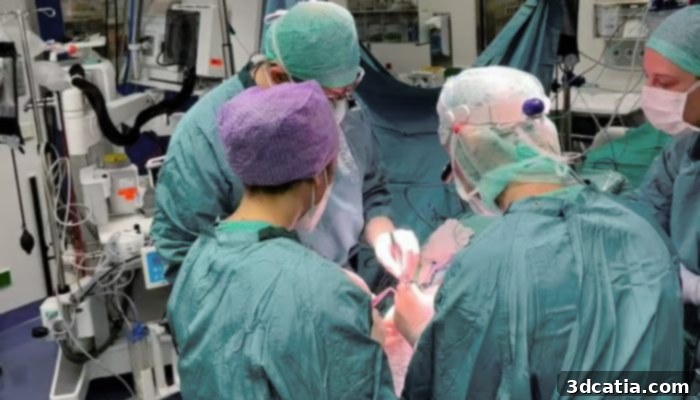
Witnessing the successful implantation surgery of the PEEK Cranial Implant, a testament to its precision and efficacy.
Market Growth and the Future of Medical 3D Printing
As the landscape of medical technology continues its rapid evolution, the market for cranial reconstruction is poised for substantial expansion. Industry reports project a remarkable market growth of approximately $2 billion by 2030, a testament to increasing demand driven by various factors, including an aging global population, rising incidence of head trauma and neurological conditions, and a growing emphasis on personalized medical solutions. 3D Systems anticipates that the convergence of this high market demand with the inherent, significant benefits offered by 3D printing technology will collectively drive widespread adoption of its PEEK Cranial Implants within the broader medical industry. This paradigm shift will likely see 3D printing move from a niche technology to a standard manufacturing method for complex, patient-specific medical devices.
The future of medical 3D printing is exceptionally bright, with patient-specific implants like the VSP PEEK Cranial Implant leading the charge. This innovative approach promises to enhance surgical precision, improve patient recovery times, reduce hospital costs, and ultimately elevate the overall standard of care. The FDA clearance secured by 3D Systems is not just a company achievement; it’s a bellwether for the entire medical device industry, signaling a future where advanced additive manufacturing plays an indispensable role in delivering highly effective, customized, and transformative healthcare solutions. This development sets a clear precedent for how personalized medicine, powered by 3D printing, can address critical surgical needs and improve the lives of countless patients worldwide. To learn more about this project and its profound implications for cranial reconstruction, interested parties can click here.
What are your thoughts on 3D Systems gaining FDA clearance for its pioneering 3D printed PEEK cranial implants? We’d love to hear your perspective! Let us know in a comment below or share your views on our LinkedIn, Facebook, and Twitter pages! Don’t miss out on the latest advancements and news in the world of additive manufacturing — make sure to sign up for our free weekly newsletter here for all the most recent 3D printing news delivered straight to your inbox! You can also explore our extensive library of videos and captivating content on our official YouTube channel.
*All Photo Credits: 3D Systems