
Revolutionizing Sustainability: Barbara Gollackner’s Wasteware Collection 3D Prints Tableware from Food Waste
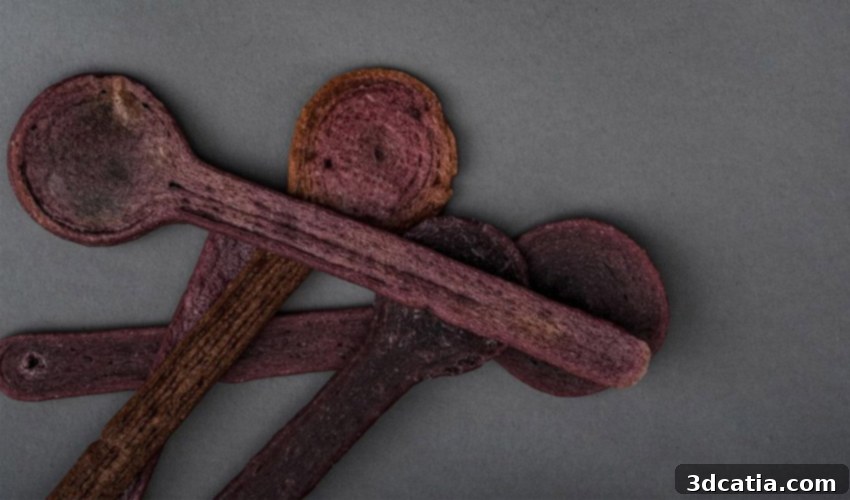
During the vibrant Vienna Design Week, which commenced on September 24th, attendees were introduced to a truly groundbreaking exhibition by the innovative design studio Barbara Gollackner. At the heart of this presentation was “Wasteware,” a visionary collection that reimagines our relationship with consumption and waste. This collection distinguishes itself by offering a series of cutlery and dishes meticulously crafted not from traditional materials, but from industrial and personal food waste, utilizing the cutting-edge technology of a food 3D printer. The array of tableware showcased, including elegant cups, functional teaspoons, and various dishes, all share a remarkable origin: they are derived from commonly discarded items such as stale bread or even pig skin. The ingenious process involves transforming these diverse waste streams into a pliable paste, which is then precisely extruded onto an FDM printer. Through the Wasteware collection, the Barbara Gollackner studio delivers a powerful and unambiguous message. Its core mission is to actively combat the escalating global problem of food waste and to challenge the pervasive production of single-use dishes, both of which exert a profoundly negative impact on our planet’s delicate ecosystems and resource reserves.
The Unseen Crisis: Understanding Food and Single-Use Waste
The statistics surrounding waste are stark and often overlooked. Annually, an astonishing 90 million tons of food are wasted globally, a figure that becomes even more alarming when considering the resources, energy, and labor invested in its production, transportation, and eventual disposal. This immense volume of discarded food contributes significantly to greenhouse gas emissions, particularly methane, a potent climate-warming agent, when it decomposes in landfills. Compounding this challenge is the additional 30 million tons of waste generated from single-use dishes and packaging. These items, designed for fleeting convenience, often end up polluting our oceans, choking wildlife, and persisting in the environment for hundreds of years due to their non-biodegradable nature, predominantly plastics. Barbara Gollackner’s personal observation of this simple yet deeply worrying trend served as a primary catalyst for her creative endeavor. Recognizing the dual threat posed by these waste streams, she embarked on a quest to devise tangible and inspiring solutions, aiming to address both issues simultaneously and, crucially, to empower consumers and society at large to significantly reduce their environmental footprint and foster more responsible consumption habits. This project serves as a compelling argument for re-evaluating our waste streams not as an endpoint, but as a rich source of untapped potential, pushing the boundaries of what sustainable design can achieve.
3D Printing and the Circular Economy: A Symbiotic Relationship for Sustainability
One of the inherent advantages that positions 3D printing, or additive manufacturing, as a pivotal technology for sustainability is its unparalleled material efficiency. Unlike traditional subtractive manufacturing methods that often generate significant scrap material, 3D printing fabricates objects layer by layer, utilizing only the necessary amount of material required for the final product. This precision dramatically reduces material consumption and, by extension, minimizes waste generation from the outset. Extending this environmentally conscious approach, 3D printing also frequently facilitates the ingenious reuse of existing waste. It enables the recovery and transformation of discarded materials into valuable new products, thereby closing the loop in what is known as a circular economy. In a circular economy model, resources are kept in use for as long as possible, extracting the maximum value from them whilst in use, then recovering and regenerating products and materials at the end of each service life. Such innovative circular economy projects are gaining considerable traction and are becoming increasingly prevalent across various sectors. A compelling example in the culinary world is Upprinting Food, a pioneering Dutch initiative that harnesses 3D printing technology to create diverse and appealing meals from previously discarded food waste. The Barbara Gollackner studio, with its Wasteware collection, operates on a fundamentally similar premise of waste valorization but innovatively applies this concept to the creation of functional and aesthetically pleasing tableware, pushing the boundaries of sustainable design beyond mere edibles. This innovative approach not only minimizes the environmental impact associated with new material extraction but also transforms perceived waste into a valuable resource, showcasing a tangible application of upcycling on a grand scale.
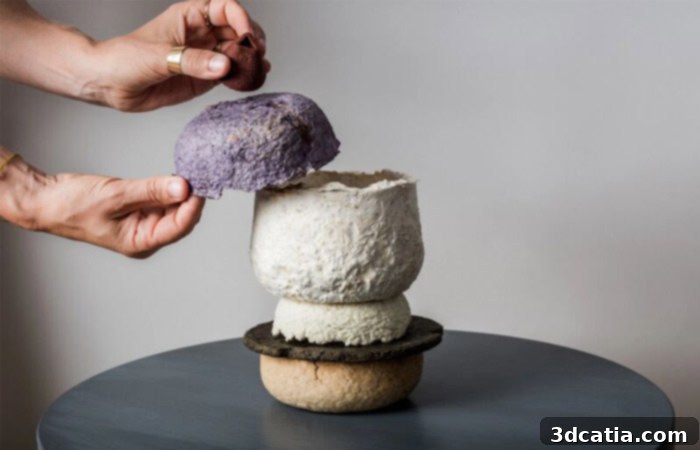
Photo Credits: Barbara Gollackner
Barbara Gollackner’s Inspiration and Material Alchemy
Austrian designer Barbara Gollackner’s journey into the Wasteware project was sparked by a profound realization of the sheer scale of global waste. Confronted with the staggering figures—90 million tons of food wasted annually, further exacerbated by 30 million tons of single-use dish waste—she felt a compelling urgency to act. Her vision was not just to highlight the problem but to actively engineer practical and inspiring solutions that could tackle both these pressing environmental challenges head-on. Furthermore, her ambition extends to empowering and encouraging consumers and society to adopt more sustainable practices, thereby significantly diminishing their collective ecological footprint. The ingenuity of the Wasteware collection begins with Gollackner’s meticulous sourcing of materials. She strategically collects both industrial waste from large-scale operations and personal, everyday waste, demonstrating the ubiquity of potential resources for upcycling. From industrial sources, she has focused on waste streams from a meat factory in Austria, specifically large quantities of pork skin that would otherwise be discarded. She elaborates, “One way we use the waste that we produce ourselves, on the other side we use industrial food waste, like pork skin. There are huge amounts of pork skin thrown in Austria by the meat industry.” This highlights a critical opportunity to valorize often-overlooked byproducts of industrial processes. Complementing this, she also incorporates personal waste, such as stale bread, a common household item often tossed away. This dual approach not only maximizes resource recovery but also makes the concept relatable, showing that waste transformation can begin at home and extend to industrial scales, offering comprehensive solutions to our global waste predicament. Her innovative material selection challenges conventional notions of waste, presenting it instead as a versatile raw material for future production.
The Transformation Process: From Waste to Extrudable Paste
The journey from raw food waste to a functional piece of tableware is a sophisticated process involving several key stages, each carefully orchestrated to ensure both the integrity of the material and the success of the 3D printing operation. First, the collected waste, whether it’s industrial pork skin or domestic stale bread, undergoes essential preparatory steps; it is either thoroughly dried or cooked. These initial treatments are crucial for several reasons: drying helps to remove moisture, preventing spoilage and creating a more stable base, while cooking can sterilize and soften certain materials, making them easier to process. Following this, the treated waste is then blended with mycelium, the vegetative root-like structure of mushrooms. Mycelium acts as a natural binder, contributing significantly to achieving the desired consistency, structural integrity, and biodegradability of the final paste. This organic addition not only binds the materials together but also enhances the ecological credentials of the collection. The designer further elaborates on the flexibility of her material formulation, explaining that she can, in some instances, strategically incorporate additional elements such as water, breadcrumbs, or other food residues to fine-tune the paste’s rheology and composition, adapting it to different waste streams and desired outcomes. Once the optimal paste is prepared, Chef Peter König, an expert in food processing and extrusion, takes the reins to precisely 3D print the desired shapes. Barbara Gollackner intentionally designed the objects with simplicity in mind—spoons, coffee cups, bowls, and similar items—to prevent the printing process from becoming overly complex. This pragmatic approach ensures efficiency and reproducibility while maintaining elegant and usable forms. The resulting items possess an undeniably unusual and captivating aesthetic, as their unique colors and textures directly reflect their recycled origins; one might encounter the deep purples reminiscent of an eggplant, or the subtle greens derived from recycled peas, each piece telling a story of transformation and sustainable innovation. This not only makes the tableware visually distinctive but also serves as a constant, tangible reminder of its eco-friendly genesis, inviting users to reflect on their own waste habits.
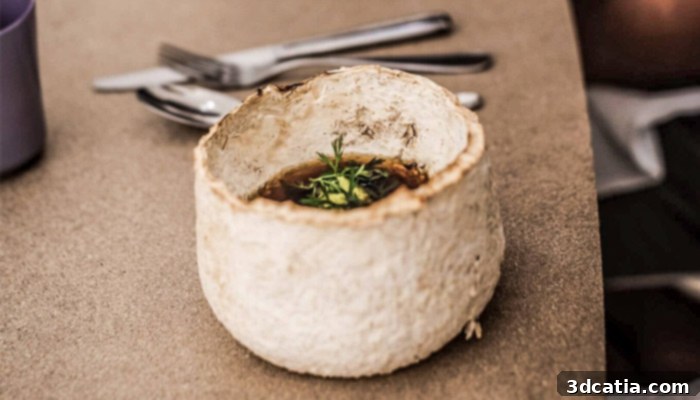
The design has imagined several bowls and containers (photo credits: Foto beigestellt)
The Impact and Future of Wasteware: Beyond Sustainable Tableware
Barbara Gollackner’s Wasteware project represents far more than just a collection of novel tableware; it embodies a rigorous, long-term commitment to addressing pressing environmental issues. The designer has dedicated several months to this intricate endeavor, a testament to the complex research and development required to transform disparate food waste into functional and aesthetically appealing products. This sustained effort allows the project to highlight a very real and pervasive social problem – waste generation and its environmental consequences – in an exceptionally innovative and original manner. By creating tangible objects that prompt contemplation, Wasteware encourages a critical re-evaluation of our throwaway culture. The collection poses a profound and inspiring question: what if every consumer could be encouraged, or even empowered, to actively transform their own food waste? This concept opens doors to possibilities ranging from localized community initiatives to individual household creativity in reducing and repurposing waste. Such an approach could foster a deeper connection between individuals and the lifecycle of their consumed goods, moving beyond mere recycling to true upcycling and resource valorization. The project’s success lies not only in the creation of beautiful and functional items but also in its potent educational value, sparking conversations about sustainable living, circular economies, and the potential of additive manufacturing to solve complex environmental challenges. It challenges traditional manufacturing paradigms and demonstrates a viable path towards truly regenerative design, where waste is seen not as an end, but as a valuable beginning. The long-term implications are vast, suggesting new avenues for product design, material science, and even gastronomic innovation. This interdisciplinary approach, merging design with environmental science and advanced manufacturing, positions Wasteware as a leading example of how creative thinking can drive meaningful change. The Austrian studio’s extensive portfolio and further insights into its pioneering work can be explored HERE.
Join the Conversation: Your Thoughts on Sustainable Design
The Wasteware collection by Barbara Gollackner stands as a powerful testament to the transformative potential of sustainable design and 3D printing technology. It challenges preconceived notions of waste and illustrates a compelling vision for a future where discarded materials are not merely disposed of, but creatively repurposed into valuable, everyday objects. This initiative encourages us all to rethink our consumption habits and consider the profound impact of our choices on the environment. We are eager to hear your perspective on this remarkable project. What do you think of the Wasteware collection? Do you believe such innovative approaches can significantly alter global waste patterns and consumer behavior? Share your insights and opinions in a comment below, or join the discussion on our vibrant Facebook and engaging Twitter pages. To stay abreast of the latest advancements, breakthroughs, and inspiring stories in the world of 3D printing and sustainable innovation, don’t forget to sign up for our free weekly newsletter, delivering all the essential news straight to your inbox every week!