
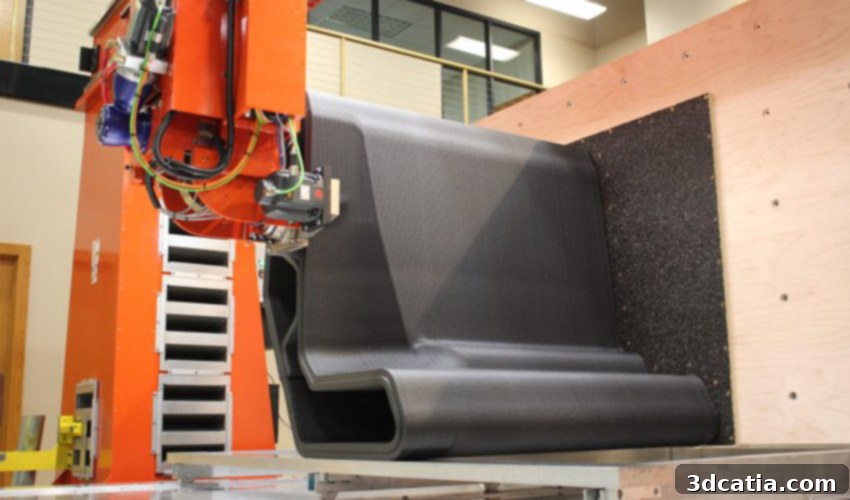
Thermwood’s Vertical Layer Print (VLP): Redefining Large-Format 3D Printing
In a groundbreaking development that promises to reshape the landscape of large-format additive manufacturing, Thermwood Corporation, a leading manufacturer of large-format 3D printers, has introduced a revolutionary approach to XXL 3D printing. Challenging the industry’s long-standing horizontal printing paradigm, Thermwood has unveiled its innovative Vertical Layer Print (VLP) process, which enables the creation of parts vertically. This pioneering method represents a significant leap forward, allowing the company to substantially increase printing volume while simultaneously enhancing the final strength and integrity of manufactured components. To demonstrate the robust capabilities of this new technology, Thermwood has successfully designed and fabricated prototypes using advanced carbon fiber reinforced ABS and high-performance PSU/PESU composites, showcasing its commitment to pushing the boundaries of material science in additive manufacturing.
Thermwood Corporation is not new to innovation in the realm of large-scale additive manufacturing. The company has garnered considerable recognition through its impactful long-standing partnership with Local Motors, an innovative automotive manufacturer widely known for integrating additive manufacturing into the design and production of its vehicles. This collaboration notably led to the development of the Olli autonomous minibus, a testament to the transformative potential of large-format 3D printing. With the introduction of the Vertical Layer Print process, Thermwood further solidifies its position as a pioneer, offering a cutting-edge composite printing solution that masterfully combines immense print volume with significantly increased material strength and structural integrity. This latest advancement leverages and adapts Thermwood’s highly regarded LSAM MT machine, incorporating the newly patented VLP process, which fundamentally alters the way large parts are fabricated. This vertical printing capability is claimed by the company to enable the production of monolithic parts soaring up to an astonishing 6 meters in height in a single continuous operation, opening up unprecedented possibilities for industrial applications.
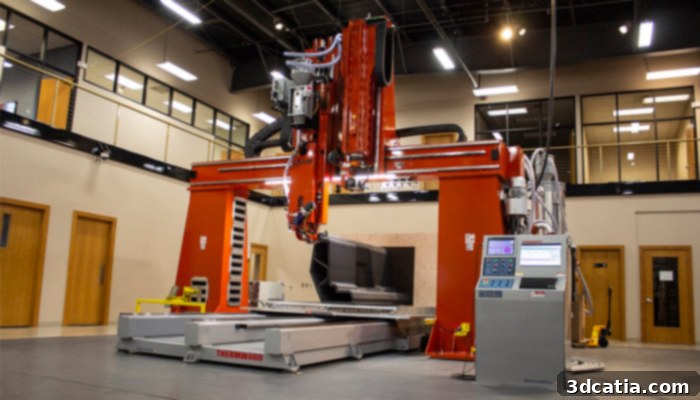
The LSAM MT machine showcasing its innovative large-format vertical 3D printing capabilities. (All image credits: Thermwood Corporation)
Traditional large format FDM/FFF machines, including earlier iterations of LSAM systems, typically feature colossal gantry structures equipped with a fixed print bed. On this bed, a mobile arm, culminating in an extruder head, meticulously moves across the X and Y axes to deposit material layer by layer horizontally. However, the Thermwood Vertical Layer Print process necessitates a radical re-imagining of this conventional setup. For vertical printing, the entire build plate, or platen, must be oriented vertically and be capable of dynamic movement to accommodate the part’s growth and intricate geometries. The groundbreaking LSAM MT solution, specifically engineered for VLP, ingeniously comprises a fixed gantry system coupled with a highly sophisticated mobile platen. This fundamental shift in design and mechanics requires a completely new operational approach, allowing for the seamless execution of vertical printing. More specifically, the part being created is not printed directly onto the moving platen’s surface in the traditional sense, but rather on a specially designed support structure. This structure is securely anchored at the back of the system and is progressively pulled onto the mobile table as the part continuously grows upward, layer by precise layer. This ingenious method ensures stability and precision throughout the vertical fabrication process, enabling the production of exceptionally tall and structurally sound parts.
Elaborating on the meticulous design and engineering behind this innovation, Thermwood explains the sophisticated mechanics of the VLP system. A secondary printing platen, impressively measuring 1.5 meters by 3 meters, has been strategically integrated and mounted vertically at the rear of the primary platen. This ingenious configuration is central to the Vertical Layer Print process. As the 3D printed component incrementally develops and increases in height, the movable platen systematically draws the growing part onto the dedicated support structure. This continuous and controlled movement is critical for maintaining the integrity and precision of the colossal vertical prints. This innovative approach offers unparalleled flexibility in design and manufacturing, allowing Thermwood to produce parts with dimensions up to 1.5 meters along the Z-axis (height) and a substantial 3 meters along both the X and Y axes (width and depth). The implications of such expansive build volumes are profound, significantly broadening the scope of what can be achieved with additive manufacturing. Furthermore, the immense range of possibilities is amplified by the fact that Thermwood’s advanced machines are often equipped with an integrated cutting function. This valuable capability is ideal for quickly and efficiently machining the desired parts post-printing, allowing for precise finishing and dimensional accuracy, streamlining the entire production workflow from raw material to final component.
The advantages of Thermwood’s Vertical Layer Print technology extend far beyond mere size. One of the most significant benefits is the potential for enhanced part strength and optimized material usage. In traditional horizontal FDM, the inherent anisotropy (direction-dependent properties) of printed parts means that layers are typically weakest along the Z-axis. By printing vertically, designers can orient the layer lines to run along the length of the part, aligning them with the primary stress directions for specific applications. This can lead to significantly stronger components, particularly for tall, slender structures where bending forces are critical. Moreover, for certain geometries, vertical printing can drastically reduce the need for extensive support structures, which not only saves material but also reduces post-processing time and effort. This efficiency is particularly valuable when working with high-performance, expensive composite materials.
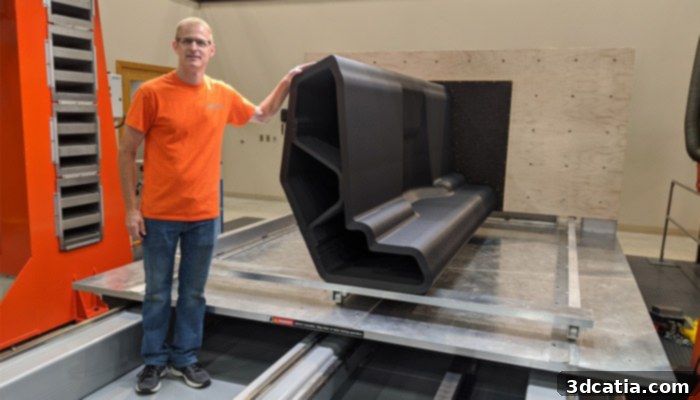
An impressive example of a large component created with Thermwood’s pioneering VLP technology, showcasing its scale and potential for intricate designs.
The dedicated engineering teams at Thermwood have rigorously tested this innovative vertical printing process with a selection of demanding and highly technical materials, focusing predominantly on high-performance composites. Their preference for materials like ABS and carbon fiber-reinforced PSU/PESU highlights the system’s capability to handle advanced engineering plastics, crucial for robust industrial applications. ABS (Acrylonitrile Butadiene Styrene) is a widely used thermoplastic known for its strength, rigidity, and impact resistance, making it an excellent base for reinforcement. The addition of carbon fiber significantly boosts its mechanical properties, including tensile strength and stiffness, while also reducing weight. PSU (Polysulfone) and PESU (Polyethersulfone) are high-temperature thermoplastics renowned for their exceptional thermal stability, chemical resistance, and mechanical strength, even at elevated temperatures. These properties make them ideal for components exposed to harsh environments, such as aerospace, automotive, and industrial tooling applications.
In a testament to the VLP system’s formidable capacity, one of the key demonstrative tests involved the fabrication of a substantial part made from the high-temperature PSU/PESU composite. This particular component achieved a total weight of an impressive 540 kilograms, pushing the maximum weight limits of the moving platter system, thereby showcasing its robust engineering. Despite its considerable size and complexity, the entire manufacturing process was completed in a remarkably efficient 16 hours and 40 minutes. This exceptional print time for such a large and intricate part underscores the efficiency and speed advantages offered by Thermwood’s vertical printing technology. Such rapid production cycles for large-scale, high-performance components mark a significant milestone in additive manufacturing, paving the way for faster prototyping and industrial production. For those eager to delve deeper into the technical specifications and explore more examples of Thermwood’s cutting-edge large-format 3D printing solutions, comprehensive information is available on the manufacturer’s official website HERE. Additionally, a compelling live demonstration of the vertical 3D printing process can be witnessed in the insightful video provided below, offering a visual understanding of this revolutionary technology in action.
The potential applications for Thermwood’s Vertical Layer Print technology are vast and transformative. Beyond the proven success with the Local Motors Olli, this process opens doors for industries requiring exceptionally large, strong, and lightweight components. Imagine the possibilities for aerospace tooling, where massive molds or fixtures can be printed in a single piece, reducing assembly time and cost. The marine industry could benefit from vertically printed boat hulls or large structural components, optimizing material usage and improving hydrodynamics. In construction, bespoke architectural elements or large-scale formwork could be produced with unprecedented efficiency. Furthermore, the integration of a cutting function within the LSAM MT machine means that complex parts can be 3D printed near net shape and then precision-machined to final tolerances, effectively combining additive and subtractive manufacturing into a single, streamlined workflow. This hybrid approach significantly reduces lead times and material waste, offering a compelling solution for industries seeking both rapid fabrication and high-precision finishing. The ability to print parts up to 6 meters high, with impressive X and Y dimensions, coupled with the strength of advanced composites, truly positions Thermwood at the forefront of the next generation of industrial manufacturing.
This innovation represents a crucial step in evolving additive manufacturing from a prototyping tool to a robust solution for end-use parts in high-stakes industries. By addressing the inherent limitations of traditional large-format 3D printing, Thermwood’s VLP process pushes the boundaries of what is mechanically possible and economically viable. The development signifies not just a technical achievement but a strategic vision for the future of manufacturing, where scale, strength, and speed converge. The capacity to rapidly produce large, structurally optimized components from advanced materials on demand holds immense potential for supply chain resilience, custom manufacturing, and the acceleration of product development cycles across various sectors. Thermwood continues to demonstrate its leadership by delivering solutions that empower manufacturers to create components previously thought impossible to fabricate additively.
What are your thoughts on this revolutionary vertical 3D printing process developed by Thermwood? How do you foresee this technology impacting your industry or potential applications? We invite you to share your insights and comments below, or engage with us on our vibrant social media platforms, including Facebook and Twitter. Don’t miss out on the latest advancements and breaking news in the world of additive manufacturing; sign up for our free weekly Newsletter to receive all the essential updates directly in your inbox!