
Pioneering Additive Manufacturing: Top 5 Innovations in 3D Printing Technology
The landscape of additive manufacturing is continuously evolving, pushing the boundaries of what’s possible across various industries. From revolutionary materials to advanced fabrication techniques, 3D printing is transforming how we design, produce, and even heal. This week, we delve into five groundbreaking innovations that exemplify the cutting edge of this transformative technology. Our curated selection showcases advancements from leading research institutions and innovative manufacturing companies, highlighting a spectrum of applications from robust industrial production to life-changing biomedical solutions. These videos offer a glimpse into the future, demonstrating how 3D printing is addressing critical challenges, accelerating design processes, and paving the way for unprecedented capabilities. Join us as we explore the ingenuity behind liquid metal printers, bio-printed bone, accelerated metal AM, efficient 3D scanning, and high-performance industrial systems.
1. Xerox Launches ElemX: A New Era in Liquid Metal 3D Printing
Xerox has made a significant leap in the additive manufacturing space with the introduction of its innovative liquid metal 3D printer, the ElemX. This groundbreaking machine directly addresses some of the persistent challenges and safety risks associated with traditional metal powder-based 3D printing processes. Unlike powder bed fusion systems, which require careful handling of fine metallic powders that can pose fire and explosion hazards, the ElemX operates by melting and depositing metal wire, thus mitigating these risks entirely. This strategic move by Xerox follows their acquisition of the pioneering startup, Vader Systems, which laid the foundation for this unique liquid metal jetting technology.
The ElemX’s innovative approach offers several advantages, including enhanced safety, simplified material handling, and reduced post-processing requirements. Its ability to print industrial-grade parts on demand, without the need for extensive facilities or specialized safety equipment, makes it an attractive solution for a wide array of sectors. Notably, the Naval Postgraduate School in California has already recognized its potential, investing in an ElemX machine to explore its applications for the U.S. Navy. This initiative underscores the printer’s capacity to produce critical components rapidly and securely, offering significant benefits for defense logistics, maintenance, and supply chain resilience. The ElemX promises to revolutionize how metal parts are produced, enabling quicker iterations, less waste, and safer operations, thereby accelerating the adoption of metal additive manufacturing in sensitive environments. The video below provides a comprehensive overview of the ElemX’s capabilities and its implications for the future of metal 3D printing.
2. UNSW Scientists Develop Revolutionary Bio-ink for 3D-Printed Bone
In a monumental stride for regenerative medicine and bioprinting, a dedicated team of scientists from the University of New South Wales (UNSW Sydney) in Australia has unveiled a novel method for creating 3D-printed bone using a groundbreaking ceramic-based bio-ink. This research, conducted at one of Australia’s leading institutions, is poised to transform orthopedic surgery and personalized medicine. The core innovation lies in the development of an ink that is not only biocompatible but also capable of integrating real living cells, allowing surgeons to custom-print bone parts tailored precisely to a patient’s needs. This breakthrough addresses critical challenges in bone regeneration, particularly for patients suffering from severe trauma, cancer resections, or congenital defects, where traditional bone grafts often face limitations such as donor site morbidity or immune rejection.
The technology employs a ceramic-based ink designed to mimic the intricate porous structure and mechanical properties of natural bone. What truly sets this development apart is the ability to incorporate stem cells directly into the printed matrix, which then differentiate into bone cells, promoting true biological integration and regeneration within the body. This process represents a significant advancement in the realm of “wet printing,” where the bio-ink is extruded directly into a liquid bath to maintain cell viability during printing, creating complex structures that closely resemble native tissue. Dr. Kris Kilian, a key researcher in this project, elaborates on the specifics of this innovative technique in the accompanying video. The implications are vast, ranging from creating personalized implants that seamlessly integrate with the patient’s existing anatomy to developing sophisticated models for drug testing and disease research. This pioneering work brings us closer to a future where damaged bones can be fully restored through patient-specific, biologically active 3D-printed solutions. Further details on this remarkable story can be found here.
3. Fraunhofer Researchers Drive Advancements in Metal Additive Manufacturing Processes
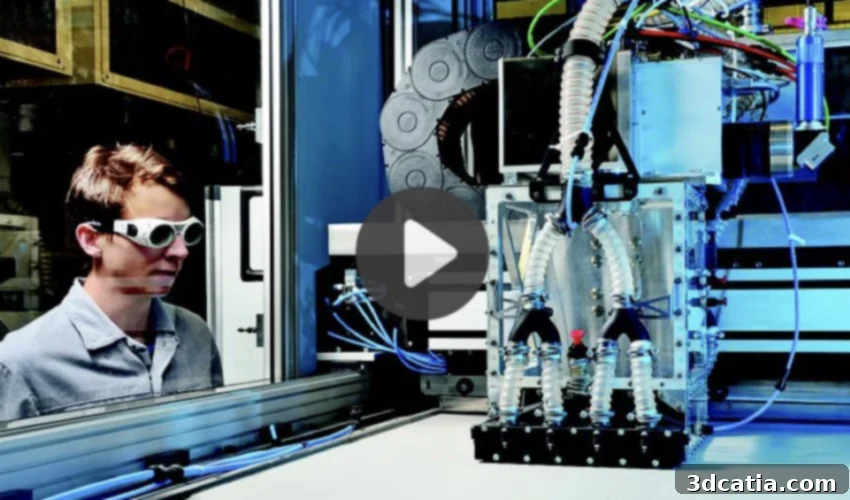
The Fraunhofer Society, renowned globally for its commitment to applied research, consistently delivers innovative projects that span a multitude of scientific and engineering disciplines. While their work encompasses a broad spectrum, from exploring sustainable materials like mycelium for 3D printing to contributing to the development of advanced industrial solutions such as Siemens Energy’s hybrid laser powder bed fusion process for turbine blade repair, their contributions to metal additive manufacturing are particularly impactful. A key initiative is the collaborative project titled futureAM – Next Generation Additive Manufacturing, launched in 2017, involving six specialized Fraunhofer institutes. This ambitious undertaking is specifically designed to overcome the current limitations of metal AM, with the audacious goal of accelerating the entire process chain for metal components by at least a factor of 10.
The futureAM project targets comprehensive optimization across every stage of additive manufacturing. This includes enhancing material development, refining printing processes for increased speed and reliability, improving post-processing techniques for superior surface quality and mechanical properties, and integrating advanced simulation and artificial intelligence for predictive process control. By addressing these bottlenecks, the Fraunhofer researchers aim to significantly reduce production times and costs, making metal AM more competitive for large-scale industrial applications. This acceleration is critical for sectors like aerospace, automotive, and medical technology, where demand for complex, high-performance metal parts is growing but current production speeds can be prohibitive. The video highlights how this collaborative effort is fostering a holistic approach to innovation, combining expertise in materials science, process engineering, and digital technologies to unlock the full potential of metal additive manufacturing. Their work not only pushes technological boundaries but also seeks to industrialize AM, ensuring its broader adoption and economic viability in the global manufacturing landscape.
4. Leveraging Artec 3D Scanners for Accelerated Design and Reverse Engineering
The integration of 3D scanners into design and manufacturing workflows has become indispensable for rapidly creating accurate digital models. Artec’s advanced 3D scanners, known for their precision and versatility, have been deployed in a multitude of impressive projects across diverse sectors, from cultural heritage preservation to industrial inspection and product development. This video perfectly illustrates how these powerful tools can dramatically accelerate the design process, making reverse engineering and quality control more efficient than ever before. Ben Hartwig, CEO of Delscan, demonstrates this efficiency by using the Artec Eva 3D scanner to capture a highly detailed 3D model of a snowmobile part in under fifteen minutes.
The Artec Eva is a professional-grade structured light 3D scanner, an excellent choice for digitizing medium-sized objects with speed, accuracy, and full-color texture capture. Its 100-micron accuracy ensures that even intricate details are faithfully reproduced in the digital model, which is crucial for precise reverse engineering or custom part creation. Following this initial scan, Hartwig proceeds to utilize the Artec Leo, a wireless, AI-powered handheld 3D scanner, to capture the entire snowmobile. The Leo’s onboard processing capabilities and intuitive interface allow for real-time scanning and data capture, making it exceptionally user-friendly for large or complex objects. The ability to quickly and accurately generate precise digital twins of physical objects fundamentally transforms various aspects of the design cycle. It significantly reduces the time spent on manual measurements, facilitates rapid prototyping by enabling direct conversion of scan data into CAD models, and improves quality assurance by allowing for precise deviation analysis. These efficiencies translate into faster product development cycles, reduced costs, and the ability to innovate with greater agility. Discover more about how Artec 3D scanners can streamline and supercharge your design workflows in the video below.
5. TRUMPF Unveils the TruPrint 5000: Advancing Industrial Metal 3D Printing
TRUMPF, a global leader and one of the world’s largest suppliers of machine tools and laser technology, continues to innovate in the field of additive manufacturing with its highly productive and semi-automated TruPrint 5000 3D printing system. This industrial-grade machine is engineered to meet the stringent demands of high-volume production, offering unparalleled reliability and component quality for metallic materials. The TruPrint 5000 distinguishes itself with several advanced features designed to optimize the Laser Metal Fusion (LMF) process, making it a powerful tool for various industrial applications.
A standout capability of the TruPrint 5000 is its integrated 500 °C preheating option. This crucial feature significantly enhances the quality and material compatibility of printed parts, particularly for high-performance alloys. By elevating the base plate and part temperature during the build, the preheating system effectively reduces thermal stresses within the material. This is especially vital when processing materials prone to cracking, such as challenging tool steels like H11 (1.2343) and H13 (1.2344). The ability to print these advanced tool steels with superior integrity and crack-free results opens up new possibilities for creating complex molds, dies, and other highly stressed components with unprecedented precision and durability. Beyond its material capabilities, the TruPrint 5000 is designed for high productivity, often featuring multiple lasers that work simultaneously to accelerate the build process. Its semi-automated operation ensures consistent results and simplifies workflow, contributing to the industrialization of additive manufacturing for demanding sectors like automotive, aerospace, and medical technology. The video below provides an in-depth look at how the TruPrint 5000 delivers high-quality, reliable, and high-performance metallic components, further solidifying TRUMPF’s position at the forefront of industrial 3D printing solutions.
These five videos collectively paint a vivid picture of the relentless innovation driving the additive manufacturing industry forward. From overcoming the safety hurdles of metal powders with Xerox’s liquid metal technology, to engineering living tissues for medical breakthroughs with UNSW’s bio-ink, and dramatically accelerating metal production processes through Fraunhofer’s futureAM project, the progress is undeniable. The efficiency gains offered by Artec’s 3D scanners are revolutionizing design, while TRUMPF’s TruPrint 5000 pushes the boundaries of industrial-grade metal part production. Each of these advancements contributes to a more efficient, versatile, and impactful future for 3D printing, promising transformative applications across every sector. We hope you enjoyed this journey through some of the most exciting developments in the world of 3D printing. Which innovation captured your attention the most? Share your thoughts and favorites in a comment below, or engage with us on our Facebook and Twitter pages! For even more captivating insights and demonstrations of additive manufacturing in action, be sure to visit our Youtube channel. And to stay at the forefront of all the latest news and breakthroughs in the 3D industry, don’t forget to sign up for our free weekly Newsletter, delivered straight to your inbox!