
Transforming Industry: The Power of Composite 3D Printing in Advanced Manufacturing
While advancements in 3D printing often highlight polymers and metals, the realm of additive manufacturing has witnessed an exceptional surge in the adoption and development of composite materials. These engineered materials, renowned for their impressive strength-to-weight ratio – often as robust as metals yet as light as many polymers – are increasingly vital for high-performance applications. Specifically for FFF 3D printing, composites typically consist of a polymer matrix reinforced with infill materials such as glass fiber or carbon fiber. This growing prevalence is underscored by the global composite 3D printing market, which is projected to achieve a staggering value of $490.47 million by 2030, building upon its already significant $198.31 million valuation in 2023. This undeniable importance of composite materials in additive manufacturing has been formally recognized and embraced by leading institutions worldwide, including the prestigious Institute of Industrial New Materials in Dezhou, China, which stands at the forefront of this technological revolution.
Established in January 2021, the Institute of Industrial New Materials embodies a strategic commitment to advancing the frontiers of material science and engineering. Its core mission revolves around the comprehensive research, meticulous development, and ultimately, the successful commercialization of innovative composite materials tailored for a diverse array of critical industrial applications. These applications span across vital sectors such as maritime engineering, advanced 5G communication infrastructure, cutting-edge manufacturing processes, and the production of high-end, precision equipment. As a distinguished provincial “new-style R&D institution” within China, the institute recognized early on the transformative potential of integrating additive manufacturing into its R&D strategies. This foresight led to a pivotal partnership with INTAMSYS, a renowned leader in high-performance 3D printing solutions. Together, they are spearheading two groundbreaking initiatives designed to leverage 3D printing for the accelerated development and optimization of complex composite product parts, demonstrating the versatile benefits of this technology in both replacing traditional methods and enabling hybrid manufacturing approaches.
Replacing Traditional Material Molding: A Paradigm Shift in Manufacturing
The notion of 3D printing serving as a direct replacement or even a powerful supplement to long-established production processes is far from novel; it has been a consistent theme in manufacturing innovation for over a decade. The inherent advantages of additive manufacturing, particularly its unparalleled ability to produce intricate geometries and highly complex internal structures with relative ease, are primary drivers for this shift. Unlike conventional methods that are often limited by tooling and manufacturing constraints, 3D printing allows for unprecedented design freedom. This flexibility enables engineers to optimize designs for enhanced performance, significant weight reduction, and improved functionality, leading to substantial cost savings and drastically reduced lead times throughout the entire product development cycle. These benefits are particularly pronounced in scenarios where complex parts and specialized materials are required, challenging the economics and timelines of traditional manufacturing techniques.
A compelling real-world example of this transformative capability emerged when the Institute of Industrial New Materials undertook the challenging task of developing intake manifolds for a specialized aircraft engine. Intake manifolds are absolutely critical components within any engine system, directly influencing overall engine performance by efficiently supplying fresh air to the cylinders. This precise air delivery ensures the optimal mixture of air and fuel required for efficient combustion, making their design and functionality paramount. However, the development of such manifolds presents numerous hurdles when approached through traditional manufacturing. Their inherently complex internal geometries, coupled with the difficulties and high costs associated with creating precise molds, and the often time-consuming vibration welding processes required for assembly, collectively make traditional production methods inefficient and costly. This is precisely where the innovative potential of 3D printing offered a revolutionary solution, promising to overcome these longstanding challenges with unprecedented efficiency.
To address these intricate challenges, the institute strategically decided to leverage FFF (Fused Filament Fabrication) 3D printing for the production of these complex aircraft intake manifolds. Their choice of equipment and material was highly calculated: they specifically opted for the advanced FUNMAT PRO 610HT 3D printer and PEEK-CF (Carbon Fiber Reinforced PEEK) filament, both provided by INTAMSYS. This decision was based on a meticulous evaluation of several key factors: the superior performance characteristics of PEEK-CF, the exceptional capabilities and reliability of the FUNMAT PRO 610HT industrial-grade printer, and the comprehensive service and technical support offered by INTAMSYS. These elements collectively ensured that the project had the best possible foundation for success, promising both material integrity and precise manufacturing.
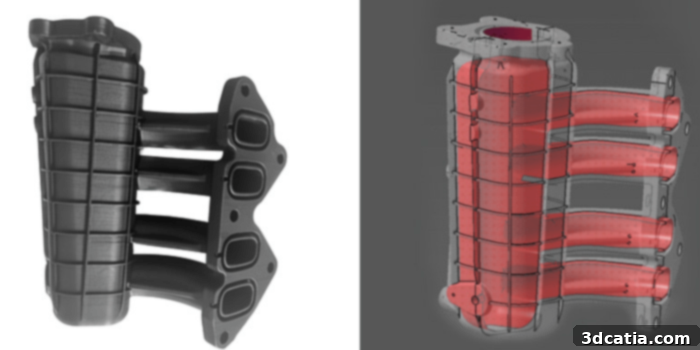
The finished (left) design manifold and the design of the part including the interior (right)
The FUNMAT PRO 610HT is widely recognized as a powerhouse in industrial additive manufacturing, specifically engineered for demanding applications. This dual-nozzle, large-format 3D printer has been meticulously designed to print high-temperature thermoplastic materials with exceptional precision and reliability. It excels with materials such as PEEK, ULTEM, and PPSU, and is equally capable of handling a wide array of custom and specialized high-performance polymers. Its advanced capabilities are primarily attributed to its state-of-the-art thermal management system. The printer’s nozzles can reach an astounding temperature of up to 500°C, while its heated build chamber can maintain a stable temperature of up to 300°C. This precise thermal control is absolutely crucial for successfully printing high-performance materials like PEEK-CF, as it prevents warping and distortion, ensuring part accuracy, dimensional stability, and optimal mechanical properties.
Beyond the hardware, a significant part of the success lay in the collaborative expertise of engineers from both the Institute and INTAMSYS, who applied DfAM (Design for Additive Manufacturing) principles. This methodology allowed for a profound optimization of both the intake manifold’s design and its subsequent printing processes. Through iterative design and simulation, they achieved a remarkable 30% reduction in weight for the 218.4 × 216.4 × 95.4mm part, with the thinnest wall measuring an impressive 1.7mm. Such intricate detailing and weight reduction would be incredibly challenging, if not impossible, with traditional molding. Furthermore, precise control over part dimensions ensured a perfect fit for the aircraft engine. Rigorous testing confirmed the superior performance of the 3D-printed manifolds, demonstrating a mechanical strength of 100mPA. This figure not only met but exceeded the performance of traditional injection-molded PA66-GF products by over 30%, while also proving its capability to withstand long-term operational temperatures of 114°C without degradation. This outcome unequivocally validated the efficacy and advantages of additive manufacturing for such critical applications.
The economic and operational benefits of this approach became immediately evident. Considering that manufacturing these same parts using traditional injection molding processes, including the significant investment in tooling, would have incurred an estimated cost of around $27,803 with a lengthy 45-day lead time, the value proposition of 3D printing was undeniable. Through the adoption of additive manufacturing, the institute was able to produce the intake manifolds as a single, fully integrated piece, eliminating complex assembly steps and material waste. This innovation dramatically reduced manufacturing costs to just 1/10 of those associated with traditional methods and, perhaps even more critically, shortened the production lead time to an astonishing 4–7 days. This dramatic reduction in both cost and time showcases the profound impact of composite 3D printing as a truly disruptive technology for industrial applications, enabling agility and efficiency previously unattainable.
Hybrid Manufacturing With Composite 3D Printing: Synergizing Technologies
The utility of composite 3D printing extends far beyond merely replacing existing traditional manufacturing methods. Its true versatility is also highlighted by its capacity to be seamlessly integrated into and enhance existing production processes, forming powerful hybrid manufacturing workflows. This innovative approach was expertly demonstrated by the Institute of Industrial New Materials in collaboration with a prominent Chinese university. Together, they embarked on a project to develop an advanced robotic composite material manipulator arm, an application where the benefits of hybrid manufacturing could be fully realized to achieve optimal performance and structural integrity.
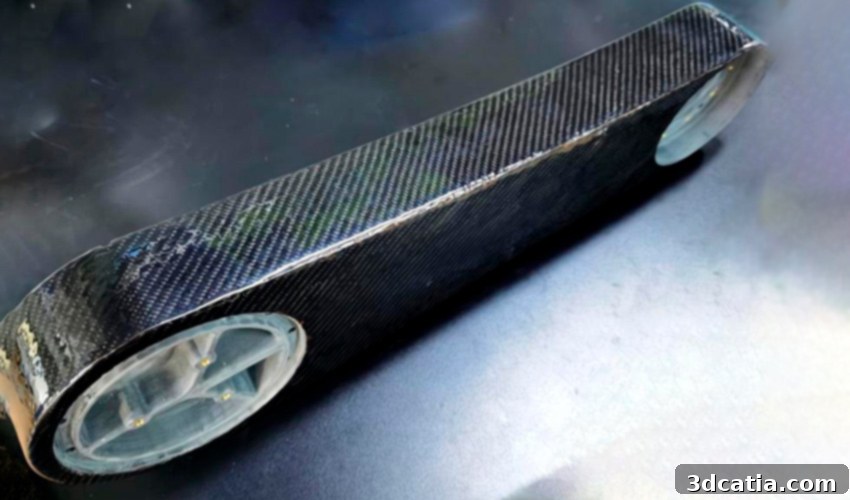
For the creation of this sophisticated manipulator arm, the FUNMAT PRO 610HT and PEEK-CF materials from INTAMSYS were once again strategically employed, this time to fabricate the internal support structure. This choice was critical because the internal structure required exceptional stiffness-to-weight ratio and specific strength to ensure the manipulator arm could operate effectively while being as light as possible. The resulting 3D-printed component was not only substantial in size but also featured complex curved surfaces, which are easily achievable through additive manufacturing, providing a robust and lightweight core. This innovative application vividly underscores the unique capability of composite 3D printing to produce intricate, high-performance foundational parts that serve as the backbone for more complex, multi-material assemblies, pushing the boundaries of what is possible in robotics and advanced machinery.
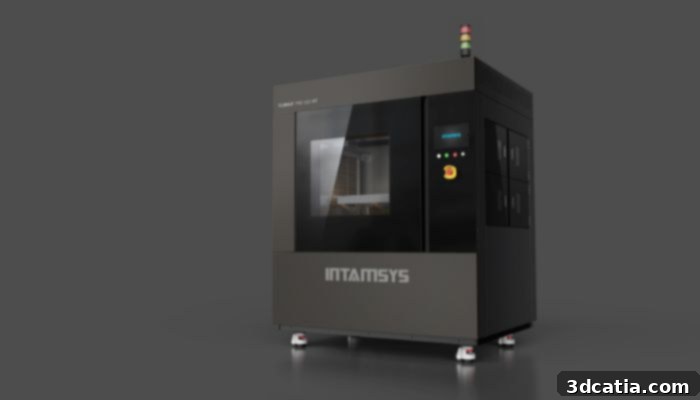
The FUNMAT PRO 610HT was used for both the intake manifolds and the robotic arm component
Following the successful 3D printing of the internal core, the university then employed a sophisticated pre-impregnated layup method to envelop the carbon fiber around the precisely fabricated 3D-printed structure. This innovative integration resulted in the rapid and cost-effective creation of an exceptionally lightweight, yet remarkably robust, composite manipulator arm. A key advantage of this hybrid manufacturing approach was the ability to circumvent the need for expensive and time-consuming mold tooling, which is typically a major bottleneck in composite part production. Despite bypassing traditional molds, the resulting manipulator arm achieved a structural strength entirely comparable to, or even exceeding, that of conventional aluminum alloys. This successful project demonstrates the profound potential of merging additive manufacturing with traditional techniques. Moreover, composite 3D printing can be effectively combined with other established processes such as traditional filament winding, automated layup, and compression molding, opening up new avenues for designing and producing high-performance, multi-material components across various industries.
In summary, the pioneering efforts of the Institute of Industrial New Materials unequivocally highlight the profound advantages of integrating composite 3D printing into advanced manufacturing workflows. Through their strategic partnership with INTAMSYS and the successful execution of these two compelling case studies—the aircraft intake manifold and the robotic manipulator arm—they have demonstrated the technology’s dual capability: not only to directly replace conventional manufacturing methods with superior outcomes but also to effectively supplement existing processes through innovative hybrid approaches. The overarching benefits are clear and significant: enhanced manufacturing efficiency, substantial reductions in production costs, and the ability to fabricate high-performance composite parts that meet the rigorous demands of modern industrial applications. This innovative approach is undoubtedly shaping the future of industrial production, making it more agile, cost-effective, and capable of producing highly optimized components.
What are your thoughts on the Institute of Industrial New Materials’ proactive embrace of composite 3D printing for these advanced applications? We’d love to hear your insights and predictions for the future of hybrid manufacturing. Share your perspectives in a comment below or join the conversation on our LinkedIn, Facebook, and Twitter pages! Don’t forget to sign up for our free weekly newsletter here to receive the latest 3D printing news directly in your inbox. You can also explore all our informative videos and engaging content on our dedicated YouTube channel, where we continually explore the cutting edge of additive manufacturing.
*Cover: The robotic arm component, printed using composite 3D printing (photo credits: INTAMSYS)