
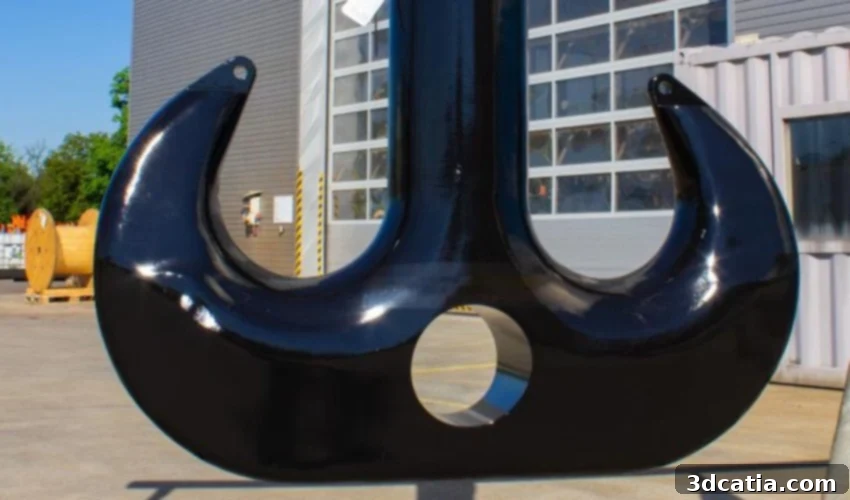
Huisman’s 3D Printed Crane Hooks: Revolutionizing Heavy Lifting with WAAM Technology
For quite some time now, additive manufacturing has been advancing far beyond its early iterations like FDM 3D printing, evolving into a transformative force across various industries. This sophisticated technology, once confined to rapid prototyping, is now integral to numerous industrial applications, particularly where component demands are exceptionally high. The construction industry serves as a prime example, with stringent safety regulations and immense structural requirements placing significant pressure on every single part. While the concept of 3D-printed houses often comes to mind when considering additive manufacturing in construction, the latest breakthrough spotlights a crucial, albeit less visible, component: 3D-printed crane hooks. Cranes, the workhorses of any major construction site, are themselves subject to the same rigorous precautions and testing as the structures they help erect. This challenge was expertly met by Huisman, a renowned manufacturer and servicer of heavy construction equipment established in 1929. The company has successfully manufactured and rigorously tested four groundbreaking 3D-printed crane hooks, certified by the independent authority Lloyd’s Register, boasting a truly remarkable lifting capacity.
The Rise of Additive Manufacturing in Heavy Industries
Additive manufacturing, or 3D printing, has rapidly transitioned from niche technology to a cornerstone of modern industrial production. Its ability to create complex geometries, optimize material usage, and accelerate production cycles has made it indispensable in sectors ranging from aerospace to medical devices. In the heavy lifting and construction industries, the adoption of additive manufacturing presents unique opportunities to address long-standing challenges related to component strength, durability, and customization. Traditional manufacturing methods for large, critical metal components, such as forging and casting, often involve significant lead times, high tooling costs, and limitations in design complexity. Additive manufacturing offers a compelling alternative, enabling the creation of bespoke parts with enhanced properties and reduced waste.
Huisman: A Legacy of Innovation Meets Advanced Manufacturing
Huisman stands as a leading global supplier of highly engineered technical solutions for demanding industries, including oil & gas, renewable energy, and construction. With a legacy spanning nearly a century since its founding in 1929, the company has consistently pushed the boundaries of innovation in heavy equipment. Its extensive product portfolio includes cutting-edge cranes, pipelay equipment, drilling machinery, powerful winches, intricate ship constructions, and bespoke special projects. Huisman’s reputation is built on delivering robust, reliable, and technologically advanced solutions for the most challenging operational environments worldwide. The decision to embrace additive manufacturing for critical components like crane hooks underscores their commitment to continuous improvement and leveraging the latest technological advancements to benefit their clients.
The Power of Wire Arc Additive Manufacturing (WAAM)
The specific additive manufacturing technology utilized by Huisman for these impressive crane hooks is Wire Arc Additive Manufacturing (WAAM). WAAM is a direct energy deposition process that employs metal wire as its raw material and an electric arc (similar to conventional welding) as the heat source to melt and fuse successive layers of material. This method is particularly well-suited for producing large, high-quality components from solid steel and other metals. Its key advantages include a high deposition rate, making it efficient for large-scale parts, and the ability to produce components with excellent mechanical properties, often surpassing those of conventionally manufactured parts due to optimized microstructures. Unlike powder-bed fusion methods, WAAM does not require a powder bed, reducing material handling complexities and costs for large parts. This robust process allows for the creation of intricate designs and custom material properties that are often difficult or impossible to achieve with traditional techniques.
Huisman’s foray into WAAM is the result of extensive dedication and expertise. As Daniel Bílek, project coordinator for Huisman, highlights, “After 5 years of research, development, and testing of 3D-printed products, we have acquired the necessary expertise to use this innovative method for the production of high-quality crane hooks.” This significant investment in R&D demonstrates the company’s meticulous approach to integrating new technologies, ensuring that every 3D-printed component meets the stringent safety and performance standards demanded by the heavy lifting industry. The rigorous testing regimen, culminating in certification by Lloyd’s Register, further validates the reliability and integrity of these additively manufactured parts, establishing a new benchmark for industrial applications of WAAM.
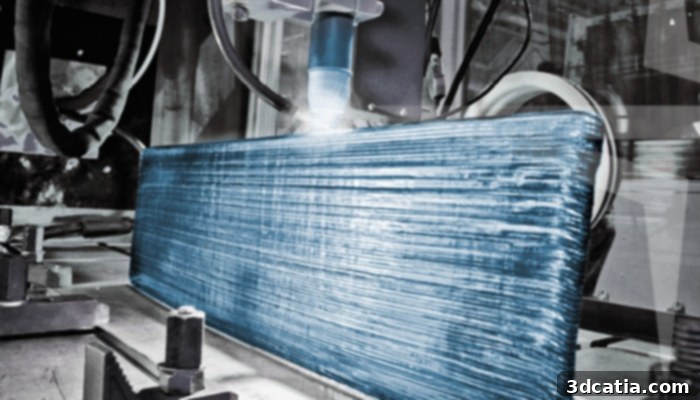
Unveiling the 3D-Printed Crane Hooks: Performance and Precision
The specifications of Huisman’s new 3D-printed crane hooks are truly astounding and mark a significant achievement in large-scale additive manufacturing. Each hook measures approximately 170 x 130 cm, weighs a substantial 1,700 kg, and boasts an incredible load-bearing capacity of 350 tons. These figures are not just impressive; they demonstrate the ability of WAAM technology to produce industrial-grade components capable of handling extreme forces under demanding operational conditions. Beyond their sheer size and strength, these hooks are engineered with tailor-made material properties. Through the precise control offered by the WAAM process, Huisman can achieve specific characteristics such as enhanced strength, superior ductility (the ability to deform without fracturing), and exceptional resistance to both wear and corrosion. These customized properties are critical for extending the lifespan of the hooks and ensuring maximum safety and operational efficiency in harsh offshore and construction environments.
Overcoming Traditional Manufacturing Challenges with WAAM
The decision to manufacture crane hooks additively was a strategic one, driven by compelling economic and logistical advantages over conventional methods. Daniel Bílek elaborates on the rationale: “Crane hooks are commonly part of the delivery of heavy lifting cranes for the offshore industry, one of our key products. The price of a forged hook increases exponentially with size, especially if it is a non-standard size. If a hook is produced by casting, the problem of inconsistent internal quality could result in longer delivery times. All this led to the idea of making the hooks ourselves, using the so-called WAAM method.” This insight highlights fundamental limitations in traditional manufacturing processes:
- Forging Challenges: While forging produces strong components, manufacturing large, custom-sized hooks through this method is incredibly costly and time-consuming. The need for bespoke dies and the complex processes involved in shaping massive metal blocks lead to exponential price increases and extended lead times, especially for unique or low-volume orders.
- Casting Problems: Casting, another common method for large metal parts, often struggles with achieving consistent internal quality. Issues like porosity, voids, and microstructural defects can compromise the structural integrity of the component, necessitating extensive post-processing and inspection, which invariably prolongs delivery times and adds to overall costs.
By contrast, additive manufacturing, specifically WAAM, offers a transformative solution. It dramatically improves cost-efficiency by reducing material waste, as parts are built layer by layer rather than subtractively. Lead times are significantly shortened, particularly for custom or non-standard parts, as there’s no need for expensive tooling or molds. Furthermore, WAAM allows for greater control over the material’s microstructure and density, leading to enhanced and more consistent quality throughout the component. This innovative approach provides Huisman with unparalleled flexibility in design, material optimization, and production scheduling, ensuring that their heavy lifting solutions remain at the forefront of performance and reliability. You can find more comprehensive information on this pioneering initiative in the official press release HERE.
The Future of Heavy Lifting: Impact and Outlook
Huisman’s success with 3D-printed crane hooks marks a pivotal moment for the heavy lifting and construction industries. This achievement not only demonstrates the viability of large-scale metal additive manufacturing for safety-critical components but also paves the way for a paradigm shift in how these parts are designed, produced, and maintained. The ability to quickly and efficiently produce custom-sized, high-performance components on demand could significantly reduce downtimes, enhance operational flexibility, and open new avenues for design optimization that were previously unattainable with traditional manufacturing methods. Furthermore, the principles of WAAM could be extended to other complex heavy machinery parts, leading to innovations across Huisman’s entire product line and potentially influencing the broader market for offshore and construction equipment.
This advancement also carries significant implications for sustainability. By building components layer by layer, WAAM inherently reduces material waste compared to subtractive processes. The potential for localized manufacturing could also shorten supply chains and decrease the carbon footprint associated with transport. As industries continue to seek more efficient, reliable, and environmentally responsible manufacturing solutions, Huisman’s pioneering work with 3D printed crane hooks stands as a testament to the transformative power of additive manufacturing. It highlights a future where advanced engineering and digital fabrication converge to create stronger, smarter, and more sustainable heavy-duty equipment for the world’s most demanding projects.
What are your thoughts on Huisman’s groundbreaking 3D-printed crane hooks and the potential impact of WAAM technology on heavy industries? We invite you to share your insights in a comment below or join the conversation on our Facebook and Twitter pages. Don’t forget to sign up for our free weekly newsletter to receive all the latest news and innovations in 3D printing delivered straight to your inbox!
Cover Photo Credit: Huisman