
Metal Additive Manufacturing: Paving the Way for a Sustainable Future with Reduced Carbon Footprints
The profound benefits of additive manufacturing (AM) extend far beyond rapid prototyping and complex part production; its role in fostering sustainability is increasingly recognized as a cornerstone of modern industrial innovation. From architectural marvels to cutting-edge consumer products and even advanced lithium batteries, examples abound of how AM is revolutionizing various sectors with a focus on environmental responsibility. A recent, comprehensive report has now shed crucial light on the specific contributions of metal additive manufacturing to sustainability, meticulously analyzing its impact across the entire value chain. This in-depth analysis directly addresses critical questions regarding AM’s environmental performance when compared to conventional manufacturing methods. It delves into the factors that contribute to a significantly lower carbon footprint and illustrates how businesses and individuals can leverage metal AM to achieve their ambitious CO2 reduction targets. This article will meticulously explore the key findings and implications of this pivotal report, offering a deeper understanding of how metal 3D printing is shaping a greener industrial landscape.
The escalating concern over rising atmospheric CO2 levels and their dire consequences for our planet, ecosystems, and human societies has driven an urgent global imperative for industries to adopt more sustainable practices. In this critical context, additive manufacturing has emerged as a powerful solution, progressively integrating into every stage of the production cycle to help companies drastically reduce their carbon footprint. To provide a quantifiable assessment of sustainability, AMPOWER, a leading authority in the field, developed a specialized calculator designed to evaluate the CO2 emissions associated with various manufacturing technologies. The quantitative data generated by this tool offers compelling evidence: processes like Powder Bed Fusion exhibit significantly lower CO2 emissions compared to traditional methods such as milling. This remarkable efficiency is primarily attributed to AM’s inherent ability to produce highly weight-optimized components, which in turn leads to a substantial reduction in both material consumption and energy input throughout the manufacturing process. Furthermore, the report highlighted the surprisingly strong performance of binder jetting, another prominent metal AM technology, demonstrating low emissions across its entire workflow, from the initial 3D printing phase to the subsequent debinding steps, underscoring its potential as an environmentally conscious choice.
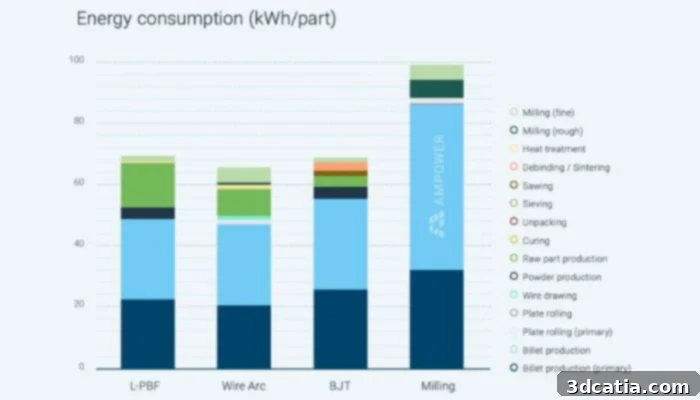
A detailed breakdown of energy consumption for each step in various metal additive manufacturing technologies compared to traditional methods, illustrating sustainability indicators.
Unlocking Sustainability Through Advanced Additive Manufacturing Processes
When evaluating the environmental footprint of manufacturing, the nature of energy consumption is a critical factor. Traditional industrial processes, such as casting, forging, and extensive machining, often rely heavily on the combustion of fossil fuels to generate the immense heat required, resulting in direct and substantial CO2 emissions. In stark contrast, metal additive manufacturing technologies operate exclusively on electrical energy. This fundamental difference is pivotal for sustainability: while electricity generation itself can have varying carbon intensities depending on the source (e.g., coal vs. renewables), the reliance solely on electricity allows AM to seamlessly integrate with and benefit from the ongoing global shift towards cleaner, renewable energy sources. As grids become greener, the carbon footprint of additive manufacturing naturally diminishes, offering a clear pathway to truly zero-emission production. This distinct energy profile positions AM as an inherently more environmentally responsible alternative, enabling industries to transition away from fossil fuel dependency in their core production activities.
The sustainability advantages of metal additive manufacturing span its entire value chain, commencing with an unparalleled level of material efficiency. Unlike subtractive manufacturing, where significant material is often wasted as chips or scraps, AM builds parts layer by layer, utilizing precisely the amount of raw material required for the final product. This “near-net-shape” capability dramatically reduces waste generation. Furthermore, the advancements in material science have led to the development of highly recyclable metal powders, with new processes continuously emerging that enable the production of 100% recyclable materials. This robust recycling infrastructure contributes significantly to a circular economy model, minimizing the extraction of virgin resources and reducing the environmental impact associated with material production.
Beyond material use, the concept of “on-demand production” facilitated by additive manufacturing represents another significant leap towards sustainability. By enabling the localized, just-in-time fabrication of parts, AM minimizes the need for extensive storage capacities and drastically cuts down on global transport requirements. This reduction in warehousing and shipping directly translates into substantial savings in CO2 emissions associated with logistics. Moreover, the inherent design freedom offered by AM allows for unprecedented product efficiency through optimization of weight and performance. Techniques like topology optimization and the integration of lattice structures enable engineers to design parts that are lighter yet stronger, reducing material usage while enhancing functionality. This optimization is particularly impactful in high-stakes sectors such as aerospace, automotive, and industrial hydraulics, where even marginal weight reductions can lead to exponential energy savings over a part’s entire operational lifespan. For instance, a lighter aircraft component contributes to lower fuel consumption, and a more efficient hydraulic part requires less energy to operate, accumulating significant environmental benefits over decades of use.
Evaluating Sustainability Across Different Additive Manufacturing Technologies
According to the insightful AMPOWER report, identifying a single “most sustainable” production method is a complex endeavor. The environmental performance of any manufacturing technology is highly contingent on several variables, primarily the specific alloy group being processed and the intricate geometry of the part being produced. In broad terms, the report indicates that for parts characterized by complex geometries, additive manufacturing consistently yields the lowest carbon footprint due to its ability to create intricate designs with minimal material waste and optimized structures. Conversely, for relatively simple, solid parts, traditional machining processes like milling may still prove to be more sustainable, largely due to their established efficiencies for straightforward designs and mature material supply chains. This nuance underscores the importance of a case-by-case evaluation, emphasizing that the “best” choice is context-dependent and requires a holistic assessment of the part’s characteristics and application.
To illustrate the profound impact of AM on sustainability, consider the aviation industry, where every gram of weight saved translates into significant reductions in fuel consumption and, consequently, CO2 emissions. The AMPOWER sustainability calculator vividly demonstrates this connection. In aviation, it’s conservatively estimated that an annual saving of 2,500 liters of kerosene can be achieved for every kilogram of weight reduced on an aircraft. Extrapolating this over the typical service life of an aircraft part, which can span around 20 years, a single kilogram of weight saved can prevent the consumption of up to 50,000 liters of kerosene. This remarkable fuel saving directly translates to an astounding reduction of approximately 126,000 kilograms of CO2 emissions per kilogram of weight saved per aircraft over its lifetime. Such figures highlight the transformative potential of AM-enabled lightweighting, not just in aviation but in any industry where moving mass requires significant energy, such as electric vehicles, drones, and robotics. For organizations keen to perform their own detailed sustainability assessments for metal additive manufacturing projects, the AMPOWER sustainability calculator is an invaluable tool for precise data-driven decision-making, with more information on purchasing and downloading available HERE.
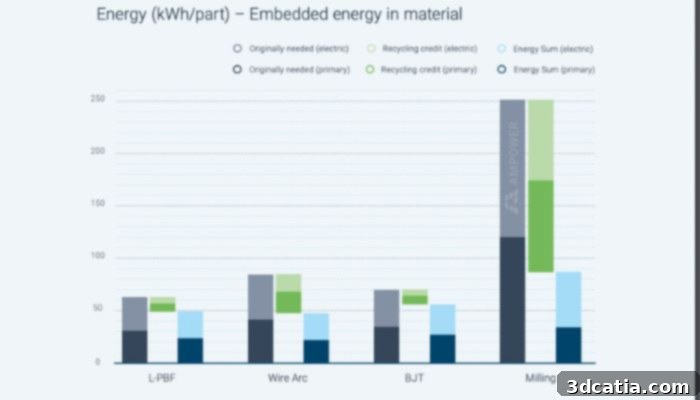
Net energy use for different methods of metal additive manufacturing when recycled energy is accounted for, showcasing the overall efficiency.
The Future Landscape of Sustainable Metal 3D Printing
The findings presented in the AMPOWER report unequivocally solidify metal additive manufacturing’s position as a critical enabler of sustainable industrial practices. Its inherent advantages—from unparalleled material efficiency and robust recycling capabilities to on-demand production and transformative lightweighting—collectively contribute to a significantly reduced carbon footprint across diverse sectors. However, the journey towards ultimate sustainability is ongoing. Continued research and development in areas such as advanced materials, more energy-efficient processes, and further integration with renewable energy sources will further amplify AM’s environmental benefits. The ability to customize production based on part complexity and alloy type allows for a tailored approach to green manufacturing, ensuring that the most environmentally sound method is chosen for each specific application.
The strategic adoption of metal AM is not merely an operational choice but a fundamental step towards achieving corporate environmental, social, and governance (ESG) goals. By embracing these technologies, companies can demonstrate a tangible commitment to planetary health, enhance their brand reputation, and potentially unlock new market opportunities driven by eco-conscious consumers and regulations. As industries worldwide strive to decarbonize and build more resilient, circular economies, metal additive manufacturing stands out as a beacon of innovation, offering practical, scalable, and impactful solutions for a greener future. Its potential to reshape global supply chains, reduce waste, and enable energy-efficient designs makes it an indispensable tool in the fight against climate change and the pursuit of true industrial sustainability.
What are your thoughts on this comprehensive study and the burgeoning role of additive manufacturing in global sustainability efforts? Do you believe the industry is moving fast enough to leverage these benefits? Share your insights and join the conversation in the comments section below, or connect with us on our social media channels: find us on LinkedIn, Facebook, and Twitter! Don’t miss out on the latest advancements and news in the world of 3D printing—sign up for our free weekly Newsletter here to get updates delivered directly to your inbox. You can also explore our extensive library of videos and interviews on our dedicated YouTube channel.