
Revolutionizing Robotics: 3D Printing and Living Skin Pave the Way for Humanoid Machines
Since the development of the first programmable industrial robot in 1956, robotics has undergone a remarkable transformation, integrating itself into nearly every facet of modern life. From the tireless efficiency of robotic arms on automotive assembly lines to the convenience of autonomous vacuum cleaners navigating our homes, robots have become indispensable tools, augmenting human capabilities and simplifying complex tasks. Yet, despite their widespread adoption and increasing sophistication, a fundamental aspiration in robotics has remained largely elusive: creating machines that not only interact with the world like humans but also look and feel like us. Traditional robotic designs, typically characterized by rigid materials and mechanical components, have offered little in the way of human resemblance, presenting a significant barrier to achieving truly intuitive human-robot interaction and integration.
However, this long-standing paradigm is now on the cusp of a profound shift. Groundbreaking advancements in tissue engineering, cellular biology, and sophisticated 3D printing technologies are converging to bridge the gap between machine and organism. Researchers are now exploring innovative ways to imbue robots with biological elements, particularly living, self-healing skin. This represents a monumental leap towards creating humanoid robots that are not just functionally advanced but also possess a lifelike appearance and tactile properties, fundamentally altering our perception and interaction with robotic entities. The integration of living tissues promises to redefine the boundaries of robotics, offering a glimpse into a future where robots exhibit unprecedented levels of realism and adaptability.
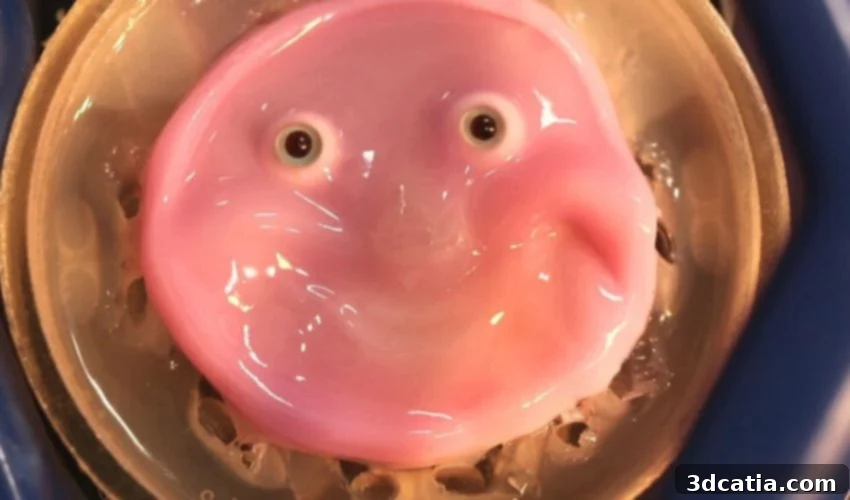
A significant stride in this ambitious endeavor has recently been made at the prestigious University of Tokyo. Under the visionary leadership of Professor Shoji Takeuchi, a team of dedicated scientists has achieved a remarkable feat: successfully attaching artificially cultivated human skin tissue directly onto the faces of 3D-printed robots. This pioneering research leverages advanced 3D printing techniques to create intricate anchoring mechanisms, enabling the seamless integration of biological skin onto a robotic substrate. The cultivated skin, ingeniously inspired by the natural elasticity and regenerative capabilities of human dermal bands, comprises living cells, granting it the extraordinary ability to heal itself. This innovative approach heralds a new era for robotics, moving beyond conventional materials to embrace organic components that could revolutionize the aesthetic and functional properties of future robots.
The methodology employed by Professor Takeuchi’s team is a testament to interdisciplinary innovation. At its core lies the meticulous cultivation of skin tissue, a complex biological process that mimics the natural properties of human skin. This living dermal layer, composed of viable human cells, offers a level of biomimicry previously unattainable in robotics. Crucially, this cultivated skin inherits the innate regenerative capacity of biological tissue, meaning it can self-repair minor damage, a feature that significantly enhances the durability and lifespan of future humanoid robots. This self-healing attribute addresses one of the major limitations of conventional robotic coverings, which often degrade or get damaged, requiring costly and time-consuming manual repairs. The resilience of living skin introduces an entirely new paradigm for robotic maintenance and longevity.
The ingenious attachment mechanism is central to the success of this project. To securely yet flexibly affix the delicate cultivated skin to the rigid robotic framework, the researchers developed and utilized custom-designed, 3D-printed perforation anchors. These intricate structures, precisely integrated into the robot’s underlying facial architecture, feature a distinctive V-shaped design with numerous small perforations. This unique geometry serves a dual purpose: it provides robust mechanical strength to hold the skin in place, preventing detachment during movement, while simultaneously offering sufficient flexibility to accommodate facial expressions and movements without tearing or damage. The numerous minute perforations act as micro-grip points, significantly increasing the surface area for biological adhesion and facilitating the initial attachment process of the skin onto the robot’s surface.
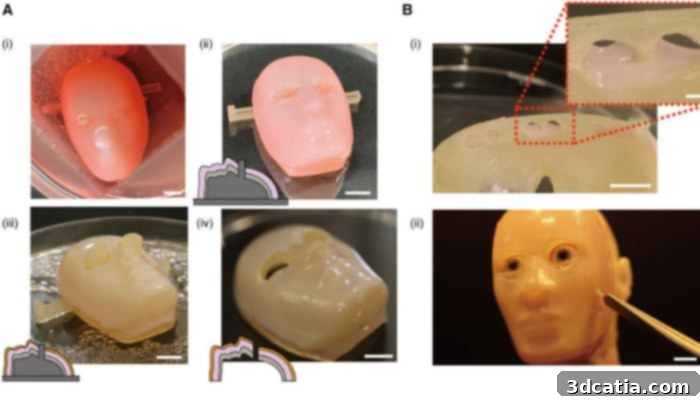
3D printing and applying the living skin to the 3D robotic face (photo credits: Takeuchi et al)
The fabrication of these specialized V-shaped perforation anchors and the underlying structural components of the robot head was accomplished using state-of-the-art additive manufacturing techniques. Specifically, the researchers relied on the AGLISTA-3100 3D printer from Keyence, a renowned Japanese technology company. This sophisticated printer employs material jetting technology, a highly precise additive manufacturing process. In material jetting, photopolymer resin droplets are selectively jetted onto a build platform and subsequently cured by ultraviolet (UV) light, layer by layer, until the desired three-dimensional object is fully formed. This method is celebrated for its exceptional accuracy, ability to produce intricate geometries, and smooth surface finishes, all of which were critical for manufacturing the delicate and functionally precise anchors required for this bio-integrated robotic system.
The selection of material jetting technology was not arbitrary; it was a deliberate choice driven by the stringent requirements of the project. The ability of the Keyence AGLISTA-3100 to achieve remarkably fine details and maintain tight dimensional tolerances ensured that the V-shaped perforations and the overall structure of the robot head were printed with unparalleled reliability and precision. This level of accuracy is paramount when dealing with the integration of living biological tissues, as any imperfections could compromise the adhesion, integrity, or functionality of the skin layer. The consistent quality and resolution offered by material jetting technology were instrumental in creating a stable and compatible foundation for the self-healing, living skin, setting a new benchmark for bio-robotic fabrication.
A crucial step in ensuring the robust and lasting adhesion of the cultivated skin to the 3D-printed robot head involved the strategic use of collagen gel. The meticulously designed perforations on the robotic surface played a pivotal role in this process, significantly simplifying the application and integration of the collagen. This bio-compatible gel acts as a scaffolding and adhesive layer, creating a strong biological bond between the living skin cells and the synthetic substrate of the robot. Its presence is vital for nourishing the skin and maintaining its structural integrity once attached. Without these perforations, achieving a uniform and secure spread of the gel, and thus stable skin attachment, would be considerably more challenging.
However, working with collagen gel presents its own set of challenges. Collagen, in its natural state, possesses a relatively tough and viscous consistency, making it notoriously difficult to manipulate and introduce into small, intricate spaces like the V-shaped perforations. To overcome this hurdle, Professor Takeuchi’s team implemented an innovative plasma treatment for the collagen gel. This specialized treatment effectively alters the surface properties and viscosity of the gel, rendering it more pliable and hydrophilic without compromising its biological integrity. The plasma treatment allowed the collagen to smoothly and efficiently flow into every minute perforation and crevice of the 3D-printed anchors. This enhanced penetrability ensured maximum contact and secure embedding of the collagen, which, in turn, enabled the living skin to adhere firmly and uniformly to the robot’s surface, establishing a durable and functional biological interface.
Prior to these advancements, efforts to apply lifelike skin to robots were often fraught with limitations. Earlier methodologies typically struggled with the delicate balance between secure attachment and dynamic flexibility. Conventional materials, even when designed for flexibility, lacked the intrinsic properties of biological tissue, making it nearly impossible to replicate the nuanced movements and natural stretching associated with human facial expressions. This often resulted in the rapid deterioration or outright damage of the applied skin layer during robot movement, undermining the goal of a truly humanoid appearance and functionality.
The current innovation, centered on the unique V-shaped perforation anchors, fundamentally addresses these previous shortcomings. By creating a robust yet flexible connection to the robot’s base structure, these anchors allow the cultivated living skin to move and stretch in a remarkably natural manner. This is particularly evident in the replication of subtle facial gestures, such as a smile, where the skin needs to contort and then return to its original shape without cracking or detaching. The bio-integrated design not only ensures the skin’s integrity during movement but also enables a significantly more expressive and human-like robotic face, opening new avenues for realistic human-robot interaction and communication that were previously unimaginable with static, synthetic coverings.
Professor Shoji Takeuchi himself eloquently articulates the significance of this breakthrough and outlines the ambitious roadmap ahead for bio-integrated robotics. He states: “In this study, we managed to replicate human appearance to some extent by creating a face with the same surface material and structure as humans. This initial success is incredibly encouraging, demonstrating the viability of integrating living tissue into robotic systems. It represents a foundational step towards achieving true biomimicry in robotics, moving beyond mere superficial resemblance to functional and structural similarity.”
However, Professor Takeuchi also candidly acknowledges the current limitations and the extensive work that still lies ahead. He continues: “Additionally, through this research, we identified new challenges, such as the necessity for surface wrinkles and a thicker epidermis to achieve a more humanlike appearance.” This highlights the intricate complexity of human skin, which is far more than just a smooth surface. Recreating the nuanced textures, folds, and variations, including the subtle presence of wrinkles that convey age and expression, requires advanced cellular engineering and even more precise fabrication techniques. Furthermore, achieving a thicker, multi-layered epidermis is crucial for both realism and enhanced durability.
Looking to the future, the research team envisions an even more biologically complex and authentic robotic skin. Professor Takeuchi emphasizes: “We believe that creating a thicker and more realistic skin can be achieved by incorporating sweat glands, sebaceous glands, pores, blood vessels, fat and nerves.” This vision extends beyond mere aesthetics, aiming for functional integration. Sweat glands could enable thermoregulation, sebaceous glands could maintain skin hydration, pores contribute to texture, while blood vessels would provide crucial nutrient supply and waste removal for a truly viable, long-lasting biological skin. The inclusion of fat layers would add natural contours and insulation, and perhaps most profoundly, nerves would grant the robotic skin sensory capabilities – allowing robots to ‘feel’ their environment with unprecedented detail, reacting to pressure, temperature, and texture in a human-like fashion.
Beyond the material composition, Professor Takeuchi underscores the importance of dynamic expression: “Of course, movement is also a crucial factor, not just the material, so another important challenge is creating humanlike expressions by integrating sophisticated actuators, or muscles, inside the robot.” While the current research has enabled basic movements like smiling, achieving the full spectrum of human facial expressions – from surprise and sadness to anger and contemplation – requires a highly intricate network of artificial muscles (actuators) that can contract and relax with precision and fluidity, mimicking the complex musculature beneath human skin. The synchronization of these actuators with the flexible living skin is key to unlocking truly emotive robotic faces.
The driving force behind these monumental efforts is clear: “Creating robots that can heal themselves, sense their environment more accurately and perform tasks with humanlike dexterity is incredibly motivating.” This overarching goal encapsulates the transformative potential of bio-integrated robotics. Robots with self-healing skin would be more robust and require less maintenance, enhancing their operational efficiency. Improved sensory capabilities would allow them to interact with delicate objects and navigate complex environments with greater safety and finesse. Ultimately, achieving human-like dexterity and appearance could pave the way for robots that seamlessly integrate into human society, performing roles that require empathy, fine manipulation, and a high degree of adaptability.
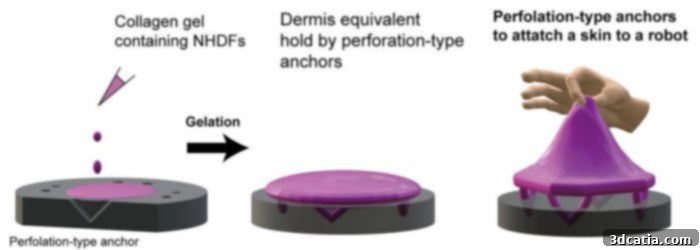
The application of collagen gel, which leads to the attachment of living skin (photo credits: Takeuchi et al.)
The genesis of this remarkable living skin begins with human cells. To produce the sophisticated cultivated skin, the researchers carefully procured normal human dermal fibroblasts and epidermal keratinocytes. These essential skin cells were obtained from anonymous human donors, ensuring ethical sourcing and maintaining scientific rigor. Dermal fibroblasts are crucial for producing collagen and other extracellular matrix components, which give skin its strength and elasticity, while epidermal keratinocytes are the primary cells of the outer skin layer, forming a protective barrier.
Maintaining the viability and health of these delicate biological components outside the human body is a complex and highly specialized process. The cultured skin cells were meticulously treated with a specialized growth medium, a nutrient-rich solution designed to mimic the physiological conditions necessary for cell proliferation and differentiation. This medium provides all the essential amino acids, vitamins, growth factors, and minerals that cells require to thrive. Furthermore, stringent aseptic techniques were employed, and antibiotics were regularly administered to prevent contamination, a critical concern when working with living tissues. The nutrient supply within the growth medium was diligently and regularly replenished to ensure a continuous and optimal environment for the skin cells to grow and mature, ultimately forming a coherent and functional tissue layer.
Professor Takeuchi provides invaluable insight into the arduous nature of this research: “Manipulating soft, wet biological tissues during the development process is much harder than people outside the field might think.” This statement underscores the immense technical skill and patience required. Unlike rigid robotic components, living tissues are incredibly fragile, susceptible to damage from even slight mechanical stress, and highly sensitive to environmental conditions. He further elaborated on the critical importance of maintaining a sterile environment: “For instance, if sterility is not maintained, bacteria can enter and the tissue will die.” The risk of bacterial or fungal contamination is constant, and a single lapse in sterile technique can lead to the loss of weeks or months of cultivation efforts, highlighting the precision and unwavering diligence demanded by bio-engineering research.
The far-reaching implications of this pioneering research extend well beyond the realm of advanced robotics, promising transformative impacts across various industries and scientific disciplines. The development of functional, cultivated human skin offers an ethical and highly effective alternative for product testing, particularly within the vast cosmetics industry. Currently, many cosmetic products are tested on animals, a practice that is ethically contentious and often faces public opposition. Bio-printed human skin could serve as a superior in vitro model, accurately mimicking human physiological responses to various chemicals and formulations. This would not only lead to a significant reduction, and potentially even the elimination, of animal testing but also provide more relevant and reliable data, as the tests would be performed directly on human-derived tissue, ensuring safer and more effective products for consumers.
In the medical field, particularly for surgical training, this engineered skin presents an extraordinary advantage. Aspiring plastic surgeons and medical students could utilize these realistic, skin-covered robotic faces for hands-on training, practicing intricate surgical procedures, suturing techniques, and reconstructive surgeries in a highly lifelike environment. This provides an invaluable, risk-free platform for developing proficiency and confidence before operating on human patients. The tactile realism and self-healing properties of the skin would allow for repeated practice on a truly representative medium, far superior to cadavers or conventional mannequins that lack the dynamic response and regenerative capacity of living tissue.
Perhaps one of the most profound transformations this research promises is in the sphere of human-robot communication. The integration of living, expressive skin on robots fundamentally alters how humans perceive and interact with machines. Human-like robots, capable of conveying emotions through a spectrum of natural facial expressions—a subtle smile, a worried brow, or a look of surprise—would foster a deeper sense of empathy and connection. This enhanced emotional communication would be revolutionary for service robots, companion robots, and educational platforms, making interactions more intuitive, comforting, and socially acceptable. It moves beyond purely functional interactions to encompass social and emotional engagement, bridging the uncanny valley and allowing for more meaningful human-robot relationships.
Within the domain of robotics itself, the innovations brought forth by this research are manifold. The incorporation of a bio-integrated skin layer contributes directly to increased mobility and flexibility, allowing robots to move with greater fluidity and naturalness, particularly in complex articulations like the face. Coupled with the potential for improved sensor functions – once nerves are integrated, enabling tactile feedback, temperature sensing, and pressure detection – robots will gain an unparalleled understanding of their physical environment. This enhanced sensory perception translates into robots that can perform delicate tasks with human-like dexterity and adapt to unforeseen circumstances with greater intelligence. The most direct benefit, however, is the achievement of a truly humanoid appearance, which is critical for social acceptance and for enabling robots to operate effectively in human-centric environments.
Crucially, the inherent self-healing capability of the living skin is a game-changer for robot longevity and economic viability. Minor cuts, abrasions, or wear and tear, which would typically necessitate costly and time-consuming manual repairs or component replacements for conventional robots, can now be biologically self-repaired. This autonomous healing mechanism dramatically extends the operational lifespan of robots, leading to significant reductions in maintenance costs and downtime. The vision of robots that can naturally mend themselves, much like biological organisms, represents a quantum leap in robotic engineering, moving towards systems that are not only advanced but also inherently more resilient and sustainable.
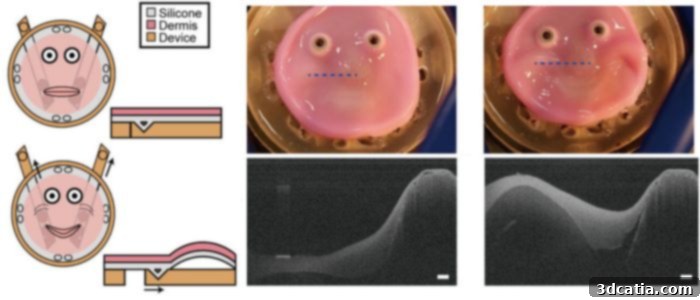
The V-shaped anchor contorts the flat robot face with the living skin into a smile. The skin then returns to its original shape (photo credits: Takeuchi et al.)
In its concluding remarks, the research report succinctly encapsulates the future trajectory of this groundbreaking work, emphasizing both scientific inquiry and practical application. The authors state: “One significant next step in this research is to leverage this model to enhance our understanding of the mechanisms underlying wrinkle formation.” This indicates a commitment to utilizing the bio-integrated robot as a research platform itself, providing an unprecedented opportunity to study complex biological processes like skin aging and expression dynamics in a controlled, replicable environment. Gaining deeper insights into how wrinkles form and how skin stretches and recovers will be instrumental not only for creating more realistic robotic faces but also for advancing dermatological science.
Furthermore, the report projects forward with an eye towards commercial and medical applications: “Moreover, applying this knowledge to recreate such expressions on a chip could find applications in the cosmetics industry and the orthopedic surgery industry.” This vision suggests a future where compact, ‘skin-on-a-chip’ systems, derived from this research, could provide miniature models for testing anti-aging creams, evaluating new cosmetic ingredients, or even simulating biomechanical responses for orthopedic device development. The ability to precisely control and observe the dynamic behavior of engineered skin, from wrinkle formation to wound healing, holds immense potential for accelerating product development, reducing costs, and refining medical treatments. Read more about the progress HERE.
This pioneering work by Professor Shoji Takeuchi’s team at the University of Tokyo marks a significant milestone in the quest for truly humanoid robots. By successfully integrating living, self-healing skin onto 3D-printed robotic faces, they have not only pushed the boundaries of bio-robotics but also opened doors to a future where robots are more resilient, empathetic, and seamlessly integrated into human society. As this research continues to evolve, we can anticipate a future where the lines between biology and machine become increasingly blurred, leading to innovations that once belonged solely to the realm of science fiction.
What are your thoughts on this groundbreaking development in 3D-printed robot faces featuring living skin? The implications for the future of robotics and human-robot interaction are vast and fascinating. We invite you to share your perspectives in the comments section below or join the discussion on our LinkedIn, Facebook, and Twitter pages! For the latest updates and insights into the rapidly evolving world of 3D printing, don’t forget to sign up for our free weekly newsletter here, delivered straight to your inbox. You can also explore all our in-depth videos and content on our YouTube channel.
*Cover Photo Credits: ©2024 Takeuchi et al. CC-BY-ND