
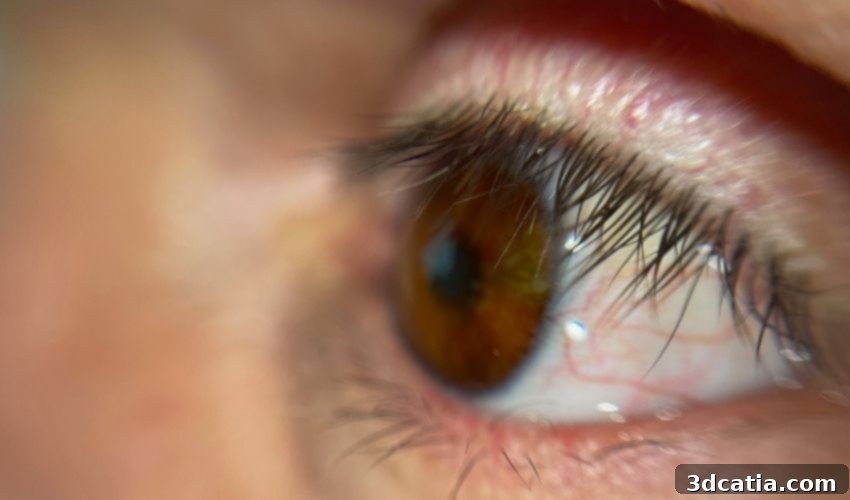
Revolutionizing Medical Prosthetics: The World’s First Fully 3D Printed Eye
Additive manufacturing continues to redefine the boundaries of medical innovation, offering unprecedented solutions for patient care. A groundbreaking development from the UK provides a compelling answer to the question of how this advanced technology can profoundly impact individuals in the medical industry. Recently, Steve Verze, a resident of Hackney, UK, made history as the first person globally to receive a fully 3D printed prosthetic eye. This landmark achievement, facilitated by the Moorfields Eye Hospital NHS Foundation Trust, also distinguishes him as the sole individual relying on a 3D printed prosthetic as his only artificial eye. What makes this innovative eye particularly remarkable is its superior realism, boasting clearer definition and genuine depth. This heightened authenticity is directly attributable to the precise 3D scans of both the eye socket and the healthy eye, ensuring an exceptionally accurate and natural-looking match.
The development of this advanced printed prosthetic is the result of an extensive collaborative effort involving a consortium of partners across the UK and Europe. Spearheaded by researchers from University College London (UCL) and the Moorfields Eye Hospital NHS Foundation Trust, this project exemplifies the power of interdisciplinary cooperation. Professor Mandeep Sagoo, a distinguished consultant ophthalmologist at Moorfields, shared his enthusiasm for this pioneering technology, stating, “We are incredibly excited about the potential that this fully digital eye presents. This achievement represents the culmination of four years of dedicated development, integrating sophisticated technology through the combined expertise of Moorfields Eye Hospital, UCL Institute of Ophthalmology, Ocupeye Ltd, and Fraunhofer. We are hopeful that the forthcoming clinical trial will furnish us with robust evidence regarding the immense value of this novel technology, clearly demonstrating the transformative difference it can make for patients. Crucially, it holds significant promise for substantially reducing patient waiting lists.”
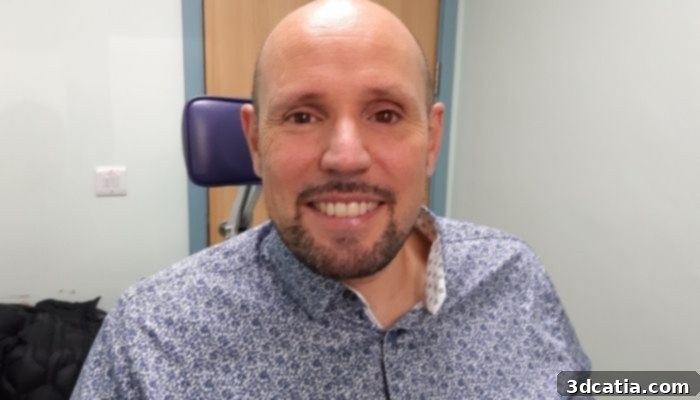
Steve Verze has received the first 3D printed eye prosthetic, which is more realistic than traditional models (photo credits: Moorfields Eye Hospital)
The Imperative for Innovation: Why 3D Print a Prosthetic Eye?
The medical sector has long embraced additive manufacturing for its transformative capabilities, with prosthetics being one of its most impactful applications. The advantages of using 3D printing in this field are manifold and immediately apparent. By leveraging advanced 3D scanning and printing technologies, medical professionals can create prosthetics that offer an unprecedented level of personalized fit, significantly enhancing patient comfort and overall well-being. Furthermore, the fabrication process is dramatically accelerated, leading to a substantial reduction in waiting times – a factor that can cause considerable distress for patients awaiting vital medical devices.
In the specific context of ocular prosthetics, the need for innovation is particularly pressing. UCL’s press release highlights that approximately 0.1% of the global population requires such an implant, translating to an estimated 60,000 to 70,000 individuals in England alone. A critical aspect of these prosthetics is their necessity for replacement every five years, coupled with the inherent uniqueness of each individual’s eye socket. These precise requirements – the need for frequent replacement and bespoke fit – make the creation of artificial eyes an ideal application for 3D printing technology, where customization stands out as a core benefit. Traditional methods often involve invasive molding processes and painstaking handcrafting, leading to inconsistencies, discomfort, and long production cycles.
Beyond Aesthetics: The Tangible Benefits of 3D Printing in Ocular Prosthetics
While the researchers involved in this project notably emphasized the superior aesthetics of the 3D printed eye – which can be considered a true biomimic, offering a more realistic appearance than its traditional counterparts – they also underscored the remarkable gains in process efficiency. The traditional method for producing acrylic prosthetic eyes typically spans around six weeks. In stark contrast, 3D printing slashes this timeline by more than half, reducing it to approximately two to three weeks. This drastic acceleration is attributed to a fundamental shift in the manufacturing workflow. Instead of the cumbersome and often invasive process of individually measuring and molding the eye socket – a particularly distressing experience for children – the new approach relies on a swift, non-invasive, and non-ionizing 2.4-second scan. This digital capture perfectly replicates the intricate details of both the eye and its surrounding socket. Following this precise digital acquisition, the prosthetic eye itself is then expertly printed by companies like Fit AG, transforming a labor-intensive craft into a streamlined, high-tech manufacturing process.
The implications of this shift are far-reaching. Traditional prosthetic eyes are often hand-painted, leading to variations in quality and realism. The ability of 3D printing to directly translate digital design data into a physical object ensures unparalleled consistency and precision. This digital workflow allows for the replication of intricate details such as iris patterns, sclera coloration, and even tiny blood vessels, leading to a prosthetic that blends seamlessly with the patient’s existing eye. This level of aesthetic fidelity has a profound psychological impact, significantly boosting patient confidence and reducing feelings of self-consciousness, which are common among individuals with traditional prosthetics. The non-invasive scanning method also eliminates the discomfort and anxiety associated with physical impressions, particularly beneficial for young patients or those with sensitive eye sockets.
The Collaborative Spirit: Driving Medical Advancement
The success of this pioneering project is a testament to the powerful synergy created through collaboration. UCL researchers provided the foundational academic and scientific expertise, pushing the boundaries of what is technologically possible in medical applications. Moorfields Eye Hospital NHS Foundation Trust, a world-renowned center for ophthalmic care, played a crucial role in bringing the technology from the lab to the clinic, ensuring clinical relevance and patient safety. Ocupeye Ltd, specializing in advanced imaging and ocular prosthetic technology, likely contributed significantly to the precise scanning and digital modeling aspects. Fraunhofer, Europe’s largest applied research organization, brought its formidable engineering and manufacturing capabilities, particularly in the realm of additive manufacturing processes, ensuring the industrial viability and scalability of the solution. This blend of academic research, clinical excellence, specialized technology development, and industrial manufacturing prowess was essential in overcoming the complex challenges associated with creating such a sophisticated medical device.
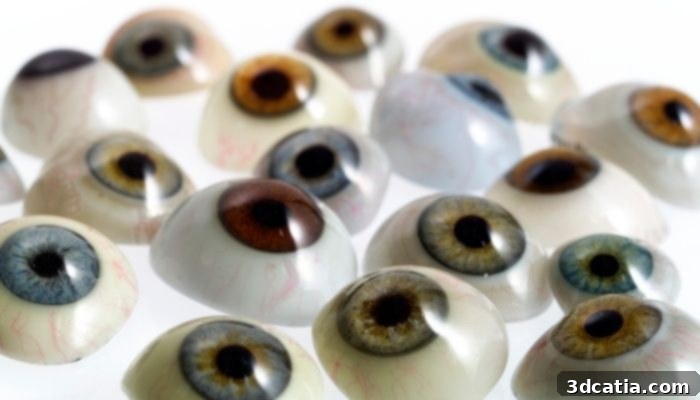
3D printing has the potential to improve the experience of patients with eye prosthetics (photo credits: Wellcome Library, London, CC BY 4.0, via Wikimedia Commons)
A Patient’s Perspective: The Human Impact of Innovation
With this revolutionary technology, the collaborating teams harbor ambitions to address a significant unmet need, aiming to fulfill the requirement for approximately 10,000 prostheses annually across the UK. The direct impact of this innovation is perhaps best articulated by the patient himself. Steve Verze, an engineer in his 40s, reflected on his experience, concluding, “I’ve needed a prosthetic eye since I was 20, and I’ve always felt self-conscious about it. When I leave my home, I often take a second glance in the mirror, and I’ve not liked what I’ve seen. This new eye looks fantastic and, being based on 3D digital printing technology, it’s only going to be better and better.” His words powerfully convey the emotional and psychological toll that traditional prosthetics can take, and the profound sense of liberation and confidence that a realistic, comfortable, and digitally optimized replacement can bring. The expectation that the technology will continue to improve highlights the iterative and progressive nature of digital manufacturing, promising even greater realism and comfort in the future.
The Future of Ocular Prosthetics and Beyond
The successful implementation of the world’s first fully 3D printed prosthetic eye marks a pivotal moment in medical history. This achievement not only promises to significantly improve the lives of tens of thousands in the UK but also sets a global precedent for personalized medicine through additive manufacturing. The reduced production time will alleviate substantial stress for patients and their families, while the enhanced realism and custom fit will foster greater confidence and social integration. This advancement could pave the way for similar breakthroughs in other areas of facial prosthetics, offering bespoke solutions for patients requiring ears, noses, or other intricate anatomical reconstructions. As clinical trials progress and the technology becomes more widespread, we can anticipate a future where accessible, highly realistic, and comfortable prosthetics are the norm, transforming patient experiences worldwide. The cost-effectiveness of scaled-up 3D printing, coupled with its speed and precision, has the potential to make advanced prosthetic solutions more widely available, ultimately democratizing access to superior medical care.
You can find out more about this groundbreaking development HERE and HERE.
What are your thoughts on this innovative 3D printed eye prosthetic and its potential to revolutionize patient care? We invite you to share your comments below or connect with us on our LinkedIn, Facebook, and Twitter pages! Don’t miss out on the latest advancements in additive manufacturing – subscribe to our free weekly Newsletter here, delivering the most current 3D printing news directly to your inbox! Additionally, explore our diverse range of videos on our YouTube channel.
*Cover Photo Credits: Moorfields Eye Hospital NHS Foundation Trust