
Bioprinted Mini-Organs: Revolutionizing Drug Testing and Personalized Medicine
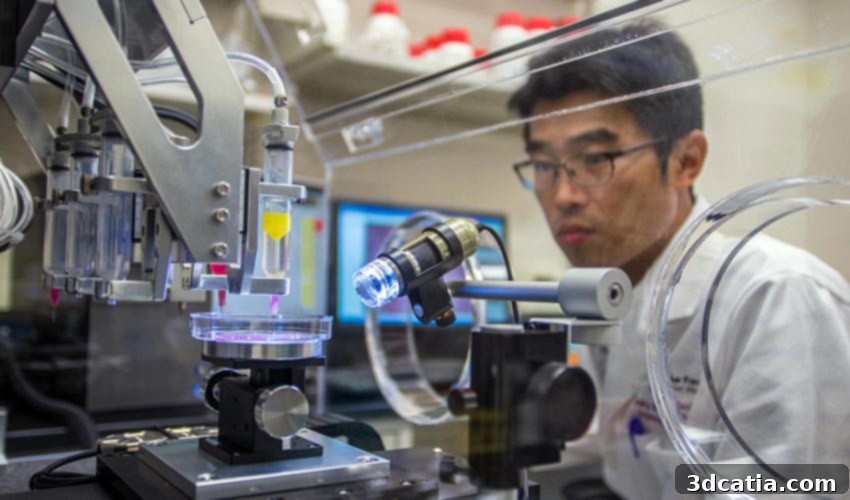
The landscape of pharmaceutical research and development is on the cusp of a groundbreaking transformation, thanks to pioneering advancements in bioprinting. Researchers at the esteemed Wake Forest Institute for Regenerative Medicine (WFIRM) have successfully engineered a sophisticated miniature laboratory model of the human body. This cutting-edge model integrates miniaturized human organs, including vital structures like the heart, lungs, and liver. Its primary purpose is to dramatically enhance the detection of adverse drug effects at a much earlier stage, long before new medications are administered to human patients. This innovative approach promises not only to accelerate the time it takes for new drugs to reach the market but also to significantly lower the exorbitant costs associated with traditional clinical testing and drastically reduce the reliance on animal experimentation, marking a new era in biomedical research.
Details of this remarkable achievement were meticulously documented in a comprehensive paper published by the journal of Biofabrication. In their report, the WFIRM researchers provided an in-depth account of the methodologies employed to create these miniature organs and elucidate the intricate workings of this novel human organ tissue system. The complexity of constructing such a system is underscored by the fact that each distinct type of tissue possesses unique individual requirements, necessitating the deployment of a diverse array of advanced biofabrication techniques for the creation of every organ. The process involved isolating tiny samples of human tissue cells and then meticulously engineering them into functional miniature versions of their full-sized counterparts. Crucially, these bioprinted mini-organs are designed to perform the exact same physiological functions as they do within the human body, albeit on a dramatically reduced scale. Each miniature organ is, in essence, a tiny, intricate 3D tissue-like structure, often representing approximately one millionth the size of an adult human organ, yet capable of mimicking complex biological responses.
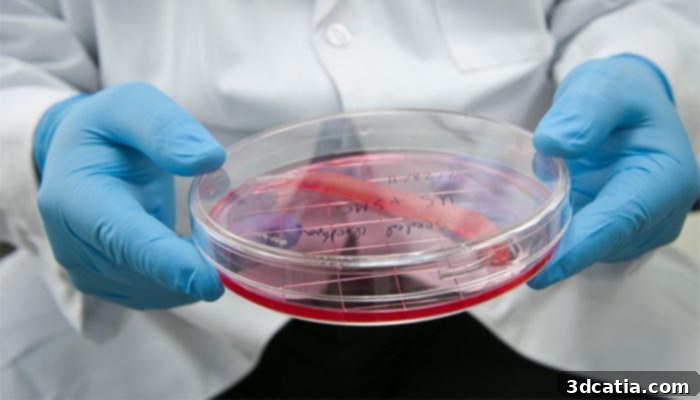
Image via Wake Forest Institute of Regenerative Medicine
The application of 3D printing technology within healthcare is not entirely new. Hospitals and clinics worldwide have increasingly adopted additive manufacturing to produce highly precise surgical models that faithfully replicate the intricate anatomy of individual patients. These custom-made anatomical models represent a monumental leap forward, enabling surgeons to prepare for complex procedures with an unprecedented level of detail and foresight that was simply unattainable in previous eras. While different in its immediate application, the underlying principle of WFIRM’s miniature organ system shares a common thread: to deeply study the human body and predict its reactions, in this case, to pharmaceutical compounds. Dr. Anthony Atala, the distinguished Director of WFIRM and a leading Professor, emphasized the profound implications of this innovation, stating: “The most important capability of the human organ tissue system is the ability to determine whether or not a drug is toxic to humans very early in development, and its potential use in personalized medicine. Weeding out problematic drugs early in the development or therapy process can literally save billions of dollars and potentially save lives.” This highlights the dual benefit of cost efficiency and enhanced patient safety.
The advent of bioprinting is undeniably accelerating the journey towards personalized medicine at an unprecedented pace. While the dream of creating fully functional human organs ready for transplantation remains a long-term aspiration, the immediate applications and benefits of this technology are already substantial and tangible. In the specific context of WFIRM’s research, the paramount objective is to accurately measure the toxicity profiles of drugs before they are ever administered to human patients. Conventional methods, such as standard 2D cell cultures or animal testing, frequently fall short in accurately predicting the toxicity of pharmaceuticals. This inadequacy stems from a fundamental limitation: these systems often lack the biological complexity, multicellular interactions, and accurate physiological similarity required to faithfully mimic human responses. As Dr. Aleks Skardal, a key researcher in the project, eloquently explains: “In order to model the body’s different responses to toxic compounds, we needed to include all of the cell types that produce these responses.” This holistic approach is what sets the bioprinted organ system apart, offering a far more reliable platform for toxicity assessment.
The inherent limitations of traditional drug testing methodologies are well-documented. Two-dimensional cell cultures, while useful for initial screenings, often fail to replicate the complex three-dimensional environment and cell-to-cell communication found within native human tissues. This often leads to misleading results that do not translate effectively to human physiology. Similarly, animal models, despite their long-standing role in drug development, present significant challenges. Differences in metabolism, physiology, and genetic makeup between animal species and humans can result in discrepancies in drug efficacy and toxicity, leading to costly late-stage failures in clinical trials. Furthermore, the ethical considerations and high costs associated with extensive animal testing continually drive the scientific community to seek more humane, efficient, and predictive alternatives. The bioprinted miniature organ system directly addresses these critical gaps, offering an `in vitro` model that is far more representative of human biological responses. By catching potential toxicity early, this technology can prevent drugs that are harmful to humans from progressing further in the development pipeline, thereby safeguarding patient health and optimizing research resources.
Image via Flickr
The development of such an intricate miniature human organ system was, predictably, no small feat. It represents the culmination of decades of dedicated research and innovation. Indeed, at WFIRM, researchers have been tirelessly working for over the past 30 years with the ambitious goal of constructing full-scale human organs suitable for transplantation into patients. This long-term commitment to tissue engineering and regenerative medicine provides the foundational expertise upon which the current miniature organ project is built. Dr. Thomas Shupe, another esteemed researcher at WFIRM, succinctly captured the logical progression of their work, concluding: “Creating microscopic human organs for drug testing was a logical extension of our work.” This highlights the synergy between their pursuit of transplantable organs and the immediate, practical applications of bioprinting in drug discovery. The techniques perfected for creating larger, more complex structures have now been adeptly scaled down and adapted to serve this critical need in pharmacology.
Looking ahead, the potential applications of bioprinted human organ models extend far beyond simple toxicity screening. These advanced “organ-on-a-chip” or “body-on-a-chip” systems could soon become invaluable tools for personalized medicine, allowing clinicians to test the efficacy and potential side effects of drugs on a patient’s own cells before treatment begins. Imagine a future where a patient’s own bioprinted mini-liver could predict their unique metabolic response to a cancer drug, or a mini-heart could forewarn of potential cardiotoxicity. This level of precision medicine could dramatically improve treatment outcomes and minimize adverse reactions. Furthermore, these models offer unprecedented opportunities for studying disease mechanisms, understanding how various conditions affect human tissues at a cellular level, and developing novel therapeutic strategies in a highly controlled and human-relevant environment. The reduction in animal testing is not just an ethical imperative but also a scientific one, as human-specific responses can be better understood without interspecies variations. This technology is poised to reshape how we approach healthcare, from drug discovery to patient-specific treatments, promising a future of safer, more effective, and highly personalized medical interventions.
What are your thoughts on this incredible new research designed to measure the toxicity of drugs with unprecedented accuracy and efficiency? We invite you to share your perspectives in a comment below or join the conversation on our Facebook and Twitter page! Don’t miss out on the latest advancements and breaking news in the world of 3D printing; sign up for our free weekly Newsletter, delivered straight to your inbox!