
HP BioPrinter: Pioneering the Future of Drug Discovery and Combating Antibiotic Resistance with Advanced Bioprinting Technology
Hewlett-Packard (HP), a formidable force in the realm of technology, has consistently demonstrated its innovative prowess, particularly within the additive manufacturing landscape. Over recent years, we have witnessed this US giant strategically open multiple sectors within 3D printing, evolving from 3D color printing to 3D metal printing. Their ambition continues to expand, as evidenced by recent announcements regarding their cutting-edge HP Metal Jet plans. However, HP’s strategic diversification this year extends beyond these established areas, venturing into the groundbreaking field of bioprinting with the introduction of the HP BioPrinter. While not a conventional 3D bioprinter in the sense of fabricating complex tissues, this innovative digital dispenser echoes the foundational principles of the technique, representing a significant step that could potentially lead the technology behemoth into an entirely new and critical sector: pharmaceutical research and healthcare.
The Alarming Rise of Antibiotic Resistance and the Need for Innovation
For several years, the World Health Organization (WHO) has sounded a global alarm regarding the escalating crisis of antibiotic resistance. This critical issue stems largely from widespread self-medication with antibiotics and the incorrect prevention of infections, which have inadvertently allowed numerous bacteria to evolve and develop immunity to existing drugs. This alarming trend poses a severe threat, risking a return to a “pre-antibiotic era” where common infections could once again become untreatable and potentially fatal. In response to this urgent global health challenge, the Centers for Disease Control and Prevention (CDC) has partnered with HP to develop revolutionary bioprinted antibiotics designed to combat this growing resistance. This collaboration highlights the critical role advanced manufacturing technologies can play in addressing some of humanity’s most pressing medical challenges.

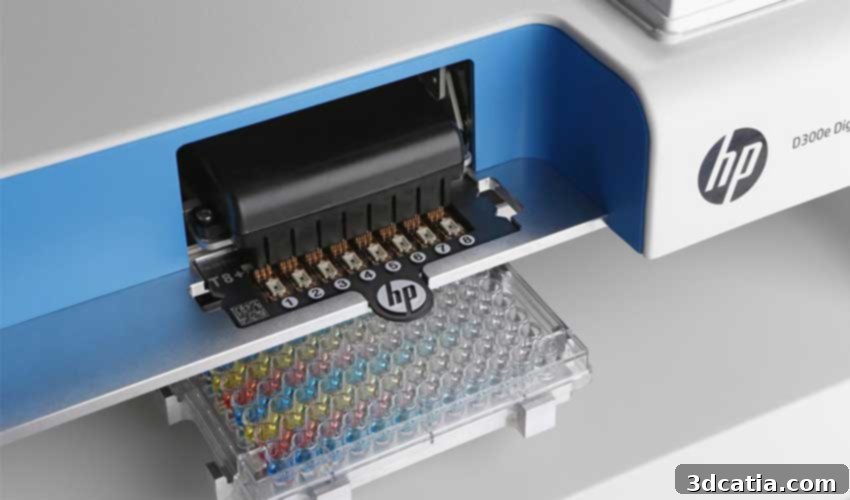
HP D300e Digital Dispenser BioPrinter. Via HP
Advancements in 3D Printed Pharmaceuticals: Setting the Stage for HP’s Entry
The concept of 3D printed drugs is not entirely new to the pharmaceutical landscape; it has been gaining traction for several years. A pivotal moment occurred with the approval of Spritam, the first FDA-approved drug created using additive manufacturing technology. Manufactured by Aprecia, Spritam offers a specialized treatment for epilepsy, notable for its porous structure that allows for rapid dissolution, an advantage for patients who struggle with swallowing pills. This breakthrough demonstrated the immense potential of 3D printing to create drugs with customized geometries, dosages, and release profiles tailored to individual patient needs. Following these initial developments, the field has seen further innovations, such as the concept of the “all-in-one drug” and personalized medicine. Projects like Multiply Labs, for instance, are exploring 3D printed personalized food supplements that can precisely control the release of vitamins and other nutrients at specific times within the body. These advancements underscore a broader shift towards precision medicine, where additive manufacturing technologies are instrumental in developing treatments that are highly effective and uniquely adapted to each patient’s physiological requirements. HP’s entry into this domain with its BioPrinter is a logical, albeit highly impactful, extension of this technological progression.
The HP BioPrinter D300e: A Digital Dispenser Revolutionizing Antibiotic Development
Infectious diseases caused by antibiotic-resistant organisms present enormous challenges, often requiring alternative treatments that can be harsh on a patient’s body and less effective. The collaboration between the HP BioPrinter and the CDC’s extensive research aims to revolutionize how we combat these resistant strains. By leveraging precise digital dispensing technology, the goal is to **print antibiotics in controlled conditions to effectively stop the spread of resistant bacteria**. This innovative approach allows researchers to rapidly test and optimize drug compounds against specific pathogens, accelerating the discovery of new, potent treatments.
Jean Patel, PH.D. D (ABMM), Science Team Leader for the Antibiotic Resistance Coordination Unit and Strategy at the CDC, succinctly articulates the urgency: “Bacteria continuously develop new ways to resist antibiotics—once a drug is approved for use, the countdown begins until resistance emerges.” She further emphasizes the strategic importance of this partnership: “To save lives and protect people, it is vital to make technology accessible to hospital labs nationwide. We hope this pilot will help ensure our newest drugs last longer and put gold-standard lab results in healthcare providers’ hands faster.” This statement highlights the dual benefits of the HP BioPrinter: extending the efficacy of existing drugs and rapidly bringing new solutions to the front lines of healthcare.
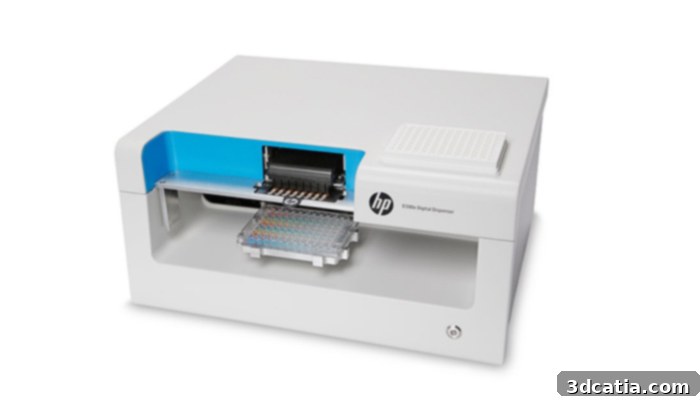
HP D300e Digital Dispenser BioPrinter. Via HP
The HP BioPrinter D300e, still in its testing phase, operates as a sophisticated digital dispenser rather than a traditional 3D bioprinter that builds macroscopic structures layer by layer. Its core function is performed similarly to a common inkjet printer, but with unparalleled precision. Researchers utilizing the D300e have managed to accurately analyze the behavior of antimicrobial bacteria and screen compounds at an unprecedented scale, facilitating the identification and optimization of the most effective bioprinted antibiotics. This device excels at **dispensing volumes ranging from picoliters to microliters of small molecules, critical for high-throughput drug discovery** and detailed research into microbiological structures. This level of precision is fundamental for creating libraries of compounds, conducting dose-response experiments, and understanding complex drug-pathogen interactions with exceptional accuracy and reproducibility, significantly accelerating the pace of pharmaceutical innovation.
Broader Applications and HP’s Future in Bioprinting
Although HP has not yet declared its intention to launch a full-fledged 3D bioprinter for tissue engineering or organ fabrication, the HP BioPrinter D300e has already found critical applications in various research fields. The CDC plans to integrate this advanced digital dispenser into its Antibiotic Resistance Laboratory Network (AR) across four regional areas in the United States. This strategic deployment will enhance the network’s capacity for rapid detection and characterization of resistant pathogens, enabling quicker responses to outbreaks and more effective treatment strategies. Beyond antibiotic resistance, the pharmaceutical company Gilead, based in California, is actively using the HP BioPrinter to develop and refine tests against the formidable Ebola virus, demonstrating the versatility and crucial utility of this technology in battling diverse infectious diseases. This collaborative use across leading research institutions underscores the BioPrinter’s immediate impact on public health and drug development.
The success and widespread adoption of the HP BioPrinter D300e raise intriguing questions about HP’s long-term strategy in the bioprinting sector. Given its historical trajectory of entering new additive manufacturing domains with significant investment and ambition, it is reasonable to speculate about the possibility of HP developing a more comprehensive 3D bioprinter in the future. Will we witness the unveiling of a full-fledged HP 3D bioprinter by 2019 or in the years to come? Such a move would undoubtedly transform the landscape of bioprinting, potentially impacting areas from regenerative medicine to personalized organ models for drug testing. HP’s current involvement, while focused on digital dispensing, positions them strategically to explore these advanced frontiers, solidifying their role as a key innovator in the intersection of digital manufacturing and biological sciences.
For more comprehensive information and a visual overview of this groundbreaking initiative, please do not miss the next video or visit the official website of HP.
What are your thoughts on the initiative of the HP BioPrinter and its potential impact on healthcare? Let us know in a comment below or on our Facebook and Twitter pages! And remember to sign up for our free weekly Newsletter, to get all the latest news in 3D printing sent straight to your inbox!