

Olaf Diegel: A Visionary Pioneer Shaping the Future of Additive Manufacturing Through Design
In our distinguished series, “The Faces of Additive Manufacturing,” we shine a spotlight on the true pioneers who have not only witnessed but actively shaped the landscape of today’s dynamic 3D printing industry. Following our insightful feature on Terry Wohlers, renowned globally for his indispensable annual reports on the sector, we are privileged to introduce you to Olaf Diegel. As a Professor of Additive Manufacturing at the prestigious University of Auckland, Professor Diegel’s journey in this revolutionary field began many years ago when he astutely recognized the immense, untapped potential of 3D printing. His vision encompassed its capacity for crafting incredibly complex parts, spanning diverse applications from bespoke musical instruments and critical medical prostheses to intricate jewelry. 3Dnatives recently had the distinct honor of meeting with Professor Diegel to delve deeper into his profound insights and forward-thinking perspective on the additive manufacturing sector’s evolution and future trajectory.
From Product Development to AM Pioneer: Professor Olaf Diegel’s Journey
“I am currently a Professor of Additive Manufacturing at the University of Auckland, nestled in the vibrant innovation ecosystem of New Zealand,” Professor Diegel begins, detailing his extensive background. “My primary area of expertise lies in the critical discipline of designing specifically for additive manufacturing – often referred to as DfAM. Prior to immersing myself fully in AM, I dedicated a significant portion of my career to product development. This involved both rigorous research into methodologies for bringing superior products to market more rapidly and practical application, where I actively assisted companies. My work spanned the entire product lifecycle, from identifying a core problem to be solved or a crucial market/user need, through meticulous engineering design, and ultimately to manufacturing and successful market launch. Over the course of my career, I’ve been instrumental in bringing well over 100 diverse products to market, encompassing sectors such as advanced theatre lighting, innovative home health monitoring solutions, specialized marine products, and even custom musical instruments.”
It was this deep involvement in product development that initially sparked Professor Diegel’s interest in what was then known as ‘rapid prototyping,’ now broadly recognized as additive manufacturing. “This was back in the mid-1990s,” he recalls. “At that time, I utilized AM strictly as a prototyping tool. Its value was in allowing me to thoroughly test and validate my designs, ensuring their functionality and viability before committing substantial financial investment to production tooling. However, as the underlying technologies matured and evolved dramatically over the subsequent years, my interest began to pivot. I became increasingly fascinated by, and involved in, exploring how AM could be leveraged not just for prototyping, but as a robust and efficient method for actual production.”
The more Professor Diegel delved into additive manufacturing, the more a critical realization crystallized: “Because AM technologies are inherently relatively slow and, in many cases, expensive compared to traditional manufacturing, it became clear that it was not commercially viable to produce AM parts that were not specifically optimized for these technologies. This profound insight catalyzed my focus on developing the best techniques for creating parts that could be printed faster and more cost-effectively. This led directly to pioneering methods for significantly reducing part weight, often through advanced techniques such as topology optimization and the strategic implementation of lattice structures, or by integrating enhanced functionality directly into the final product. The core idea was to maximize the inherent advantages of AM to create parts that were simply impossible or uneconomical to produce with conventional methods.”
A Current Project: Where Art Meets Advanced Manufacturing
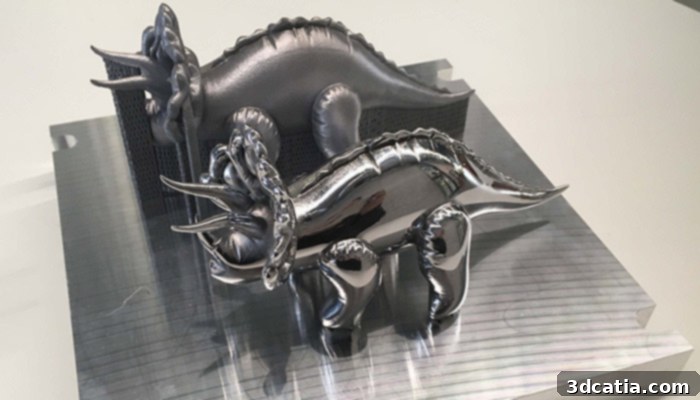
When asked about his current projects, Professor Diegel eagerly shares an intriguing collaboration. “Recently, our lab embarked on a fascinating project with a local artist named Gregor Kregar. Gregor is renowned for his monumental, large-scale art installations. For this particular endeavor, he expressed a keen interest in both exploring the transformative potential of AM for artistic creation and the possibility of producing smaller, yet equally impactful, artworks. Specifically, Gregor wanted to play with a compelling contrast: dinosaurs that *appeared* inflatable and incredibly light, yet possessed a surprising heft when lifted. To achieve this paradox, we 3D printed the dinosaurs as a shell, featuring a 2mm outer wall thickness. Crucially, we intentionally left all the entrapped, unmelted powder inside the structure, making them as heavy as possible to fulfill the artist’s unique vision.”
These « inflatable » triceratops were 3D printed in aluminium (AlSi10Mg) on an EOS M290 machine
“This particular project exemplifies one of the coolest aspects of working in our lab,” Professor Diegel enthuses. “We have the incredible opportunity to collaborate with a diverse spectrum of individuals, ranging from rigorous, hard-core engineers focused on technical specifications to visionary artists who arrive with the most unconventional and ‘crazy’ ideas. Often, it’s these artists who truly push the boundaries of the technologies furthest. Their creative freedom means they aren’t constrained by the established ‘knowledge’ of what engineers believe cannot be done. This forces us to critically re-evaluate our assumptions, think outside traditional paradigms, and ultimately figure out innovative ways to achieve what initially seems impossible.” This interdisciplinary approach, he suggests, is a powerful engine for innovation in additive manufacturing.
A Decade of Transformation: Additive Manufacturing’s Evolution
As a true pioneer in the AM industry, Professor Diegel offers a unique perspective on its past. “Looking back 10 years ago provides a remarkably good vantage point,” he explains, “because that timeframe roughly marks when some additive manufacturing technologies matured to a point where they could consistently produce full-strength parts suitable for real-world production applications. Prior to that pivotal moment, almost all AM technologies were predominantly suited for rapid prototyping functions. Unquestionably, during the 20 years preceding that decade, prototyping technologies had undergone dramatic improvements. They evolved from being purely cosmetic prototyping tools to sophisticated functional engineering prototyping technologies, which profoundly accelerated the speed and efficiency of product development cycles across industries.”
“Since that critical turning point, we have witnessed significant advancements almost every single year. These continuous innovations are steadily enhancing the suitability of AM for an ever-wider spectrum of production needs. As machine speeds continue to increase, and as surface qualities and material properties relentlessly improve, I firmly believe that we will see these technologies deployed in a much broader range of commercial applications. This expanded adoption will come from a greater number of companies, including many that might not even be considering AM today, due to current perceptions of cost or capability.”
The Crucial Shift: From Prototype to Production Mindset
Professor Diegel identifies the single most impactful change in the additive manufacturing industry. “I believe the most significant transformation occurred when a few pioneering companies made the courageous leap of realizing that the technologies had matured sufficiently to be used for producing actual end-use parts, not just prototypes. This decision necessitated a profound mental shift within these organizations – moving away from viewing 3D printing as merely a design aid to recognizing it as a legitimate manufacturing process. It also undoubtedly required a considerable amount of bravery to assume the risk of integrating 3D-printed components into a real, commercially viable product. So, while the underlying technology itself had been improving incrementally over many years, I firmly believe that this mental paradigm shift – the realization that AM could be reliably employed for production – was the true catalyst that propelled additive manufacturing into what it has become today: a transformative force in global manufacturing.”
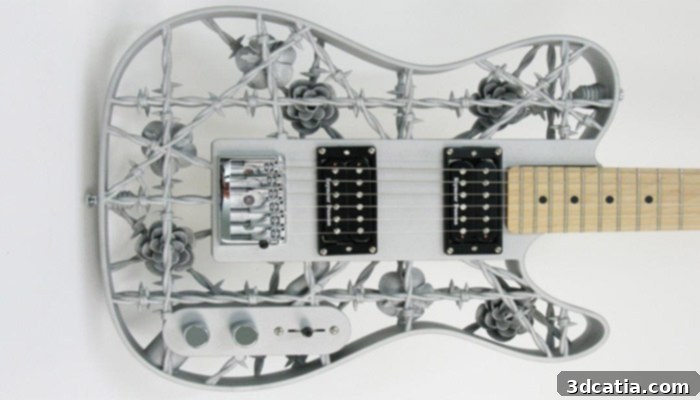
Passionate about music, Olaf worked on various 3D printed instruments, including guitars, drums or even a saxophone
Future Growth: Powder Bed Fusion and Multi-Material Innovations
Delving into the future of additive manufacturing, Professor Diegel offers specific insights into technologies and materials poised for significant growth. “From a production standpoint, the technologies utilizing material in powder form, specifically metal and polymer powder bed fusion, are undoubtedly the most suitable for robust, real-world production applications today. This suitability is largely attributed to their ability to produce parts with excellent mechanical properties, often exhibiting near-isotropy, making them reliable for demanding applications. In contrast, most current photopolymer-based technologies, which are cured by UV light, are susceptible to ambient UV exposure and consequently do not exhibit optimal long-term aging characteristics, though some notable exceptions are emerging.”
He continues, “The real game-changer for photopolymers will arrive once chemists successfully engineer these polymers to cure into truly permanent, stable plastics. Once that breakthrough occurs, these technologies could become incredibly interesting from a product development perspective. Their inherent advantage lies in their unparalleled ability to facilitate multi-material printing and to create functionally graded materials within a single part. This capability holds the promise of enabling an entirely new generation of products – designs that can harness the unique advantages of such advanced materials, creating functionalities and performance characteristics that are simply not achievable with today’s manufacturing paradigms or material limitations.”
Bridging the Knowledge Gap: The Critical Role of DfAM Education
Professor Diegel identifies the foremost challenge hindering the widespread global adoption of additive manufacturing. “Today, I firmly believe that the single biggest hurdle is the pervasive lack of knowledge among the majority of designers and engineers regarding how to properly design for AM (DfAM). It’s a common scenario: companies approach our lab with a part that was originally conceived and designed for traditional manufacturing methods like machining or injection molding, and they simply ask if we can 3D print it for them. Our answer is invariably ‘yes, we can,’ but then they often experience a ‘mild heart attack,’ as I like to put it, when we quote them the price. The reality is that all AM technologies, at their current stage, are relatively slow processes, making the resulting parts quite expensive. This limits their immediate economic viability to only the very highest-value products or niche applications.”
“However,” he emphasizes, “with a robust and intelligent application of Design for Additive Manufacturing principles, these costs can be reduced substantially – often by as much as 80% or even 90% compared to printing a part not optimized for AM. Simultaneously, DfAM dramatically improves the functionality of the part. For instance, a well-designed AM part can be 70% lighter than its conventionally manufactured counterpart, or it can consolidate multiple components into a single, integrated design, reducing assembly complexity and potential points of failure.”
“Certainly, as AM technologies continue to advance in speed and efficiency, adoption rates will naturally increase at an accelerating pace. But implementing excellent DfAM practices actively lowers that barrier to adoption much more quickly and significantly. It makes AM economically viable for a far broader range of applications right now.”
He notes a positive trend: “It is genuinely encouraging to observe that, particularly over the last two years, we have seen a growing proliferation of dedicated DfAM courses. These initiatives are crucial in beginning to remedy this critical educational gap. However, what we are not quite seeing yet – or not at the desired pace – is the systematic integration of DfAM principles into university curricula’s general manufacturing courses. The goal should be that graduates emerge from university with an inherent understanding of how to design effectively for AM, or at the very least, a fundamental awareness that designing for additive manufacturing requires a distinctly different approach compared to traditional manufacturing technologies. It is beginning to happen, but frankly, a bit more slowly than I would ideally like to see.”
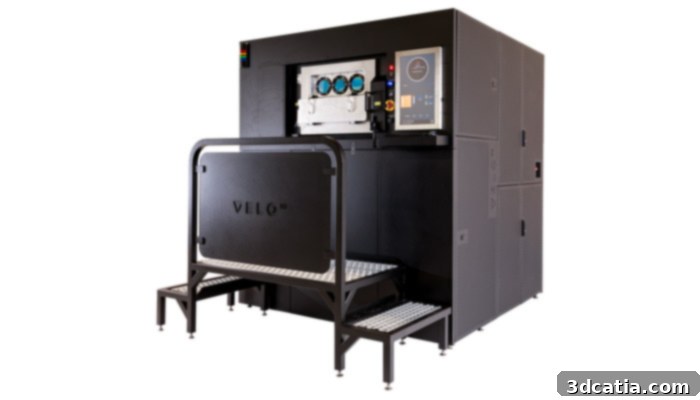
Velo3D’s machine to be able to print metal parts that are free-floating manufacturing
Exciting Innovations: Velo3D and EOS LaserProFusion
Recent Innovations Catching the Eye of an AM Expert
When asked about recent exciting developments, Professor Diegel shares, “Over the past year, two specific technologies have particularly captured my attention and generated significant excitement. The first is the immense potential demonstrated by Velo3D’s groundbreaking machines. Their capability to print complex metal parts that are essentially ‘free-floating’ within the metal powder bed, requiring no support material whatsoever – or only minimal support structures at extremely low angles – is a revolutionary leap. This dramatically expands design freedom and reduces post-processing. The second innovation that stands out is EOS’s innovative LaserProFusion technology. This system utilizes an array comprising a million laser diodes to melt polymer powder, holding the promise of profoundly increasing the speed and throughput of polymer 3D printers. This could be a game-changer for high-volume polymer additive manufacturing.”
He concludes with a word of caution, however. “As always, in an industry often characterized by marketing hype, we must exercise prudence. The ultimate proof, as the saying goes, will be in the pudding. We will truly see the impact and validate the claims once these exciting new technologies are rigorously tested by real users in real-world applications, producing real parts under demanding conditions.”
*Credits Cover Image: Dean Carruthers/University of Auckland
What are your thoughts on Professor Olaf Diegel’s forward-thinking vision for the additive manufacturing market? We invite you to share your insights and comments below, or join the conversation on our official Facebook and Twitter pages! Don’t miss out on the latest advancements and news in the world of 3D printing; sign up for our free weekly Newsletter to have all the essential updates delivered directly to your inbox!