
Top 5 Revolutionary 3D Printing Videos: Discover Weekly Innovations in Additive Manufacturing
Welcome to our weekly roundup of the most groundbreaking and inspiring videos from the world of 3D printing. Additive manufacturing continues to evolve at an incredible pace, not just shaping industries but fundamentally changing how we design, produce, and innovate across various sectors. Each week, we scour the internet to bring you the most compelling content that highlights significant technological advancements, practical applications, and the transformative potential of 3D printing. This curated selection of the TOP 5 VIDEOS of the week offers a concise yet impactful glimpse into how additive manufacturing is continuously redefining the boundaries of what’s possible. From revolutionizing electronics to enhancing consumer products and critical industrial components, these videos are sure to inspire and inform. If you find these insights valuable and wish to explore more cutting-edge developments, you can discover even more captivating 3D printing videos on our Youtube channel. We hope you enjoy this showcase of innovation and have a fantastic Sunday!
Top 1: Nano Dimension and 3D Printing of Electronic Circuits
A few years ago, Nano Dimension emerged with an ambitious vision: to fundamentally revolutionize the electronic circuit manufacturing sector. Their innovative approach involved creating functional electronic circuits directly on a 3D printer, a concept that led to the development of their pioneering DragonFly 2020 system. This state-of-the-art machine is engineered with the capability to precisely deposit micro-droplets of both conductive metallic inks and insulating dielectric plastics. This unique multi-material deposition process allows for the direct fabrication of complex, multi-layered electronic circuits, significantly streamlining the prototyping and production cycles for Printed Circuit Boards (PCBs). While the DragonFly 2020 excels at printing the foundational conductive traces and insulating layers, discrete electronic components such as LEDs, transistors, resistors, and capacitors are subsequently added to the printed circuit board after the additive manufacturing process is complete. This hybrid approach marries the agility of 3D printing with the reliability of conventional component integration. In the captivating video below, Nano Dimension impressively demonstrates how they successfully managed to create a fully functional electronic circuit board featuring nine integrated LEDs in under 24 hours. This achievement underscores the incredible speed, efficiency, and design flexibility that direct 3D printing of electronics brings to the table, paving the way for faster innovation in fields like IoT, medical devices, and custom electronics.
Top 2: Formlabs Unveils Two New Printers: Form 3 and Form 3L Featuring LFS Technology
Formlabs, an undisputed leader in the desktop stereolithography (SLA) 3D printing market, continues its impressive trajectory, building on the success of its widely acclaimed Form 2 3D printer, which has sold over 50,000 units globally. At prominent industry events like the Hannover Messe and AMUG 2019, the American manufacturer seized the opportunity to unveil its highly anticipated next-generation machines: the Form 3 and Form 3L. These new printers introduce a revolutionary new printing process known as Low Force Stereolithography (LFS). LFS technology represents a significant leap forward from traditional SLA, employing a flexible tank and a re-engineered light processing unit (LPU) to dramatically reduce the peel forces during the printing process. This innovation translates into several key advantages: a consistently smooth surface finish, improved print accuracy, and significantly enhanced print reliability, especially for intricate and delicate geometries. The Form 3 is designed as a powerful successor for desktop applications, offering professional-grade results in a compact footprint. The Form 3L, on the other hand, extends these capabilities to a much larger build volume, enabling the production of bigger parts or multiple parts in a single batch, making it ideal for demanding industrial and prototyping applications. This expanded capacity and improved print quality make the Form 3L particularly appealing for industries requiring high-fidelity models, such as dental labs, engineering firms, and product design studios. Discover the transformative power of LFS technology and these cutting-edge printers in the following detailed video presentation:
Top 3: Ecco and Dassault Systèmes Partner to Offer Custom 3D Printed Insoles
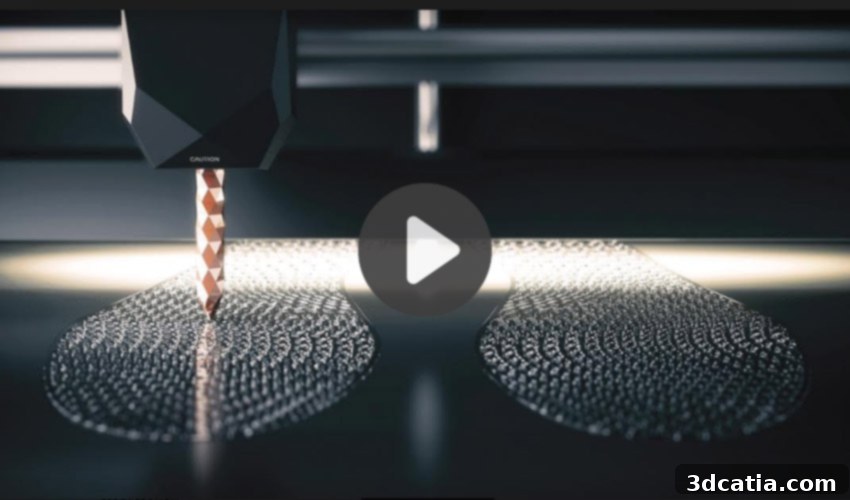
The renowned footwear manufacturer ECCO has recently unveiled a groundbreaking concept set to redefine personalized comfort: 3D printed soles that are entirely customized to the unique biomechanics of each individual’s foot. This revolutionary system goes beyond simple shoe sizing; it incorporates sophisticated analysis of your gait, foot morphology, pressure points, and other crucial biometric data. By partnering with Dassault Systèmes, a global leader in 3D design software, ECCO is harnessing advanced digital manufacturing capabilities to create truly bespoke footwear experiences. This collaboration has the potential to profoundly revolutionize the footwear sector, and more specifically, the insole market. Traditional insoles often offer a generic fit, which can lead to discomfort, improper support, and even contribute to foot-related issues over time. ECCO’s innovative approach promises to deliver a product that is not only unique but also consistently provides unparalleled comfort, support, and performance tailored precisely to every customer’s needs. The process leverages detailed data acquisition to generate a digital model of the ideal insole, which is then precisely fabricated using additive manufacturing techniques. This level of personalization ensures optimal foot alignment, cushioning, and stability, addressing individual requirements that standard off-the-shelf products simply cannot. This synergy between anatomical data, advanced software, and 3D printing technology marks a significant step towards the future of personalized consumer products, highlighting how additive manufacturing can deliver truly unique and comfortable solutions for every customer.
Top 4: 3D Printing for Production of Spare Parts for Aircraft
The aerospace industry, particularly the maintenance, repair, and overhaul (MRO) sector, faces unique challenges in sourcing and producing spare parts for aging aircraft fleets. The University of Dayton Research Institute (UDRI) is at the forefront of addressing these critical needs, now actively collaborating with America Makes, 3D Systems, and the US Air Force to seamlessly integrate additive manufacturing into the production pipeline for spare parts. This strategic initiative aims to efficiently replace damaged or obsolete components on older aircraft, ensuring continued operational readiness and extending the lifespan of vital assets. The traditional supply chain for aerospace spare parts can be slow, costly, and complex, often involving long lead times for specialized components or the outright unavailability of parts for legacy aircraft. 3D printing offers a compelling solution to these challenges by enabling on-demand production, reducing reliance on extensive physical inventories, and facilitating rapid prototyping and iteration. The project teams utilize advanced tools like the HandScan scanner to accurately capture the precise geometry of the damaged or required part. This digital scan is then processed and meticulously modeled on robust CAD software, such as SolidWorks, to refine the design and prepare it for additive manufacturing. Finally, the part is 3D printed on a high-precision 3D Systems machine, leveraging its capabilities for creating complex, high-strength components. Beyond merely replacing parts, 3D printing makes it possible to better control inventory levels, offer parts that are often lighter and more durable due to optimized designs, and significantly reduce overall production costs. This approach not only enhances operational efficiency but also provides a more sustainable and resilient solution for aerospace maintenance. The video below showcases this innovative process in action, demonstrating the tangible benefits of additive manufacturing in a mission-critical industry.
Top 5: Unique 3D Printed Trophy for the voestalpine European Races
Celebrating excellence with a symbol of cutting-edge innovation, the trophy for the prestigious voestalpine European Races was meticulously designed and produced using advanced metal 3D printing technology. voestalpine, a global technology and capital goods group, stands as one of the pioneering leaders in this sophisticated manufacturing process, which involves melting fine metal powder layer by layer to create highly complex and robust components. This technique, often referred to as selective laser melting or laser powder bed fusion, allows for unprecedented design freedom, enabling the creation of intricate geometries and internal structures that are impossible to achieve with conventional manufacturing methods. The metal powder utilized for the trophy’s production was sourced directly from voestalpine’s specialized Kapfenberg location, highlighting the company’s integrated expertise in both advanced materials and additive manufacturing. The actual 3D printing of the elegant trophy took place at the Group’s state-of-the-art in-house Competency Center in Düsseldorf, a facility dedicated to pushing the boundaries of additive manufacturing applications. This center serves as a hub for research, development, and industrial production, leveraging voestalpine’s deep understanding of metallurgy to create high-performance metal components. The use of metal 3D printing for such a prominent award not only showcases the aesthetic possibilities of the technology but also its capability to produce strong, lightweight, and uniquely designed items for various industrial sectors. It underscores voestalpine’s commitment to innovation and its leadership in embracing new production paradigms. Find out more about the creation of this distinctive award and the technology behind it in the video below:
We hope this week’s selection of TOP 5 VIDEOS has provided you with valuable insights into the dynamic world of 3D printing and additive manufacturing. From enhancing electronic functionality and revolutionizing desktop manufacturing to personalizing consumer products and optimizing critical industrial processes, the innovations showcased are truly remarkable. We’re eager to hear your thoughts on these groundbreaking advancements and how you envision their impact on various industries. Drop a comment below to share your perspective or engage with us on our vibrant Facebook and Twitter pages! Don’t miss out on any future developments in this rapidly evolving field. And, for an even deeper dive into the latest news, trends, and breakthroughs in the 3D printing industry, don’t forget to sign up for our free weekly Newsletter to receive all the crucial updates straight to your inbox!