
The Evolving Landscape: A Comprehensive Look at Additive Manufacturing Adoption Across Global Industries
The integration of cutting-edge technologies into traditional manufacturing processes is a defining characteristic of modern industry. Among these, additive manufacturing (AM), commonly known as 3D printing, stands out as a transformative force. While the significant benefits of AM – including unprecedented design freedom, rapid prototyping, reduced material waste, and the ability to produce complex, customized parts – have become widely acknowledged, many businesses remain cautious. They grapple with the uncertainty of timing, the substantial investment required, and the precise ways in which this technology can deliver tangible returns within their specific sectors. Understanding this dynamic, AMFG, a London-based pioneer in workflow automation software for businesses keen on integrating 3D printing into their broader operations, recently published an insightful report detailing the current state of additive manufacturing adoption across diverse industries. This report provides a crucial benchmark for companies assessing their own readiness and potential for leveraging this powerful technology.
The report sheds light on varying levels of enthusiasm and implementation, illustrating which industries are leading the charge and which are still navigating the initial phases of adoption. AMFG defines a “mature” sector as one where “the technology is proven, well-understood, and established as a manufacturing method across many industry sectors. The key standards have been developed, enabling repeatable quality at scale.” Based on this definition, AMFG identifies the aerospace and medical sectors as the most advanced in their embrace of additive manufacturing technologies. While neither sector has fully reached this ultimate stage of maturity, they are undeniably the closest, demonstrating a robust understanding and extensive application of 3D printing across numerous use cases. Their journey provides valuable lessons and insights for other industries contemplating deeper dives into AM.
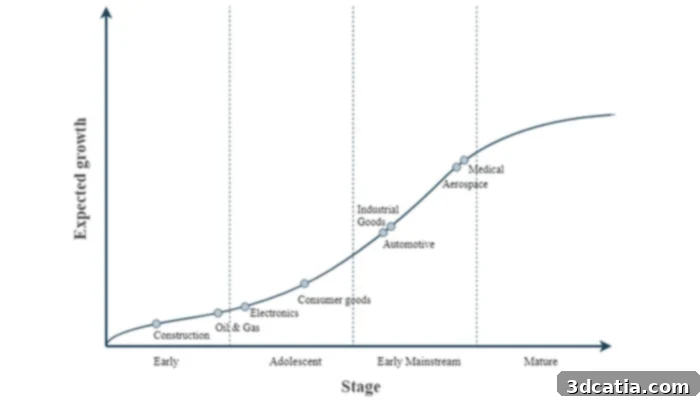
The maturity chart illustrating the adoption rates of 3D printing across different industries | Image Credits: AMFG
The aerospace industry’s early and enthusiastic adoption of 3D printing is a logical development given its unique requirements. This sector constantly seeks ways to reduce weight, optimize performance, and consolidate complex assemblies into fewer, more intricate parts – all areas where additive manufacturing excels. Aerospace companies have recognized an undeniable advantage in investing in 3D printing, not just for rapid prototyping and creating custom tooling, but increasingly for producing critical end-use components. The ability to manufacture lightweight, structurally optimized parts with complex internal geometries directly impacts fuel efficiency, payload capacity, and overall aircraft performance. Furthermore, AM enhances supply chain resilience by enabling on-demand production of spare parts, reducing reliance on extensive inventories and lengthy lead times for specialized components. The Gartner Hype Cycle, a respected barometer for emerging technologies, predicted at the beginning of this year that the aerospace and defense sector would reach its “plateau of productivity” in 5 to 10 years, signifying mainstream acceptance and significant impact. AMFG’s report corroborates this outlook, stating, “When looking at the projected growth of 3D printing in aerospace, market reports predict a CAGR between 17.5% and 20.24% over the next five years. These figures suggest that the use of the technology will continue to proliferate, as aerospace companies are finding new use cases and deepening their expertise in 3D printing.” This sustained growth underscores the strategic importance and deepening integration of AM within the aerospace ecosystem, from engine manufacturers to spacecraft developers.
Additive manufacturing applications in the medical sector are also experiencing a significant boom, driven by the profound need for customization, precision, and rapid innovation in patient care. One of the most groundbreaking developments this year was the creation of a small bioprinted human heart using a patient’s own cells, an extraordinary achievement by a team of researchers from Tel Aviv University. This breakthrough highlights the immense potential of bioprinting for regenerative medicine, drug discovery, and organ transplantation, moving beyond theoretical possibilities into tangible, life-changing applications. Beyond bioprinting, the medical sector presents a vast and rapidly expanding market for custom medical devices. This includes patient-specific implants (such as cranial, dental, or orthopedic components), customized orthoses for support and correction, and highly personalized prostheses that offer improved fit, comfort, and functionality compared to their mass-produced counterparts. Furthermore, 3D printing is indispensable for creating presurgical models, allowing surgeons to practice complex procedures on anatomically accurate replicas, thereby reducing risks and improving patient outcomes. SmarTech reports that the market for medical devices produced via AM, currently valued at an estimated $1.25 billion, is projected to surge to $6.08 billion by 2027. This phenomenal growth is primarily fueled by the unparalleled ability of AM to deliver personalization, a feature that is absolutely critical for this segment of the industry. Applications that leverage this capability to create patient-specific solutions are poised for exponential growth, revolutionizing healthcare delivery and improving quality of life for countless individuals.
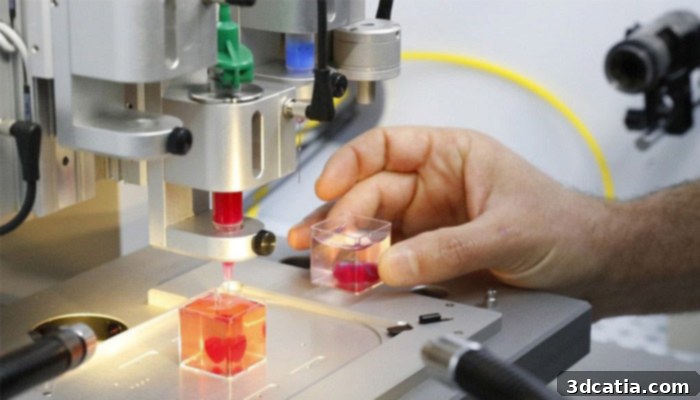
Researchers in Tel Aviv were the first to successfully engineer and print an entire heart replete with cells, blood vessels, ventricles and chambers
Transitioning from the pioneers, AMFG identifies Industrial Goods and Automotive as two other significant sectors that have recently entered the “early mainstream” stage of additive manufacturing adoption. The automotive industry, in particular, has been actively working towards the industrialization of 3D printing within its production workflows. Historically, AM adoption in automotive was predominantly observed in niche applications, such as for luxury vehicles, high-performance racing cars, or specialized prototyping. However, this trend is rapidly shifting. Automotive manufacturers are increasingly recognizing the broader potential of 3D printing for rapid iteration of design concepts, production of functional prototypes, and creation of complex jigs, fixtures, and tooling. Beyond these applications, the industry is now exploring the direct manufacturing of end-use parts, especially for low-volume production runs, custom vehicle components, and critical parts for electric vehicles where lightweighting and thermal management are paramount. The benefits extend to optimizing supply chains, enabling localized production, and rapidly responding to market demands with agile manufacturing capabilities. Similarly, the Industrial Goods sector, encompassing a wide array of products from heavy machinery components to consumer appliances, is realizing the advantages of AM. This includes the ability to produce highly customized parts, reduce lead times for spare parts, and create intricate geometries that improve product performance and consolidate multiple components into a single, more efficient print.
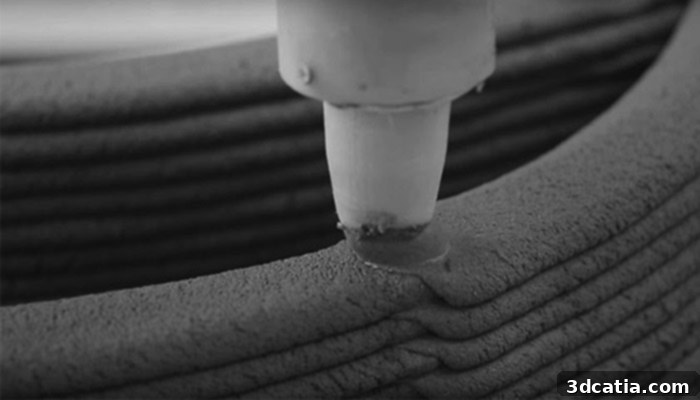
At the earlier end of the adoption spectrum, AMFG places sectors such as Electronics, Construction, and Oil & Gas. These industries, while showcasing immense long-term potential for additive manufacturing, are currently primarily leveraging the technology for prototyping purposes. This initial focus on prototyping allows them to explore design possibilities, test concepts, and validate applications without the significant commitment required for full-scale production. For example, despite numerous intriguing developments and reports on 3D printing in the construction sector, it remains an early-stage adopter of AM. While stories of 3D-printed houses and infrastructure capture headlines, the commercial reality is still nascent. AMFG highlights this distinction in its report, stating, “The vast majority of the construction projects realized in the last few years has been for demonstration purposes only. The value of these projects comprises a few hundred million dollars, a drop in the ocean when compared to the construction industry’s annual revenue of $10 trillion globally.” This emphasizes that while the proof of concept is strong, significant research and development are still required to overcome challenges related to material scalability, regulatory compliance, process standardization, and large-scale cost-effectiveness. The future for AM in construction promises rapid, customized, and sustainable building methods, but bridging the gap from demonstration to widespread industrial application demands continuous innovation and investment in R&D.
The Oil & Gas sector also stands on the cusp of being significantly reshaped by the emergence of 3D printing. Major players like BP have recognized this transformative potential, listing additive manufacturing as one of six key technologies poised to impact the energy sector within the next few years. The unique operational demands of Oil & Gas – which often involve remote locations, extreme temperatures, high pressures, and corrosive environments – make it an ideal candidate for AM’s benefits. Key advantages for this sector include improved product performance through optimized designs (e.g., better flow efficiency in pipelines and valves), significantly reduced costs by enabling on-demand production of highly specialized spare parts, and shorter lead times for critical components that might otherwise take months to source. Furthermore, AM fosters a more flexible and distributed supply chain, allowing parts to be manufactured closer to the point of need, thereby minimizing logistical complexities and downtime. However, the path to widespread adoption is not without its hurdles. The primary challenges in the Oil & Gas sector mostly revolve around a lack of comprehensive research and extensive experience with AM-produced components in these harsh operating conditions. Rigorous testing, material certification for extreme environments, and process validation are crucial to building confidence and ensuring the reliability and safety of 3D-printed parts in such demanding applications. As these challenges are addressed through collaborative research and pilot projects, the oil and gas industry is expected to progressively integrate additive manufacturing, unlocking new efficiencies and operational resilience.
The journey of additive manufacturing across various industries is one of continuous evolution, marked by groundbreaking advancements in some sectors and steady, foundational progress in others. From the sophisticated needs of aerospace and medical industries driving rapid innovation, to the nascent but promising explorations in construction and oil & gas, 3D printing is steadily redefining manufacturing paradigms. The insights provided by reports like AMFG’s are invaluable for stakeholders navigating this dynamic landscape, offering a clear perspective on current maturity levels and future trajectories. As the technology continues to mature and overcome existing challenges, its impact will only deepen, ushering in an era of greater efficiency, customization, and sustainable production across the global economy.
For those interested in delving deeper into the specifics of industry adoption and the detailed analysis, the full report can be accessed on AMFG’s website HERE.
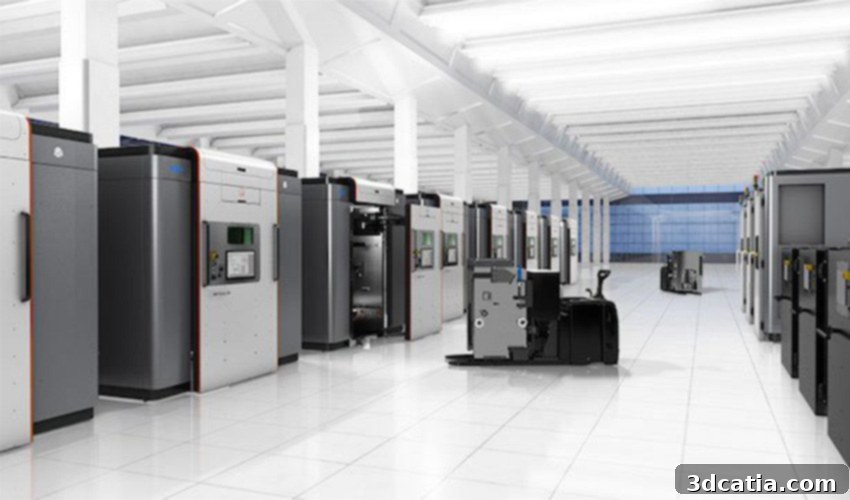
*Cover Image Credits: 3D Systems
What are your thoughts on the current adoption rates and future potential of 3D printing across these and other sectors? Share your insights and opinions in a comment below or join the conversation on our Facebook and Twitter pages! Don’t miss out on the latest news and innovations in additive manufacturing; sign up for our free weekly Newsletter, delivered straight to your inbox!