
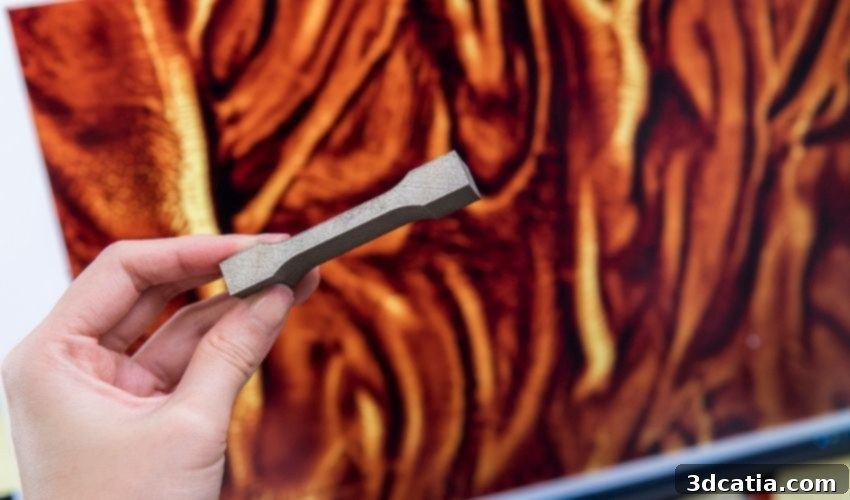
Revolutionizing Material Science: CityU Scientists Pioneer Stronger, Lighter Titanium Alloys with Additive Manufacturing
In a groundbreaking advancement that promises to redefine material engineering, scientists from the City University of Hong Kong (CityU) have achieved a significant breakthrough in the design and production of advanced titanium alloys. Utilizing the transformative capabilities of additive manufacturing (AM), also widely known as 3D printing, the research team successfully engineered an alloy possessing unparalleled mechanical qualities, marking a pivotal moment for industries relying on high-performance materials. This pioneering work challenges conventional metallurgical wisdom and opens new avenues for material design through sophisticated manufacturing techniques.
The genesis of this remarkable project stemmed from intricate computational modeling. For decades, the prevailing scientific understanding in metallurgy suggested that achieving increased uniformity in alloy components was paramount. This uniformity was believed to be essential in mitigating brittleness and ensuring structural integrity. However, the CityU research proposed a radical departure from this dogma. Their models indicated that, contrary to popular belief, a carefully controlled degree of heterogeneity—or diversity—within the alloy’s microstructure could actually lead to the creation of unique structural formations that significantly enhance the material’s inherent properties. This theoretical insight paved the way for experimental validation, leveraging the precision and versatility of additive manufacturing.
Building upon this bold hypothesis, the scientists embarked on an ambitious experimental phase. They employed laser powder bed fusion (L-PBF), a highly precise additive manufacturing technique, using a carefully selected combination of stainless steel and titanium alloy powders. The objective was to intentionally introduce and control heterogeneity at a microscopic level. The outcome was nothing short of revolutionary: an alloy that exhibited both superior strength and a remarkably lighter weight compared to traditional materials, setting a new benchmark for advanced metallic materials.
The Visionaries Behind the Breakthrough: Professor Lieu and Dr. Zhang
The formidable research team driving this innovation was spearheaded by Professor Chain-Tsuan Lieu, a distinguished academic at CityU’s Hong Kong Institute for Advanced Study (HKIAS). Their seminal findings were meticulously documented and subsequently published in the prestigious journal *Science*, under the compelling title, “In situ design of advanced titanium alloy with concentration modulations by additive manufacturing.” This publication meticulously outlined their experimental methodology, observations, and the profound implications of their work for the broader field of material science.
A core tenet of their research was to push the boundaries of additive manufacturing beyond its well-established role in creating geometrically complex parts. While AM is celebrated for its ability to produce intricate designs that are impossible or cost-prohibitive with conventional methods, Professor Lieu’s team explored its potential as a tool for fundamental material design. Instead of merely using existing materials to print parts, they investigated how AM could be precisely controlled to sculpt the very properties of materials at a microstructural level, thereby designing materials with inherently superior characteristics. This shift in perspective from “manufacturing parts” to “designing materials” represents a paradigm shift in how we approach advanced material development.
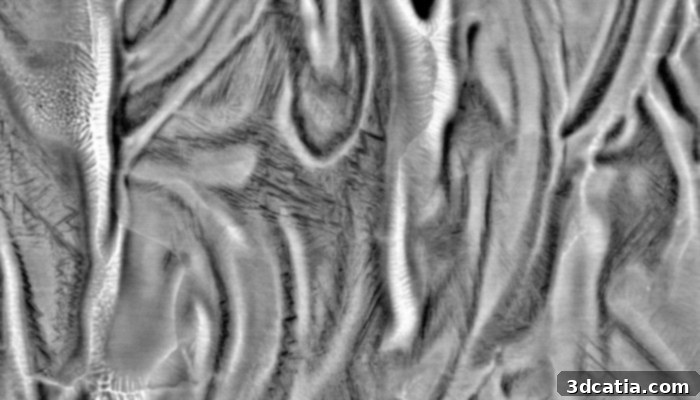
The Lava-like microstructure in the 3D-printed titanium alloy (Photo Credits: Credit: Dr Zhang Tianlong /DOI number: 10.1126/science.abj3770)
Dr. Tianlong Zhang, a postdoctoral researcher in the Department of Materials Science and Engineering (MSE) at CityU and a key author of the paper, eloquently articulated the unique advantage offered by additive manufacturing in this context. “The unique features of additive manufacturing provide us with a greater freedom in designing microstructures,” Dr. Zhang explained. “Specifically, we have developed a partial homogenisation method to produce alloys with micrometer-scale concentration gradients with the aid of 3D printing, which is unachievable by any conventional methods of material manufacturing.” This statement underscores the novelty and significance of their approach, highlighting how AM enables the creation of material architectures previously thought impossible.
The Methodology: Crafting Heterogeneity with Precision
The innovative process developed by the CityU team involved a sophisticated application of laser powder bed fusion (L-PBF). At its core, L-PBF involves using a high-powered laser to selectively melt and fuse metallic powders layer by layer, building a 3D object from a digital design. In this particular study, the team went beyond conventional L-PBF applications by melting and intricately mixing two distinct types of alloy powders: titanium alloy powders and stainless steel powders.
More specifically, the researchers utilized Ti-6Al-4V, which is one of the most widely used titanium alloys, renowned for its excellent strength-to-weight ratio and corrosion resistance, making it a staple in aerospace and biomedical applications. To this base, they incorporated a small, yet precisely controlled, amount of 316L stainless steel powder. The strategic introduction of 316L, known for its good ductility and corrosion resistance, was key to their “partial homogenisation method.” By carefully manipulating the laser parameters during the L-PBF process, the team was able to produce micrometer-scale concentration modulations of the stainless steel elements within the titanium alloy matrix. This meant that instead of a perfectly uniform mixture, they created tiny, deliberate gradients of material composition throughout the structure.
This meticulously controlled heterogeneity had a profound impact on the material’s properties. The introduction of these concentration gradients led to a significant microstructural transformation. The resulting alloy exhibited a remarkable combination of characteristics: a higher tensile strength, which is the material’s resistance to breaking under tension, coupled with uniform elongation, indicating that the material stretches evenly before failure. Furthermore, it demonstrated an excellent work-hardening capacity, meaning it becomes stronger and more resistant to deformation as it is plastically deformed. These attributes are highly desirable for applications requiring both robustness and durability under stress.
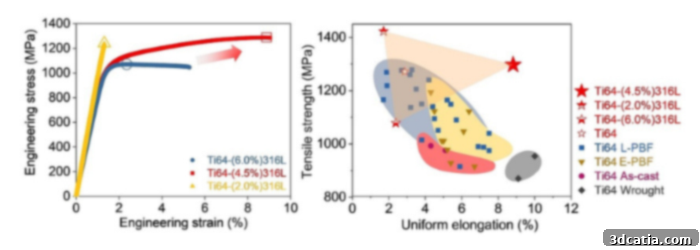
The results showed that the resulting alloy had superior mechanical properties (photo credits: Dr Zhang Tianlong /DOI number: 10.1126/science.abj3770)
Unprecedented Control and Superior Performance
The ability to precisely control the distribution of elements was paramount to the success of this research. The CityU team achieved this by meticulously adjusting critical printing parameters, such as laser power and scanning speed, during the L-PBF process. This fine-tuning allowed them to intentionally create the desired non-uniform composition of elements in a highly controllable and repeatable manner. Unlike traditional alloying methods where achieving such fine-scale, controlled heterogeneity is virtually impossible, additive manufacturing provided the necessary spatial resolution and process control.
The mechanical properties of the newly developed alloy are truly exceptional and represent a significant leap forward in material science. The material is not only significantly stronger but also remarkably lighter. Specifically, the innovative titanium alloy is approximately 40% lighter than traditional stainless steel while still exhibiting incredible strength and resilience. This combination of high strength and low density is a holy grail for numerous advanced engineering applications, particularly in sectors where weight reduction directly translates to performance improvements, cost savings, and enhanced energy efficiency.
Imagine the impact of such a material: aircraft components that are both lighter and more durable, leading to reduced fuel consumption and extended service life; biomedical implants that integrate better with the human body due to optimized mechanical properties and biocompatibility; and high-performance automotive parts that contribute to faster, more fuel-efficient vehicles. The implications are vast and potentially transformative across a multitude of industries.
Beyond the Lab: Real-World Implications and Future Outlook
The CityU team’s breakthrough is more than just a scientific curiosity; it represents a tangible step towards a future where materials are not just selected but custom-designed for specific, demanding applications. The ability to precisely tailor microstructure through controlled heterogeneity offers a powerful new paradigm for materials discovery and engineering. This research challenges us to rethink fundamental principles of alloy design and unlocks the full potential of additive manufacturing as a material development tool.
While the initial results are highly promising, the journey does not end here. Future research will likely focus on scaling up the production process, exploring the applicability of this “partial homogenisation method” to other alloy systems, and conducting extensive long-term performance and fatigue testing under various real-world conditions. The continuous development of advanced alloys like this one is crucial for addressing the ever-increasing demands for high-performance, lightweight, and sustainable materials in the modern world.
For those interested in delving deeper into the intricate details of this pioneering study, access to the full research paper can be obtained HERE. Additionally, a comprehensive press release from CityU provides further insights and context, available HERE.
What are your thoughts on this remarkable advancement in titanium alloy design? Share your insights and perspectives in the comments section below, or connect with us on our social media platforms. You can find us on LinkedIn, Facebook, and Twitter. Don’t miss out on the latest advancements in 3D printing and material science; sign up for our free weekly Newsletter here to receive top stories straight to your inbox! For more visual content, explore all our videos on our YouTube channel.
*Cover Photo Credits: City University of Hong Kong