
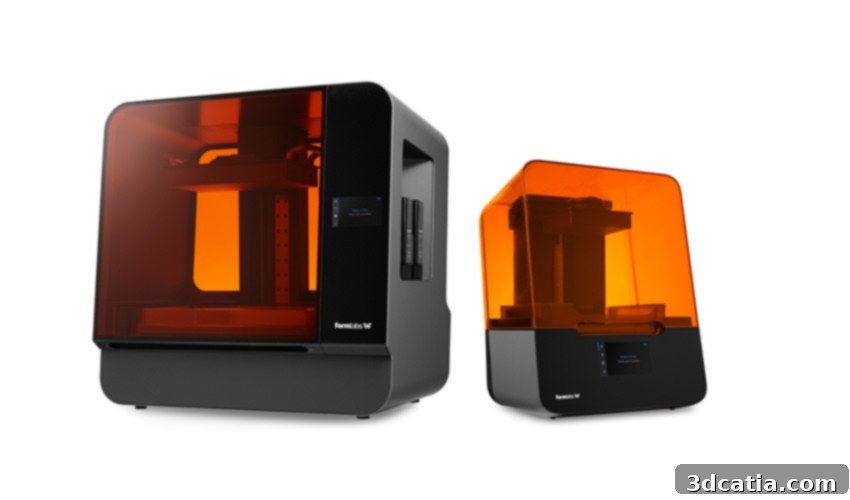
Formlabs Unveils Form 3 and Form 3L: Revolutionizing Professional SLA 3D Printing with Advanced LFS Technology
Formlabs, an American manufacturing pioneer, has firmly established itself as the undisputed market leader in desktop Stereolithography (SLA) 3D printing. With over 50,000 units of its highly acclaimed Form 2 3D printer sold worldwide, the company has consistently pushed the boundaries of accessible, high-quality additive manufacturing. At the prestigious Hannover Messe event, Formlabs once again demonstrated its innovative prowess by unveiling its latest generation of machines: the formidable Form 3 and its large-format counterpart, the Form 3L. These new printers are powered by a groundbreaking, proprietary printing process known as Low Force Stereolithography (LFS), signaling a significant leap forward for the entire industry.
The Dawn of Low Force Stereolithography (LFS): A New Paradigm in Resin 3D Printing
At the core of Formlabs’ latest offerings lies the revolutionary Low Force Stereolithography (LFS) process. This innovative technology represents a complete re-imagining of resin 3D printing, engineered to deliver unparalleled precision, reliability, and part quality. According to Formlabs, the LFS process employs a meticulously designed custom laser and mirror system to accurately polymerize liquid photosensitive resin, transforming it into isotropic solid parts with exceptional detail and consistency. Unlike traditional SLA methods that often rely on pulling parts off a rigid build platform, LFS minimizes the forces exerted on the printed part during the curing process, leading to a host of significant benefits for users.
Max Lobovsky, CEO and co-founder of Formlabs, encapsulated the company’s vision, stating, “We have completely rethought our approach to resin 3D printing with the LFS (Low Force Stereolithography) printing process on which the Form 3 and Form 3L printers are based.” This sentiment underscores the depth of innovation behind LFS, which aims to overcome common challenges in resin printing, such as support structure removal and surface finish, ultimately enhancing the user experience and expanding the possibilities of desktop SLA technology.
Enhanced Features and Unrivaled Reliability: The Form 3 Advantage
The Form 3, building upon the legacy of its predecessor, introduces a suite of advanced features meticulously designed to optimize the 3D printing workflow from start to finish. One of the most immediately noticeable improvements is the promise of easier post-treatment and significantly smoother parts. This is largely attributed to the LFS process’s ability to generate lightweight and easily detachable support structures, minimizing the need for extensive manual finishing and reducing post-processing time. For professionals in fields like product design, engineering, and jewelry, this translates directly into greater efficiency and higher quality end-use parts.
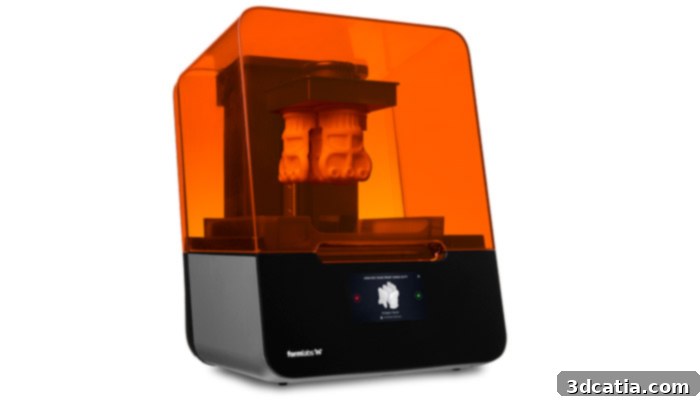
The Form 3 showcases Formlabs’ commitment to precision and ease of use | Credits: Formlabs
Beyond physical improvements, the Form 3 incorporates a sophisticated array of intelligent monitoring systems. Featuring no fewer than 20 integrated sensors, the printer diligently monitors and maintains ideal printing conditions throughout the entire build process. These sensors constantly track parameters such as resin temperature, printer status, and part detection, ensuring consistent performance and minimizing potential print failures. This proactive approach to print management significantly enhances the reliability of the machine, giving users greater confidence in achieving successful prints every time. Furthermore, Formlabs has emphasized modular and scalable components in the design, meaning that key parts can be easily replaced or upgraded, further contributing to the machine’s longevity and overall reliability. This foresight in design ensures that the Form 3 is not just a powerful tool today, but a durable and adaptable asset for years to come.
In an increasingly connected world, the Form 3 and Form 3L also embrace enhanced connectivity. Both machines offer the highly anticipated possibility of remote printing, managed effortlessly through an intuitive online Dashboard. This feature allows users to initiate prints, monitor progress, and manage their print queues from virtually anywhere, streamlining workflows and providing unprecedented flexibility for professional environments. This level of control and accessibility is crucial for optimizing productivity, particularly in busy workshops or multi-user settings.
Reiterating the company’s journey and future aspirations, Max Lobovsky added, “We made our first steps in this sector seven years ago with the first powerful and reasonably priced SLA desktop 3D printer, since then our customers have printed more than 40 million parts. We are pleased to take this great leap forward with 3D LFS printing, which significantly improves the print quality and reliability that our customers can expect, while continuing to offer the most powerful and affordable 3D printer on the market.” This statement highlights Formlabs’ continuous commitment to innovation, building on its proven track record to deliver even higher standards of performance and affordability to its growing customer base.
Introducing the Form 3L: Formlabs’ First Industrial-Scale Desktop 3D Printer
While the Form 3 refines desktop SLA, a major highlight of Formlabs’ announcements at Hannover Messe was the introduction of the Form 3L. This groundbreaking machine marks Formlabs’ strategic entry into the large-format desktop 3D printing market, offering a solution for professionals who require greater build volumes without compromising on the precision and quality synonymous with Formlabs. The main advantage of the LFS process, in this context, remains its exceptional ability to scale up for larger printing jobs while maintaining intricate detail.
The Form 3L stands out with its formidable capacity, engineered to produce high-volume 3D prints with impressive speed. To achieve this, it ingeniously utilizes two Light Processing Units (LPUs) simultaneously, working in tandem to cure resin efficiently and uniformly across its expansive build platform. Formlabs has specified that the Form 3L boasts a printing volume an astounding five times greater than that of the Form 2, effectively unlocking new possibilities for industrial prototyping, batch production, and manufacturing large-scale functional parts. Furthermore, this dual-LPU system enables the Form 3L to print up to four times faster than its predecessor, a critical advantage for accelerating product development cycles and increasing throughput in demanding professional environments.
Detailing the specific capabilities, the Form 3 will comfortably print parts with dimensions of up to 145 x 145 x 185 mm, making it ideal for a wide range of standard professional applications. The Form 3L, however, pushes these boundaries significantly further, offering an impressive XXL manufacturing volume of 300 x 335 x 200 mm. Both machines deliver an exceptional 25 micron XY resolution, ensuring fine feature detail and smooth surfaces, and can achieve a minimum layer thickness of 25 microns using their powerful 250mW lasers. This combination of resolution and build volume makes both the Form 3 and Form 3L highly versatile tools for diverse industries. In terms of accessibility, the Form 3 will be available starting from 3299€ (approximately $3,692), while the larger Form 3L will be priced from 9399€ (approximately $10,517), positioning them competitively within their respective market segments, especially considering their advanced capabilities and the proprietary LFS technology.
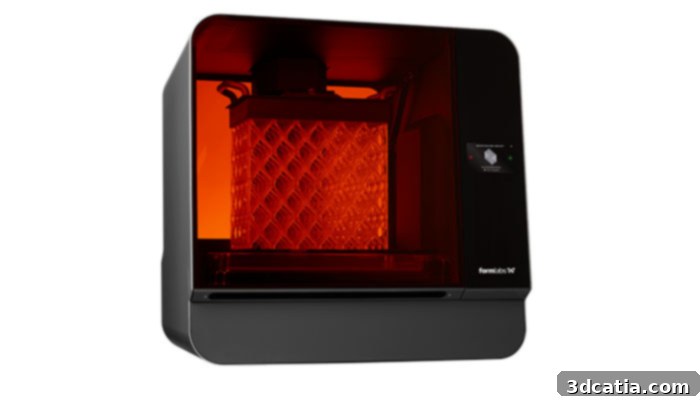
The Form 3L, designed for larger-scale applications | Credits: Formlabs
Accelerated Prototyping with New Draft Resin
Complementing the new hardware, Formlabs also unveiled an exciting addition to its extensive materials library at Hannover Messe: the innovative Draft Resin. This new material is specifically engineered for the rapid production of prototypes, catering to the critical need for speed in early-stage product development and iterative design processes. Draft Resin stands out by allowing parts to be printed with significantly thicker 300-micron layers, a feature that dramatically reduces overall print times. This capability translates into printing speeds up to four times faster than those achievable with conventional resins, offering an unprecedented acceleration for design iterations and concept validation. For engineers, designers, and manufacturers, Draft Resin will be an invaluable tool, enabling quicker turnaround times from concept to physical model, thereby compressing development cycles and fostering greater innovation.
These announcements collectively reinforce Formlabs’ position as a frontrunner in the additive manufacturing space, continuously pushing the boundaries of what is possible with desktop and now, larger-format, professional SLA 3D printing. The Form 3 and Form 3L, powered by LFS technology, along with the versatile Draft Resin, represent a compelling ecosystem for a wide array of industries seeking high-quality, reliable, and efficient 3D printing solutions.
For more comprehensive information on these latest innovations and Formlabs’ full product portfolio, please visit Formlabs’ official press section HERE.
What are your thoughts on Formlabs’ new generation of SLA 3D printers and the revolutionary LFS technology? We invite you to share your insights and opinions in a comment below, or engage with us on our social media platforms, including Facebook and Twitter! Don’t miss out on the latest updates and advancements in the 3D printing world—be sure to sign up for our free weekly Newsletter, delivering all the essential news straight to your inbox!