
UpNano Revolutionizes Micro-Scale 3D Printing with High-Speed, High-Resolution NanoOne Technology
UpNano, a dynamic spin-off company based in Vienna, Austria, is rapidly establishing itself as a pioneer in the realm of high-resolution micro-scale 3D printing. Their groundbreaking technology, built upon an advanced 2-photon polymerization (2PP) process, is setting new benchmarks for speed, precision, and versatility in additive manufacturing at the microscopic level. This innovative approach enables the rapid fabrication of intricate plastic parts, spanning an impressive volume range from 100 to 1012 cubic micrometers, all within minutes. By harnessing a powerful laser, an intricately optimized optical path, and sophisticated smart-scanning algorithms, UpNano empowers industries to produce exceptionally small components – from several micrometers up to a few centimeters – without compromising on the critical aspects of resolution and detail. This signifies a monumental leap forward, promising to transform sectors from electronics and medicine to advanced research and mechanical engineering with unprecedented capabilities for microfabrication.
The Core Technology: Two-Photon Polymerization (2PP) Explained
The foundation of UpNano’s technological prowess lies in its highly refined 2-photon polymerization (2PP) process. This advanced additive manufacturing technique involves using a focused femtosecond laser beam to selectively solidify photosensitive resins. Unlike traditional single-photon absorption, 2PP requires two photons to simultaneously excite a molecule, which only occurs within a tiny focal volume where the light intensity is extremely high. This inherent localization allows for the creation of features far smaller than the laser’s wavelength, pushing the boundaries of what is achievable in 3D printing regarding resolution and geometric complexity. The precise control over the polymerization process at a sub-micron level makes 2PP an indispensable tool for fabricating highly detailed and intricate structures vital for numerous cutting-edge applications.
UpNano’s patented innovation significantly enhances this already powerful 2PP process. Their system uniquely utilizes a high-power laser, capable of delivering up to 1 Watt of power – a stark contrast to the lower power lasers typically employed by competitors. This substantial power output is intelligently channeled through a widely optimized optical path, ensuring maximum energy efficiency and precise beam delivery. Crucially, this high power is combined with a suite of smart-scanning algorithms designed to adaptively control the printing surface. These algorithms dynamically adjust parameters such as laser power, scanning speed, and focus depth, enabling the system to achieve unparalleled printing speeds, especially in the meso-range, without sacrificing the exquisite nano-resolution that defines their output. This synergy of high power and intelligent control is the secret behind UpNano’s ability to achieve what was previously considered impossible: fast, ultra-high-resolution 3D printing of parts varying greatly in size and complexity.

Image credits: UpNano
NanoOne: Redefining Speed and Resolution in Micro-3D Printing
The culmination of UpNano’s research and development is the NanoOne system, a revolutionary micro-scale 3D printer engineered to overcome the long-standing trade-off between speed and resolution. Traditional micro-3D printing processes are often painstakingly slow, particularly when attempting to produce larger objects with fine details. The NanoOne shatters these limitations by offering significantly faster production times across its entire operational spectrum. This unprecedented speed is a direct result of the high-power laser and sophisticated adaptive resolution technology integrated into the system. Whereas weaker lasers would necessitate a much lower throughput to achieve comparable resolution, UpNano’s powerful laser provides the necessary energy to expedite the polymerization process, dramatically cutting down fabrication times.
Bernhard Küenburg, CEO of UpNano, elaborates on this pivotal advantage: “The benefit of this innovation is most notable in the meso-range. The NanoOne system offers significantly faster production times than other systems. Add our patented adaptive resolution technology to this and you end up with a capability to print centimeter large objects with a micrometer resolution in short production cycles.” This statement highlights the NanoOne’s unique ability to bridge the gap between microscopic and macroscopic scales, allowing users to print objects that are several centimeters in size while maintaining critical micrometer-level precision. This flexibility makes it an ideal tool for diverse applications, from rapid prototyping of complex micro-devices to the production of functional parts that demand both scale and intricate detail. The impact on research and industrial adoption is profound, as it dramatically shortens design cycles and opens new avenues for innovation in fields reliant on precise, miniature components.
Versatility Across Scales: From Micrometers to Centimeters
Beyond raw power and speed, the NanoOne’s versatility is further amplified by its ingenious optical system, which allows for dynamic adjustments to the laser spot size. The integrated algorithms enable the laser spot to be enlarged by up to 10 times, precisely tailored to the specific characteristics and resolution requirements of each part being printed. This means that instead of relying on a fixed focal point, the system can intelligently optimize the printing process for various geometries and desired levels of detail. Changing the lens is all that’s required to transition between producing minute, highly detailed micro-parts and larger components with slightly reduced but still impressive precision. The NanoOne currently supports a wide array of lenses, offering magnifications from x4 up to a powerful x100, providing unparalleled flexibility for researchers and manufacturers alike.
To vividly illustrate the extensive capabilities of its technology, UpNano undertook an impressive demonstration: printing four scaled models of the iconic Eiffel Tower. These models varied significantly in size, measuring 40 mm, 15 mm, 3 mm, and a minuscule 0.2 mm. The time taken for each print showcased the NanoOne’s remarkable efficiency and scalability. The largest 40 mm model was completed in 8 hours and 49 minutes, while the 15 mm version took a mere 1 hour and 29 minutes. The 3 mm Eiffel Tower was printed in just 37 minutes, and the smallest, a truly microscopic 0.2 mm replica, was finished in an astonishing 27 minutes. These examples not only highlight the NanoOne’s ability to operate across a broad spectrum of sizes but also underscore its exceptional speed, particularly for smaller, high-resolution objects. Such demonstrations prove the technology’s readiness for demanding applications that require both micro-scale precision and efficient production.
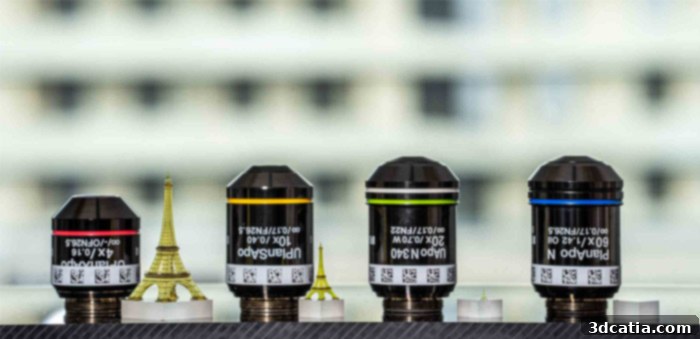
The different sizes of the Eiffel Tower next to the associated laser lenses. (Image credits: UpNano)
Impact and Diverse Applications
The transformative potential of UpNano’s micro-scale 3D printing technology has garnered significant attention across various high-tech industries, particularly in the medical sector and advanced research and development (R&D). In medicine, the ability to create incredibly precise and intricate structures opens up new frontiers for drug delivery systems, tissue engineering, and specialized surgical tools. For instance, the NanoOne has already facilitated the design and fabrication of micro-needles with exquisitely precise features, promising less invasive and more effective methods for administering medication or sampling biofluids. Beyond micro-needles, the technology holds immense promise for developing bespoke implants, microfluidic devices for lab-on-a-chip applications, and scaffolds for regenerative medicine, where cellular integration and complex geometries are paramount.
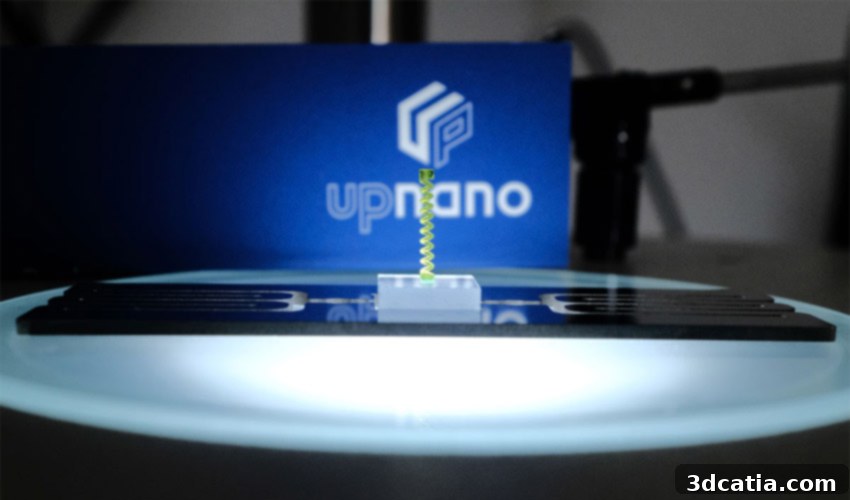
Furthermore, the mechanical sector stands to benefit profoundly from UpNano’s innovations. The capability to print functional, highly detailed micro-components at speed is invaluable for developing next-generation micro-electromechanical systems (MEMS), sensors, and actuators. As a testament to this, a 6 mm high spring, a crucial component in many precision mechanisms, was demonstrated to be printed in less than 6 minutes, showcasing the rapid production of functional micro-parts with exceptional mechanical properties. This speed and precision also extend to the electronics industry, where the miniaturization of components continues unabated. UpNano’s technology can create high-performance miniature components for advanced packaging, optical waveguides, and specialized connectors. The broad applicability also extends to optics, photonics, and even certain aspects of aerospace and defense, where lightweight, high-performance, and complex micro-structures are increasingly vital. The widespread interest underscores the technology’s versatility and its capacity to address complex manufacturing challenges across a multitude of scientific and industrial disciplines.
The Future of Microfabrication with UpNano
As a spin-off from the prestigious Vienna University of Technology, UpNano is rooted in deep scientific expertise and a clear vision: to revolutionize the field of 3D micro-scale printing. By breaking down the traditional barriers of speed, resolution, and part size, they are not merely offering an incremental improvement but fundamentally reshaping what is possible in microfabrication. The NanoOne system, with its twelve orders of magnitude in operational range and unmatched speed, is poised to accelerate innovation across various sectors, enabling researchers and engineers to bring previously theoretical designs into tangible reality. This capability will undoubtedly shorten development cycles, reduce costs associated with traditional micro-manufacturing techniques, and foster an environment ripe for new scientific discoveries and technological advancements. UpNano’s commitment to continuous innovation ensures that their technology will continue to evolve, pushing the boundaries even further and solidifying its position as a global leader in high-resolution additive manufacturing. The future of miniaturized, high-performance components looks brighter than ever, thanks to the pioneering spirit and engineering excellence of UpNano.
What are your thoughts on UpNano’s groundbreaking micro-scale 3D printing technology? We invite you to share your insights in a comment down below or join the conversation on our Facebook and Twitter pages! For those eager to stay abreast of the latest developments in 3D printing, don’t forget to sign up for our free weekly Newsletter, delivering all the essential news straight to your inbox!