
Equinor’s Drone and 3D Printing Revolution: Pioneering Sustainable Offshore Logistics
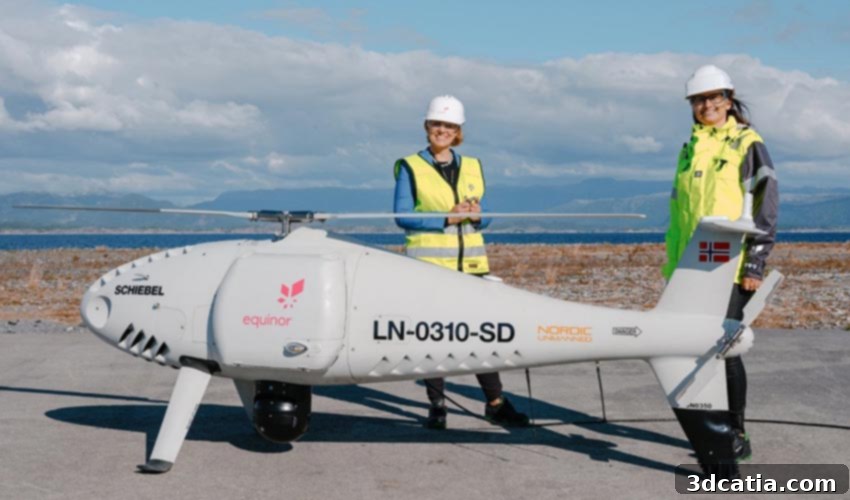
First established in 1972, Equinor has a rich history of pushing technological boundaries to overcome complex challenges within the oil and gas industry. Today, its vision has broadened considerably, aiming to lead as the world’s most carbon-efficient oil and gas producer, while simultaneously spearheading innovation in offshore wind and other renewable energy sectors. In recent years, this forward-thinking approach has focused on integrating cutting-edge technologies, specifically drones and 3D printing, to dramatically enhance production efficiency and reduce CO2 emissions from its extensive Norwegian oil and gas operations. A significant milestone in this endeavor was recently achieved when Equinor successfully executed a pioneering drone flight, transporting a critical 3D printed spare part from its Mongstad base in Norway to the Troll A platform, Norway’s largest gas producer, located in the challenging environment of the North Sea. This event not only showcased the company’s commitment to innovation but also set a new standard for offshore logistics and maintenance.
Transforming Offshore Operations: The Strategic Integration of Drones and Additive Manufacturing
The implementation of such an advanced system for transporting a 3D printed part to a remote offshore location is a strategic move, reflecting Equinor’s ambition to revolutionize traditional operational paradigms. Arne Sigve Nylund, Executive Vice President for Development and Production Norway, articulated this vision clearly: “Equinor aims to lead the way in utilizing new technology on the Norwegian continental shelf. Development is rapid, and we see a huge potential within drone technology that could transform the way we operate, both under and above the sea surface.” This highlights the immense potential of drones as highly efficient transportation systems. They introduce unprecedented flexibility into conventional supply chains, significantly reducing lead times for critical parts and, importantly, lowering the carbon footprint associated with traditional logistics methods like vessels and helicopters. The ability to quickly deliver essential components, especially those that are obsolete or require rapid replacement, minimizes downtime, which is crucial for maintaining continuous production and ensuring operational safety in high-value offshore assets. Furthermore, the integration of 3D printing with drone delivery offers a holistic solution to supply chain vulnerabilities, enabling on-demand manufacturing and swift deployment.
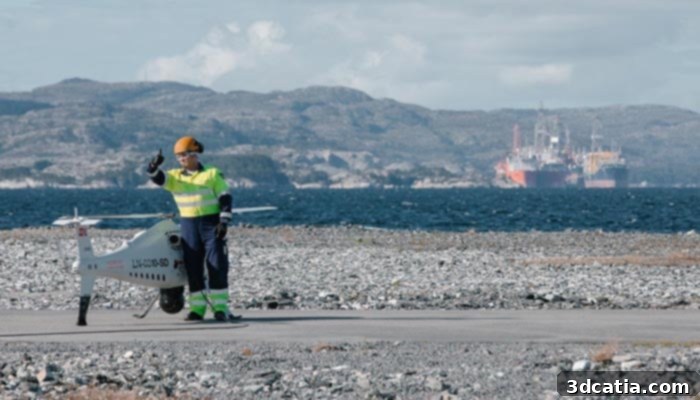
Photo: Ole Jørgen Bratland / Equinor ASA
A Landmark Flight: The 3D Printed Part and Its Significance
The successful drone flight, spanning approximately 80 kilometers to the Troll field, took about an hour, conducted at an altitude of around 5,000 feet. Although classified as a test, the operation was carried out under normal conditions, proving the practical viability and reliability of drone-based logistics in an active industrial environment. The cargo for this groundbreaking journey was a 3D printed diesel nozzle holder, an absolutely critical component for the lifeboats on the Troll A platform. The importance of this specific part underscores a profound challenge faced by many industries with aging infrastructure: obsolescence. Given that the original part is no longer manufactured and thus incredibly difficult to obtain through conventional channels, additive manufacturing technologies provided an indispensable solution. Engineers were able to digitally re-model the component, and through an advanced metal 3D printing process, a precise replica was produced using Inconel 718. This sturdy industrial alloy is celebrated for its exceptional strength, resistance to high temperatures, and superior corrosion properties, making it ideal for the demanding conditions of offshore environments and critical safety equipment. This incident perfectly exemplifies one of the core benefits of 3D printing technologies: their unparalleled ability to manufacture unique, customized pieces on demand, often at a more competitive price point (by eliminating the need for expensive molds and tooling), and within strict time constraints, ensuring operational continuity and enhanced safety.
Additive Manufacturing: Revolutionizing Spare Part Management and Supply Chains
The challenge of sourcing the diesel nozzle holder highlights a pervasive issue in the industrial world: the long-term support of equipment when original manufacturers discontinue parts. This is where additive manufacturing, or 3D printing, truly shines as a game-changer. Rather than relying on dwindling physical inventories or lengthy, costly traditional manufacturing runs, companies can maintain digital libraries of part designs. This “digital inventory” approach means that a part can be printed on-demand, whenever and wherever it’s needed, drastically cutting lead times, reducing warehousing costs, and minimizing waste. For an operation like the Troll A platform, where a single component failure in a lifeboat could have severe consequences, the ability to rapidly produce a high-quality, fit-for-purpose replacement from a robust material like Inconel 718 is invaluable. Inconel 718’s properties—its high tensile, creep, and rupture strength at elevated temperatures, coupled with excellent fatigue and corrosion resistance—make it exceptionally suitable for demanding applications in corrosive marine environments. The adoption of 3D printing not only addresses immediate replacement needs but also fosters a more resilient, agile, and sustainable supply chain for the entire energy sector, shifting from a ‘make-to-stock’ to a ‘make-to-order’ model for specialized components.
Beyond Logistics: Diverse Applications of Drones in Equinor’s Operations
While the rapid delivery of critical parts represents a significant advancement, Equinor anticipates drones playing an even more expansive and pivotal role across its diverse operations. The versatility of drone technology allows it to facilitate numerous aspects of their activities, enhancing safety, efficiency, and environmental performance. For instance, drones are proving invaluable for detailed and safe inspections of vast infrastructures, including towering wind turbines, complex offshore platforms, and sprawling onshore facilities. Equipped with extremely advanced camera equipment—encompassing high-resolution visual cameras, thermal imagers, and multispectral sensors—they can accurately identify anomalies, structural fatigue, corrosion, or heat signatures that might indicate potential failures. This capability not only dramatically improves worker safety by reducing the need for personnel to access hazardous locations but also significantly speeds up inspection processes and generates more comprehensive, data-rich reports for predictive maintenance strategies. Furthermore, drones can be utilized for deploying specialized equipment or sensors, assisting personnel performing maintenance tasks, thereby streamlining operations and mitigating risks associated with manual handling. By leveraging drones for these tasks, Equinor can often avoid the necessity of costly and environmentally impactful vessel lifts, which traditionally contribute substantially to CO2 emissions and incur significant operational expenses. The environmental benefits extend to enhanced monitoring capabilities. As stated on Equinor’s website: “In addition to conducting logistics operations, airborne drones can also be used for inspections and observations of the technical condition of our offshore installations and onshore facilities. They have extremely advanced camera equipment and can be used in search and rescue operations, for example to locate people who have fallen into the sea, or for early detection of pollution on the sea.” This broad spectrum of applications, from routine inspections to critical emergency response and environmental stewardship, firmly establishes drones as indispensable tools for ensuring the resilience and sustainability of modern energy operations. For more detailed information on Equinor’s innovative drone initiatives, further insights are available HERE.
The Future of Energy: Towards Smarter, Safer, and More Sustainable Operations
The successful integration of drone logistics and additive manufacturing by Equinor marks a critical juncture for the energy industry. It showcases a tangible pathway towards operational models that are not only more efficient and cost-effective but also inherently safer and environmentally responsible. The synergy between rapid, data-driven inspections facilitated by drones and the agile, on-demand production of bespoke parts through 3D printing creates a powerful operational advantage. This drastically reduces potential downtime, extends the operational lifespan of critical assets, and significantly lessens the environmental impact associated with traditional manufacturing and extensive logistical operations. The wider implications of this technological adoption are profound, propelling a broader shift towards digital workflows, where digital twin concepts replace physical inventories, and remote, autonomous operations become increasingly viable. This paradigm shift holds immense promise not only for the conventional oil and gas sector but also for accelerating the development and maintenance of renewable energy infrastructure, particularly offshore wind farms, which face similar logistical and maintenance challenges. Equinor’s proactive embrace of these cutting-edge technologies firmly positions it as a vanguard in the digital transformation of the global energy landscape, establishing new benchmarks for operational excellence and robust environmental stewardship. The vision of a future where energy production is seamlessly optimized for both output and planetary health is gradually transitioning from aspiration to an achievable reality.
Did you imagine companies would be leveraging drones and 3D printing in such innovative ways to revolutionize energy operations? We invite your thoughts and perspectives on these exciting developments. Share your comments below or engage with us on our Facebook and Twitter pages! To stay informed about all the latest advancements and breaking news in the dynamic world of 3D printing, remember to sign up for our free weekly Newsletter, delivering cutting-edge information straight to your inbox.