
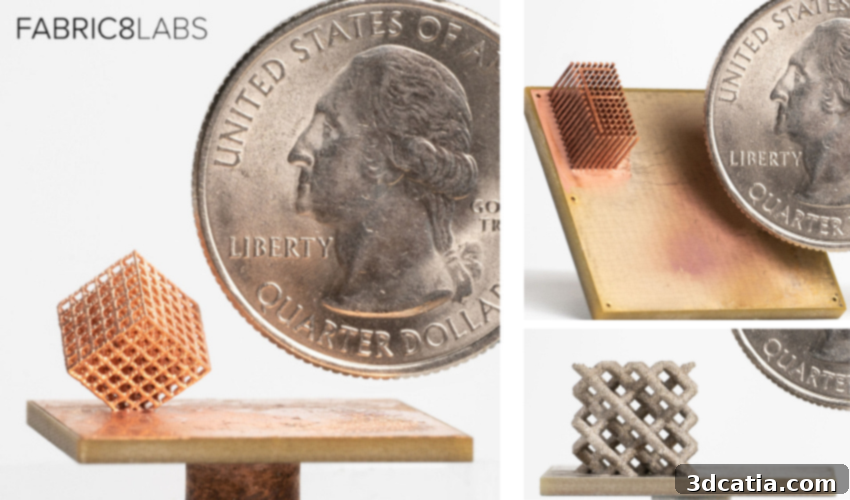
Fabric8Labs Secures $19.3M to Revolutionize Sustainable Metal Additive Manufacturing
San Diego-based additive manufacturing (AM) startup, Fabric8Labs, has recently announced the successful closure of a $19.3 million Series A financing round. This substantial investment is poised to dramatically accelerate the commercialization of its groundbreaking proprietary additive manufacturing process. With this fresh capital, Fabric8Labs is set to expand its reach into a diverse array of high-growth markets, including semiconductor packaging, advanced electronics, critical medical devices, efficient thermal management solutions, and high-performance radio frequency (RF) components. This announcement comes at a pivotal moment, as both metal AM and micro-scale 3D printing technologies continue to gain significant traction and prominence across various industries, largely due to their expansive and disruptive application potential.
The Series A funding round was spearheaded by Intel Capital, with a strong consortium of syndicate partners also participating. Investors were particularly drawn to Fabric8Labs’ distinct technological approach, which promises to deliver the inherent advantages of metal 3D printing while simultaneously addressing some of its most persistent challenges. Crucially, their process eliminates the reliance on expensive and often hazardous metal powders, a significant cost driver in traditional metal AM. Furthermore, it bypasses the need for time-consuming and energy-intensive post-processing steps. This innovative method also boasts superior sustainability credentials, operating effectively near room temperature, which drastically minimizes energy consumption and fosters a more environmentally friendly manufacturing footprint.
The Expanding Landscape of Additive Manufacturing and Fabric8Labs’ Position
The global additive manufacturing market is experiencing exponential growth, with projections estimating it to reach an astounding $235 billion by 2030. Within this booming sector, both metal AM and micro-scale 3D printing have witnessed rapid expansion in recent years, driven by advancements in materials, processes, and a growing demand for customized, complex parts. The industry’s vitality is underscored by significant activity, including major acquisitions from leading AM manufacturers. For instance, 2021 alone saw substantial moves such as Nano Dimension’s acquisition of DeepCube and Desktop Metal’s move to acquire EnvisionTEC. This latest Series A financing for Fabric8Labs further solidifies the continued health and innovative momentum within the additive manufacturing industry, particularly as AM technologies begin to make deeper inroads into sectors like electronics, where their disruptive potential is quickly becoming recognized.
The impressive roster of investors backing Fabric8Labs, led by Intel Capital, includes influential names such as Lam Capital, TDK Ventures, SE Ventures, imec.xpand, Stanley Ventures, and notable entrepreneur Mark Cuban. These strategic partners collectively highlighted not only the escalating strength of additive manufacturing as a whole and its transformative potential across all traditional manufacturing methods but also Fabric8Labs’ unique and patented process. This technology, they affirm, enables unparalleled precision and performance, all while significantly reducing production costs. This combination of innovation and cost-efficiency positions Fabric8Labs as a formidable player ready to redefine conventional manufacturing paradigms.
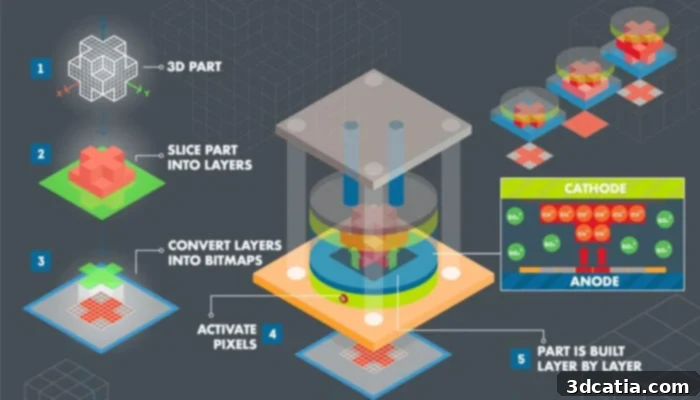
Fabric8Labs’ patented AM process (photo credits: Fabric8Labs)
A Deep Dive into Fabric8Labs’ Game-Changing Technology
Fabric8Labs’ core innovation lies in its unique electrochemical additive manufacturing process, a stark contrast to traditional powder bed fusion or bound metal extrusion methods. This patented technology allows for the creation of intricate metal parts at an atomic level of precision, building up structures from readily available commodity metal salts. By utilizing an electrolytic deposition process that operates at or near room temperature, Fabric8Labs bypasses several critical drawbacks associated with conventional metal 3D printing:
Firstly, the elimination of expensive metal powders drastically reduces material costs and simplifies supply chain logistics. Traditional metal powders can be costly to produce, store, and handle, often requiring inert atmospheres for safety and quality. Fabric8Labs’ use of metal salts sidesteps these complexities and associated expenses, making advanced metal manufacturing more accessible.
Secondly, the room-temperature printing capability represents a significant leap forward in sustainability and operational efficiency. High-temperature processes, common in many metal AM techniques, are energy-intensive and contribute to higher operational costs and carbon footprints. Fabric8Labs’ method minimizes energy consumption, aligning perfectly with global efforts towards more sustainable industrial practices. Moreover, the system is designed to recycle all metals in the feedstock, further enhancing its environmental friendliness and promoting a circular economy approach to manufacturing.
Thirdly, the process offers unprecedented levels of design freedom, which is a key advantage for additive manufacturing users. Parts manufactured using Fabric8Labs’ AM process exhibit zero shrinkage, a common challenge in other metal AM methods that often leads to internal stresses and dimensional inaccuracies. Furthermore, the technology allows for printing with high overhang capabilities, which is not always feasible with other 3D printing processes without extensive support structures. The absence of a need for thermal post-processing, such as sintering or hot isostatic pressing, further enhances design flexibility, reduces production cycle times, and lowers overall manufacturing costs. This means designers can create more complex, optimized geometries without worrying about post-print deformation or additional processing steps.
Finally, the versatility of Fabric8Labs’ technology allows users to print either free-standing components or directly onto existing substrates. This capability opens up new possibilities for integrating advanced metal features onto existing products or creating hybrid components, enhancing functionality and performance across various applications. The ability to deposit metals directly onto sensitive electronic components or dissimilar materials without thermal stress is particularly valuable for industries like electronics and semiconductor manufacturing.
Investor Confidence and Vision for the Future
Nicolas Sauvage, the Managing Director of TDK Ventures, one of the key companies backing Fabric8Labs, eloquently articulated the strategic rationale behind their investment. He stated, “After nearly two years of scouting for a high purity, high-precision and low-cost metal printing solution, TDK Ventures is backing Fabric8Labs for its unique market approach and innovation pipeline with future multi-materials. Fabric8Labs not only cuts across explosive markets in electrification, thermal management, and 5G applications, but also does so in an environmentally friendly manner by recycling all the metals in the feedstock, hence helping build sustainable yet resilient supply chains, aligning with our investment mission.”
Sauvage’s comments highlight several crucial aspects of Fabric8Labs’ appeal: the demand for high-purity, high-precision, and low-cost metal solutions, the potential for multi-material printing, and the alignment with critical growth sectors. The emphasis on “explosive markets” like electrification, thermal management, and 5G applications underscores the widespread industrial need for advanced metal components that Fabric8Labs is poised to meet. For instance, in electrification, the need for efficient, lightweight, and complex conductive parts is paramount. For 5G, highly precise and conductive RF components are essential for optimal signal integrity and performance. In thermal management, the ability to create intricate, optimized heat sinks and cooling channels at a micro-scale can revolutionize electronics and power systems.
Furthermore, the commitment to environmental responsibility, as evidenced by the recycling of feedstock metals and the low-energy printing process, resonates with the increasing global push for sustainable manufacturing. This focus on building “sustainable yet resilient supply chains” is not merely an environmental consideration but also a strategic business advantage, offering a more robust and less volatile production method compared to those reliant on scarce or environmentally impactful resources.
Unlocking New Applications Across Diverse Industries
Fabric8Labs’ innovative process is set to unlock a myriad of new applications across the target industries, providing solutions that were previously difficult or impossible to achieve with traditional manufacturing or even existing AM technologies:
- Semiconductor Packaging: The ability to print complex metal interconnects and thermal vias at a micro-scale with high purity and precision is critical for advanced chip packaging, enabling smaller, more powerful, and more efficient semiconductor devices. The room-temperature process minimizes thermal stress on sensitive components.
- Electronics: From micro-electromechanical systems (MEMS) to advanced circuit boards, Fabric8Labs can create highly conductive and intricate metallic structures, enhancing device performance and enabling further miniaturization. The low-cost nature of the process makes it viable for high-volume electronics manufacturing.
- Medical: The precision and material purity offered by the technology are ideal for producing custom medical implants, surgical instruments, and micro-fluidic devices from biocompatible metals. The ability to create complex internal structures can improve osseointegration for implants and optimize fluid flow for diagnostic tools.
- Thermal Management: Efficient heat dissipation is crucial for modern electronics and high-performance systems. Fabric8Labs can produce geometrically optimized heat sinks, micro-channels, and heat exchangers with high surface area-to-volume ratios, leading to superior cooling performance. The design freedom allows for complex internal lattice structures impossible with conventional methods.
- Radio Frequency (RF) Components: For applications like antennas, waveguides, and filters, the high electrical conductivity and precise geometric control offered by Fabric8Labs’ process are invaluable. This enables the creation of high-performance RF components with tailored electromagnetic properties, essential for next-generation communication systems like 5G and beyond.
The press release further details how this patented process empowers users to create sophisticated metal parts with atomic-level precision. The combination of readily available commodity metal salts and the ability to print at room temperature significantly reduces costs, paving the way for entirely new applications that were previously economically unfeasible. This high level of design freedom, coupled with zero shrinkage and high overhang capabilities without thermal post-processing, truly distinguishes Fabric8Labs in the additive manufacturing landscape. For more comprehensive details, you can refer to the official press release HERE.
Conclusion: A New Era for Metal Additive Manufacturing
Fabric8Labs’ successful $19.3 million Series A funding round marks a significant milestone not just for the company, but for the entire metal additive manufacturing industry. By addressing critical limitations of existing technologies—namely high costs, complex post-processing, and environmental impact—Fabric8Labs is charting a new course for sustainable, high-precision, and cost-effective metal 3D printing. With strong backing from leading investors and a clear strategy to target high-growth markets, Fabric8Labs is well-positioned to drive the next wave of innovation in advanced manufacturing, promising to deliver disruptive solutions across a multitude of industrial applications. This investment validates their unique approach and signifies a promising future where advanced metal components can be produced with unprecedented efficiency and environmental consciousness.
What are your thoughts on Fabric8Labs’ Series A financing round and their innovative approach to metal AM? We invite you to share your insights in a comment below or join the conversation on our Facebook and Twitter pages. Don’t forget to subscribe to our free weekly newsletter for all the latest news and updates in the exciting world of 3D printing, delivered directly to your inbox!
*Thumbnail Photo Credits: Fabric8Labs