
Unlock Production Potential: A Comprehensive Guide to 3D Printing Nesting Software
In the dynamic world of additive manufacturing, effective modeling represents a cornerstone of successful part creation, particularly when dealing with intricate geometries. The 3D printing sector offers a myriad of Computer-Aided Design (CAD) programs, each designed to facilitate the complex process of model generation. As the market continues its rapid expansion, manufacturers are under increasing pressure to streamline their production cycles. This necessitates not only significant reductions in lead times but also prudent material management, all while maintaining uncompromising part quality. The crucial question then arises: how can the production of 3D-printed products be accelerated without sacrificing these vital parameters? The straightforward answer lies in maximizing the number of components produced within a single print job. This is precisely where specialized nesting software emerges as an indispensable tool, meticulously optimizing this critical phase of the 3D printing workflow.
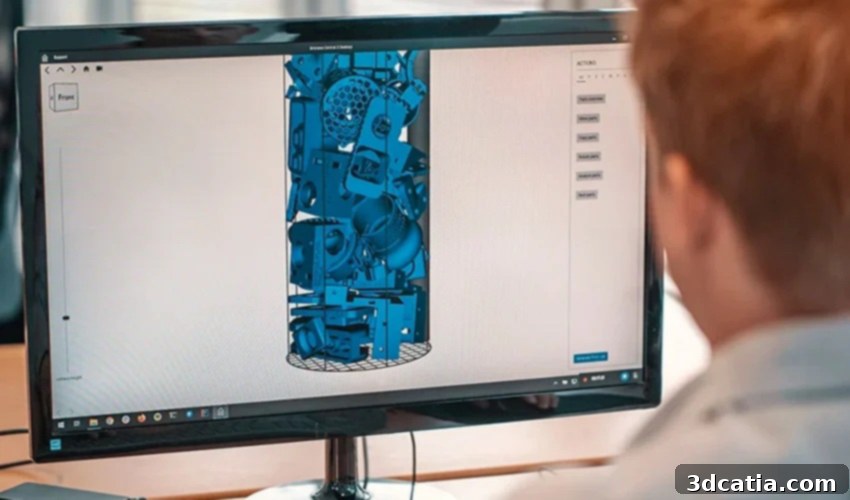
The fundamental role of nesting software is elegantly simple yet profoundly impactful: to achieve peak efficiency in material utilization and dramatically cut down part production times. It’s important to clarify that nesting software is not, in itself, a CAD program; it does not empower users to design or modify 3D models. Instead, its core function is to intelligently arrange and orient existing 3D files on the printer’s build platform. The objective is to fit the highest possible number of parts into a given printing volume during a single manufacturing run. Whether executed through automated algorithms or manual adjustments, 3D nesting meticulously sorts, aligns, and organizes these digital models. This strategic placement ensures the optimal use of every available cubic millimeter inside the 3D printer, rigorously avoiding any interference with non-manufacturing zones or compromising the integrity of individual parts.

Parts are strategically positioned and oriented to maximize space within the 3D printer’s build volume (photo credits: Materialise).
Key Benefits of 3D Printing Nesting
The implementation of effective nesting strategies yields a multitude of advantages beyond mere material and time savings. Firstly, it significantly enhances throughput by allowing a greater quantity of parts to be processed concurrently, leading to higher overall production capacity. This directly translates into reduced manufacturing costs per part, making 3D printing a more economically viable solution for larger production runs. Furthermore, by optimizing material usage, nesting contributes to sustainability efforts within the additive manufacturing industry, minimizing waste and environmental impact. Properly nested parts can also benefit from more uniform thermal distribution during the printing process, potentially leading to more consistent part quality and reduced instances of warping or internal stress. Essentially, nesting transforms the build platform from a simple base into a meticulously planned canvas, where every part contributes to the efficiency of the entire print job.
Integration and Leading Nesting Solutions
Conversely, suboptimal or inefficient nesting practices can severely undermine these benefits, resulting in considerable material wastage, increased print failures, and extended production schedules. To better understand its function, envision nesting software as a sophisticated version of the video game Tetris: the goal is to perfectly place each digital “block” (your 3D part) into a specific orientation and position to maximize the available space on the “game board” (the print bed). Recognizing its critical importance, nesting functionality is increasingly being integrated into existing CAD solutions, offered either as embedded features or robust add-on modules. Prominent examples of such solutions currently available in the market include Sculpteo’s Fabpilot, CoreTechnologie’s 4D_Additive, and Autodesk’s Fusion 360 and Inventor Nesting. While some standalone nesting applications exist, the majority of advanced nesting capabilities are typically found as powerful extensions to established CAD or additive manufacturing preparation software, providing a seamless workflow from design to optimized production.
Compatible 3D Printing Technologies and Materials
The efficacy of nesting extends across nearly all 3D printing technologies, though its advantages are most pronounced and transformative for specific processes. Notably, 3D nesting offers exceptional benefits for powder-based additive manufacturing techniques that, crucially, do not necessitate extensive support structures. This includes Powder Bed Fusion (PBF) solutions such as Direct Metal Laser Sintering (DMLS), Selective Laser Sintering (SLS), and Multi Jet Fusion (MJF). In these processes, parts are surrounded by unfused powder, eliminating the need for complex, time-consuming support removal. This characteristic enables parts to be densely packed in three dimensions, maximizing build volume utilization. Sintratec, a leading manufacturer of SLS 3D printers, has extensively validated the immense value of this software. Their internal reports demonstrate how nesting, when combined with their selective laser sintering technology, can lead to staggering efficiencies. For instance, Sintratec documented savings of approximately 800 hours in part production time, a reduction of 47 kg of powder material, and a saving of 50 hours of labor across 100 typical printing jobs. These figures powerfully illustrate how nesting directly contributes to increased productivity and substantial material cost reductions in industrial environments. While powder bed fusion remains the preferred process for optimal nesting benefits, Binder Jetting is another technology that leverages nesting to improve efficiency. For resin-based technologies like DLP and MSLA, 3D nesting also plays a vital role. While material savings are less pronounced due to the nature of resin consumption, nesting in these processes still delivers significant time savings by enabling the concurrent production of multiple parts, thereby optimizing machine uptime and accelerating delivery schedules.
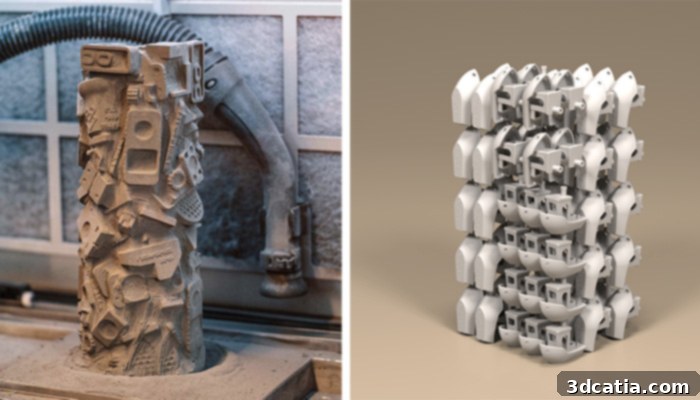
Nesting achieves maximum efficiency with powder-based 3D printing technologies due to their support-free nature.
The versatility of nesting software extends to compatibility with a broad spectrum of 3D printing materials. This includes robust nylon, high-performance PEEK, flexible polypropylene, various resins, and even intricate metal powders. While theoretically compatible with all 3D printer types, nesting software finds its most impactful application within professional and industrial-grade machines. These systems, characterized by their larger build volumes and higher production capacities, are where the economies of scale offered by nesting truly shine. Nesting for 3D printing is not confined to a single industry; its benefits are widely applicable across diverse sectors, including the demanding fields of automotive, medical, and aerospace. In the automotive industry, for example, nesting allows for the simultaneous production of numerous custom jigs, fixtures, or prototype components. In the medical sector, it facilitates efficient batch production of patient-specific implants or surgical guides. For aerospace, nesting enables the cost-effective manufacturing of lightweight, complex parts with minimal material waste. Furthermore, nesting software is highly adaptable to varied production requirements. It can efficiently arrange parts of differing shapes, sizes, and orientations within a single build, catering to diverse customer demands and maximizing the utility of each print run, unlike traditional manufacturing methods that often require dedicated setups for each unique part.
Mistakes to Avoid With 3D Printing Nesting Software
While nesting software offers profound advantages, meticulous attention to detail is paramount to prevent costly printing errors. Ignoring specific guidelines can negate the benefits and lead to failed builds. Here are some critical mistakes to avoid:
- Insufficient Gaps Between Components: This is a common oversight. Whether employing automated or manual nesting, it is absolutely crucial to maintain adequate spacing between all parts within your 3D file. For SLS techniques, a minimum gap of 1.5 mm is recommended. For MJF processes, this critical clearance increases to at least 5 mm. These gaps are not arbitrary; they are essential to manage the significant heat generated by 3D printers during operation. Without sufficient spacing, parts can fuse together, becoming irrevocably bonded, or suffer from thermal deformation, rendering them unusable. Ensuring proper clearance prevents material welding and facilitates easy post-processing and separation of individual components.
- Interlocking Rings (or Geometries): This particular issue arises when the nesting software, or the user’s manual placement, fails to respect the distinct structures of adjacent parts, especially those with intricate or circular geometries like rings. If elements are positioned too closely or overlap due to miscalculation, they can become physically interlocked or bind together during the printing process. The result is two or more parts that are inextricably linked and often unusable, leading to material waste and production delays. Careful visual inspection and robust collision detection in the software are key to preventing this.
- Printing Small Objects Inside Larger Parts Without an Opening: A seemingly clever way to save space – nesting a smaller component within the empty volume of a larger part – can quickly turn into a major problem if no consideration is given to extraction. If a small object is printed entirely enclosed within another, it becomes impossible to remove without damaging one or both parts. Users must consciously design a small, accessible opening or access point in the larger component to facilitate the easy retrieval of the internal part after the print is complete.
- Ignoring Thermal Considerations and the Risk of Curling: Even if the above errors are avoided, aggressive nesting strategies that push the limits of material density on the build plate without considering thermal management can introduce new problems. The most common is “curling,” a well-known 3D printing phenomenon. Curling occurs when the printed layers do not adhere properly to each other or to the build plate, often due to uneven cooling or internal stresses. This results in curved edges, delaminated layers, or parts that lift off the build platform. While not directly a nesting error in the placement sense, an excessively dense nest can exacerbate thermal gradients across the build plate, increasing the likelihood of curling, especially in technologies with significant thermal activity like SLS. Proper part orientation, thoughtful spacing, and understanding material-specific thermal behaviors during nesting are crucial to mitigate this risk.
Conclusion: The Future of Efficient Additive Manufacturing
Nesting software has cemented its position as an indispensable tool in the pursuit of efficiency and productivity within additive manufacturing. By intelligently optimizing the placement of parts, it addresses critical challenges related to material consumption, production time, and overall cost-effectiveness. As 3D printing technologies continue to evolve and mature, the capabilities of nesting software are also advancing, incorporating more sophisticated algorithms, AI-driven optimization, and tighter integration with the entire digital manufacturing workflow. From small prototyping batches to large-scale industrial production, nesting empowers manufacturers to unlock the full potential of their 3D printers, making additive manufacturing a more sustainable, economical, and scalable solution for a wide array of applications across every conceivable industry. Embracing best practices and leveraging the latest advancements in nesting technology will be key for any company looking to stay competitive in the fast-paced world of 3D printing.
What are your thoughts on the transformative power of nesting in 3D printing? Share your experiences and insights by leaving a comment below or connecting with us on our LinkedIn, Facebook, and Twitter pages! Don’t forget to subscribe to our free weekly Newsletter here to receive the latest 3D printing news directly in your inbox. You can also discover all our informative videos on our dedicated YouTube channel.
*Cover Photo Credits: Sintratec