
Revolutionizing Bridge Maintenance: How 3D Printing and Cold Spray Are Combating Corrosion
The structural integrity of a nation’s infrastructure is paramount to its economic vitality and public safety. Bridges, as critical connectors in transportation networks, are particularly susceptible to deterioration, with corrosion of steel components being a primary culprit. The grim reality is underscored by reports like the 2025 Report Card for America’s Infrastructure, which reveals a concerning state: a mere 49% of U.S. bridges are deemed in “fair” condition, while a significant 6.8% are categorized as “poor.” The financial burden of rehabilitating these aging structures is staggering, with estimates exceeding $191 billion. However, this daunting figure could be dramatically reduced through the adoption of innovative repair techniques. In a concerted effort to address this nationwide crisis, a pioneering research team from the University of Massachusetts (UMASS) Amherst, in collaboration with the Department of Mechanical Engineering at the Massachusetts Institute of Technology (MIT), is spearheading research into cold spray additive manufacturing (CSAM) as a transformative solution.
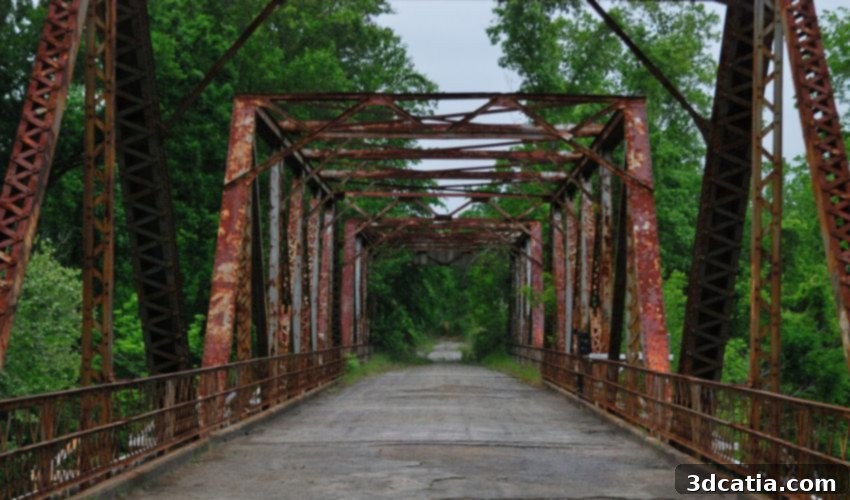
Corrosion stands as one of the most destructive forces acting upon steel infrastructure, systematically eroding its strength and compromising overall structural integrity. The pervasive nature of this issue is particularly acute in rural or remote areas, where delayed detection and limited access can accelerate deterioration, frequently leading to abrupt road closures, extended detours, and significant disruptions to local economies and emergency services. Compounding this challenge is the inherent difficulty in accurately detecting early-stage corrosion and comprehensively assessing its true impact using traditional methods. Furthermore, many regions contend with severe financial constraints, impeding their ability to execute timely repairs and implement robust routine maintenance programs. Simos Gerasimidis, a leading figure in this project and an associate professor of civil and environmental engineering at the University of Massachusetts Amherst, has dedicated over a decade to the study of bridge deterioration. Gerasimidis laments, “Any time you drive, you go under or over a corroded bridge. They are everywhere. It’s impossible to avoid, and their condition often shows significant deterioration. We know the numbers.” This stark observation underscores the urgent need for scalable, efficient, and cost-effective solutions.
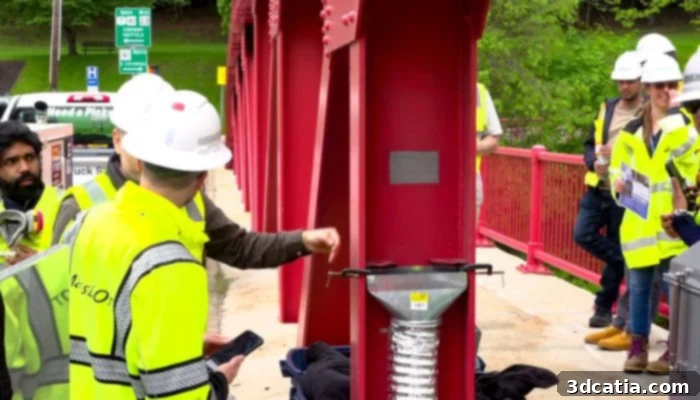
Researchers at the University of Massachusetts conduct final tests for the project (Image: University of Massachusetts)
The UMASS Amherst team is directly confronting these challenges through their ambitious project, aptly titled “3D Printing and Steel Structures: Innovation in Repairs.” Their comprehensive approach involves two key pillars: rigorously testing CSAM for on-site bridge repair and developing advanced 3D LiDAR scanning methods to replace outdated, subjective visual assessments. Traditional visual inspections are notoriously time-consuming, prone to human error, and often fail to provide quantitative data necessary for precise intervention. In contrast, the innovative 3D LiDAR scanning method enables researchers to identify corrosion with unprecedented precision, generating highly detailed digital models of bridge components. This digital mapping facilitates the creation of a precise, data-driven repair plan, allowing engineers to pinpoint exact areas requiring intervention. This targeted approach not only optimizes the use of time and materials but also significantly reduces the overall cost and environmental impact of repairs. As Gerasimidis eloquently states, “By combining scanning with precise material deposition, we can be very targeted and say, ‘we’re going to print here and here and here and we’re going to give this bridge another 10 years of life,’ which is huge.” This integration of advanced scanning and manufacturing represents a paradigm shift in infrastructure asset management.
The Cold Spray Additive Manufacturing Advantage: Precision and Durability for Infrastructure
Cold Spray Additive Manufacturing (CSAM), often referred to simply as cold gas spraying, represents a revolutionary approach to material deposition. Unlike traditional thermal spray techniques or welding, CSAM operates well below the melting point of the sprayed material. In this process, fine metal powder particles are accelerated to supersonic speeds, typically using a high-pressure carrier gas such as nitrogen or helium. These high-velocity particles impact the damaged surface—for instance, the corroded metal girders of a bridge—with sufficient kinetic energy to cause plastic deformation and metallurgical bonding upon impact. This solid-state bonding process avoids the heat-affected zones and undesirable microstructural changes common in welding or high-temperature processes, preserving the original material properties and minimizing thermal stress. Repeated spraying creates multiple, dense layers that effectively restore the thickness, load-bearing capacity, and other crucial structural properties of the treated area. The UMASS/MIT team is subjecting this innovative technology to a battery of rigorous experimental tests, including tensile tests, fatigue tests, and additional corrosion tests, to comprehensively evaluate the effectiveness and long-term durability of these proposed techniques for repairing or protecting steel structures in challenging corrosive environments.
The versatility and robustness of CSAM have already been proven in various demanding large-scale applications, including the repair and restoration of components in airplanes, ships, and submarines, where material integrity and performance are absolutely critical. However, applying this technology to bridges presents a unique set of logistical and engineering challenges, primarily centered around the necessity of bringing the sophisticated 3D printing equipment directly to the repair site. This differs significantly from factory-based manufacturing. Despite this, one of the most compelling advantages of CSAM for bridge repair is its capacity to perform repairs with minimal disruption to traffic. Simos Gerasimidis highlighted this crucial benefit, explaining that the team can perform CSAM operations even while vehicles continue to traverse the bridge. This significantly reduces economic impact, minimizes inconvenience for commuters, and enhances safety by avoiding lengthy road closures typically associated with conventional repair methods. The ability to conduct repairs without impeding traffic flow makes CSAM an incredibly attractive and practical solution for maintaining critical infrastructure.
A Promising Repair: The Great Barrington Case Study and Future Validation
The UMASS team recently achieved a significant milestone by completing a groundbreaking test repair in Great Barrington, Massachusetts, on the historic Red Bridge (formerly known as the “Brown Bridge”), originally constructed in 1949. This proof-of-concept demonstration successfully showcased the viability of CSAM for real-world bridge applications. Gerasimidis expressed immense optimism regarding the outcome: “Now that we’ve completed this proof-of-concept repair, we see a clear path to a solution that is much faster, less costly, easier, and less invasive.” He further emphasized the pioneering nature of their work, stating, “To our knowledge, this is a first. Of course, there is some R&D that needs to be developed, but this is a huge milestone to that.” This initial success paves the way for wider adoption and further technological refinement, moving from laboratory controlled experiments to real-world deployment.
While the Red Bridge is scheduled for demolition in a few years due to its age and original design limitations, this impending event offers a unique and invaluable opportunity for in-depth scientific analysis. The UMass team plans to carefully retrieve the cold-sprayed beams from the demolished bridge and transport them back to their state-of-the-art laboratory facilities. Here, they will conduct an exhaustive series of post-mortem examinations. These tests will meticulously measure the success of the deposited steel powder’s adhesion to the original structure under real-world field conditions, comparing it directly to control samples treated in a more controlled lab setting. Furthermore, researchers will diligently check for any signs of continued corrosion in the repaired sections after their exposure to the elements and will precisely determine the mechanical strength properties, such as tensile strength, fatigue life, and impact resistance, of the repaired material. This comprehensive validation process is crucial for establishing the long-term efficacy, durability, and safety of CSAM as a standard bridge repair methodology.
The success and potential widespread implementation of this transformative technology are greatly bolstered by robust collaborative efforts. The Massachusetts Department of Transportation (MassDOT), the Massachusetts Technology Collaborative (MassTech), the U.S. Department of Transportation, and the Federal Highway Administration are all actively collaborating on this vital project. This multi-agency partnership is instrumental in securing funding, facilitating regulatory approvals, and ensuring that the research aligns with national infrastructure needs and standards. Such interdisciplinary and inter-organizational cooperation is essential for translating cutting-edge academic research into practical, deployable solutions that can truly make a difference in the maintenance and longevity of our nation’s aging bridge infrastructure. For those interested in delving deeper into the specifics of this project, more information can be found HERE.
The potential of cold spray additive manufacturing to revolutionize bridge maintenance is immense, offering a faster, more cost-effective, and less disruptive alternative to traditional repair methods. What are your thoughts on using this innovative 3D printing technology for repairing our vital bridges? We encourage you to share your insights in a comment below or join the conversation on our LinkedIn or Facebook pages! Plus, don’t forget to sign up for our free weekly Newsletter to get the latest 3D printing news straight to your inbox. You can also find all our videos on our YouTube channel for more exciting developments in additive manufacturing.
*Cover Photo Credits: Jeffrey Schreier