
Revolutionizing Manufacturing: Arris Composites Scales Additive Molding for High-Performance Composites
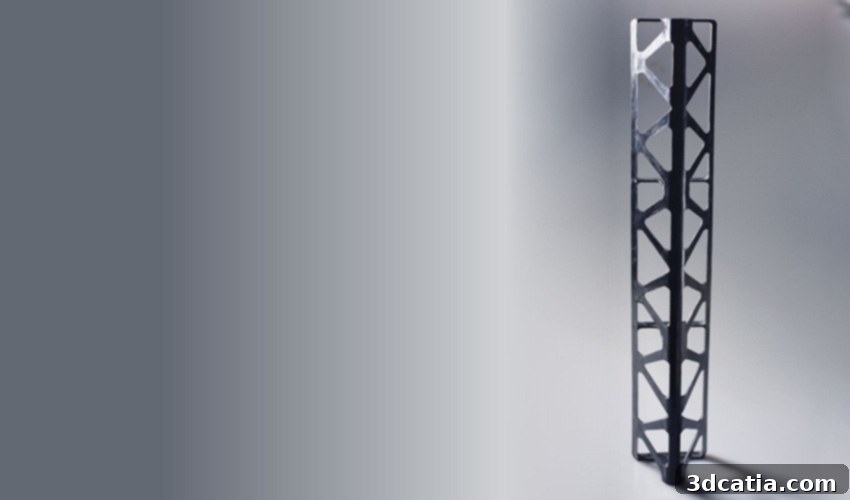
Arris Composites, a leading innovator in the field of next-generation composite materials and manufacturing, recently announced a significant milestone: securing $48.5 million in Series B funding. This substantial investment is earmarked for the expansion of its groundbreaking proprietary composite manufacturing capabilities and the establishment of new state-of-the-art facilities across the U.S. and Taiwan. Since its inception in 2017, the startup has been at the forefront of developing its revolutionary Additive Molding technology. This advanced manufacturing approach, as detailed by the company, facilitates the mass production of exceptionally high-strength and remarkably lightweight composite parts by ingeniously integrating additive manufacturing techniques into conventional composite production methods. The result is an unprecedented capability to produce carbon fiber components at speeds comparable to traditional plastic molded products. To delve deeper into Arris Composites’ ambitious vision and the transformative applications its technology enables, we had the privilege of speaking with its visionary CEO and Founder, Ethan Escowitz.
3DN: Can you introduce yourself and elaborate on your relationship with 3D printing?
Ethan Escowitz
My name is Ethan Escowitz, and I am the CEO and Founder of Arris Composites. My journey in manufacturing has spanned over two decades, with more than a decade specifically dedicated to the exciting world of 3D printing and additive manufacturing. Prior to that, my professional focus was heavily rooted in traditional manufacturing technologies. This dual background in both conventional and cutting-edge processes provided a unique perspective, ultimately leading me to found Arris in 2017. My core vision for Arris was to unlock the potential for mass-producing high-performance composites by leveraging the inherent advantages of additive manufacturing techniques. We observed a significant gap in the market: while composites offered incredible material properties, their mass production at scale, particularly with complex geometries, remained a challenge.
At Arris Composites, our mission extends beyond mere manufacturing; we aim to advance humanity by creating the highest performance products imaginable. We firmly believe that superior materials and manufacturing processes can lead to innovations that improve efficiency, safety, and sustainability across various sectors. To achieve this, we actively partner with the world’s most innovative companies – from aerospace giants to consumer electronics leaders – to collectively imagine, design, and manufacture the future. This collaborative approach allows us to push the boundaries of what’s possible, translating our advanced Additive Molding technology into tangible, high-impact products that solve critical engineering challenges.
3DN: Can you tell us more about the role and benefits of composites in additive manufacturing? How do they compete with metal AM?
It’s crucial to first acknowledge that in the realm of advanced manufacturing, there are indeed different tools perfectly suited for different jobs. At Arris, we operate with a pragmatic approach: for suitable applications, especially during the prototyping phase, we frequently utilize plastic, composite, and metal additive manufacturing to achieve faster part fabrication than would be possible with our traditional CNC machines. However, our Additive Molding technology carves out a unique niche where we can demonstrably replace both conventional and metal AM solutions, offering superior performance characteristics.
Consider the example of topology-optimized brackets, particularly prevalent in aerospace applications. Topology optimization software excels at designing ideal structures, minimizing weight while maximizing strength. Historically, the challenge has been manufacturing these complex, organic designs with the ideal material. While metal 3D printing has been a go-to for these structures, it often comes with limitations. Even optimized metal parts might still carry a weight penalty due to the material’s inherent density and the isotropic nature of many metal AM processes. This means that while they offer good specific strength (strength-to-weight ratio), they are not always optimal. Arris’ Additive Molding™ technology revolutionizes this by manufacturing these exact topology-optimized structures with the *ideal* material: continuous fiber composites precisely aligned through the x, y, and z axes. This multi-directional fiber placement is critical for translating the theoretical benefits of topology optimization into real-world performance. In these demanding applications, we typically meet or exceed customer functional requirements while achieving remarkable 50% to 70% weight savings compared to conventionally manufactured or metal 3D printed alternatives. This reduction in weight directly translates to increased fuel efficiency, extended range, and enhanced payload capacity for aircraft.
Beyond the impressive weight savings, the scalable nature of our manufacturing process opens doors to new markets. The high cost and slower production rates of metal 3D printing have often prevented the commercialization of these optimized structural forms in high-volume industries like automotive. Additive Molding’s scalability in terms of volume allows us to bring these innovative structural designs to the automotive sector, where lightweighting and performance are increasingly critical for electric vehicles and beyond. Furthermore, the scalability of our process extends to size; we can manufacture large, complex structures that embody these design ideals within a single, monolithic form. This eliminates the need for multi-part assemblies, reducing complexity, improving structural integrity, and cutting down on manufacturing costs and lead times. While aerospace and automotive represent significant areas of overlap and competition with metal AM, our technology also excels in other sectors, such as the production of high-performance consumer electronics and recreational equipment, where the unique properties of continuous fiber composites offer significant advantages and metal AM is simply not a relevant solution.
3DN: Arris Composites recently secured $48.5 million in Series B funding; what does this investment mean for your company?
This Series B funding round, totaling $48.5 million, marks a pivotal moment for Arris Composites. While we’ve been successfully collaborating with early adopters over the past three years, demonstrating the capability and value of our Additive Molding technology, the demand has now surged significantly. This investment is absolutely crucial for us to scale our production capacity comprehensively. Firstly, it will enable us to bring online the higher volume production orders from our “early adopter” customers who have thoroughly qualified our manufacturing technology and are now ready to transition to larger scale. Secondly, it allows us to effectively meet the rapidly increasing demand from “early majority” customers who are currently in the qualification phase for their own products. These customers represent a broader market adoption, and we need to be prepared to support their production needs.
As a direct result of this capital injection, two major areas of expansion at Arris will be prioritized: significantly increasing our production capacity, which includes investing in more advanced machinery, automation, and optimizing our operational workflows, and enhancing our engineering and customer collaboration resources. This latter point is vital, as co-development and close technical support are essential for helping new customers integrate our advanced composite solutions into their product lines. The establishment of new facilities in the U.S. and Taiwan is also a key part of this expansion, strategically positioning us to serve our global customer base more efficiently and to build a resilient, geographically diversified supply chain. This investment isn’t just about growth; it’s about solidifying our foundation for sustained innovation and market leadership in high-performance composites.
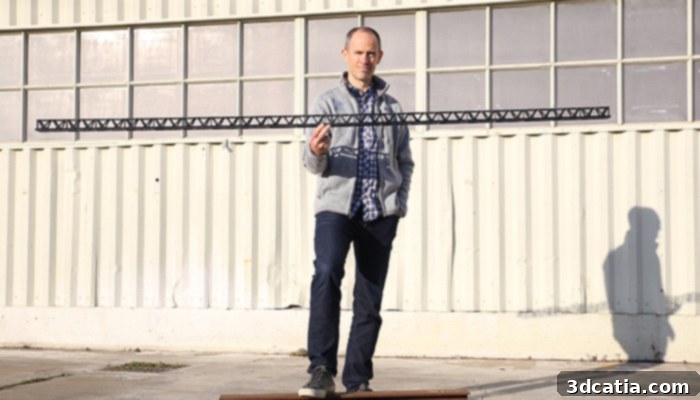
Ethan Escowitz holding 8ft continuous carbon fiber truss | Image via Arris Composites
3DN: What does mass production using additive manufacturing look like at Arris Composites, and what are its main benefits and limitations?
Mass production utilizing our Additive Molding™ technology, in many respects, bears a striking resemblance to other highly advanced manufacturing systems. This is by design, as we strategically leverage existing, proven technologies such as sophisticated robotics, comprehensive factory automation, and robust industrial controls. By integrating best-in-class, off-the-shelf manufacturing technology to operate our unique processing hardware, we are able to deliver the critical attributes required in demanding production environments: unparalleled reliability, exceptional repeatability, and robust scalability. This approach allows us to mitigate the risks often associated with entirely new manufacturing paradigms and facilitates smoother integration into existing supply chains.
While we’ve achieved significant success with “drop-in replacement” parts that simply outperform existing components, some of the most profound benefits for our customers arise from the transformative gains in product performance and manufacturing efficiency. These advantages stem from our ability to consolidate a complex, often multi-part and sometimes multi-material assembly into a single, high-performance component, even at high production volumes. Our process uniquely allows for the creation of intricate geometries, composed of the strongest and lightest continuous fiber composite materials strategically placed adjacent to functional materials – such as metals, plastics, or ceramics. This precise material placement optimizes for varied performance requirements within a single part, addressing multiple functional demands simultaneously. Traditionally, achieving such architectures would either be technically impossible or prohibitively expensive, requiring numerous assembly steps and sacrificing performance.
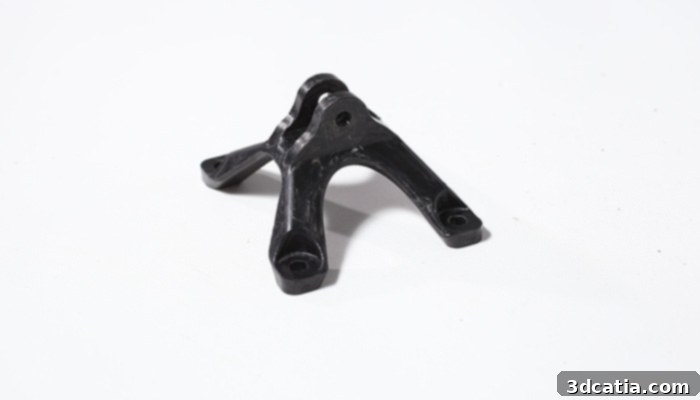
Aerospace bracket | Image via Arris Composites
Regarding limitations, our biggest challenge mirrors that of many of our peers in the broader additive manufacturing space. It inherently takes time and significant effort to educate engineers and designers about a fundamentally new manufacturing process. There’s a paradigm shift required in thinking – moving beyond conventional design-for-manufacturing rules to fully leverage the design freedom and material optimization capabilities of Additive Molding. This involves identifying the most impactful products and applications for collaboration, followed by the rigorous qualification process and ultimately bringing these innovative new products to market. While this educational curve is steep, the collective efforts of the entire AM industry over the last decade have undoubtedly helped accelerate this process, making industries more receptive to evaluating and adopting novel manufacturing methods. We are already engaged with industry leaders across critical sectors like consumer electronics, sporting goods, automotive, and aerospace, which speaks to the significant potential our technology holds. From a technical standpoint, our process does involve certain fixed costs associated with setup and process development, meaning it typically doesn’t make economic sense for producing fewer than 100 total parts. For very low-volume needs, traditional 3D printers and CNC machines remain the more appropriate and cost-effective solutions.
3DN: Any last words for our readers?
Indeed, much has been written and discussed about the profound impact that additive manufacturing will have on global manufacturing. Many narratives often focus on 3D printing displacing conventional manufacturing processes entirely. While this perspective holds true for certain highly specialized products, such as complex jet engine nozzles that were previously impossible to produce, my extensive experience in developing applications across a diverse range of additive technologies suggests a more nuanced reality. I believe AM’s greatest strength lies in its ability to significantly *improve* and enhance, rather than solely replace, the conventional manufacturing technologies that continue to produce the vast majority of products worldwide.
Consider the myriad applications where AM is already making a tremendous difference: the rapid production of jigs & fixtures, molds, custom automation components, and of course, prototyping. These applications, while not always end-use parts, collectively reduce manufacturing setup and operating costs, streamline complex production lines, and critically, accelerate time-to-market for countless products. Our Additive Molding technology is a prime example of this synergistic approach. By intelligently applying sophisticated additive manufacturing techniques to a conventional molding method, we are able to harness the unique benefits of both worlds: the geometric complexity and material placement precision of AM combined with the speed and scalability of traditional molding. This hybrid approach allows us to achieve performance and cost metrics that neither technology could deliver on its own.
As we look to the coming years in additive manufacturing, we find ourselves at an incredibly important juncture. Progress in several interconnected areas – including advanced robotics, artificial intelligence, novel material science, and sophisticated simulation software – has converged. This convergence is leading to a proliferation of entirely new product architectures and design possibilities that were previously unimaginable. In this unique moment, innovative manufacturing technologies like ours are no longer solely battling the inertia of entrenched incumbent suppliers and previously specified manufacturing technologies. Instead, the landscape is shifting towards a meritocracy where logic reigns supreme, and the best cost-to-performance solutions are poised to prevail. This presents an unprecedented opportunity for accelerated progress along the adoption curve, bringing the transformative benefits of advanced composites to a wider array of industries and ultimately enriching our daily lives with lighter, stronger, and more efficient products. You can find more information HERE.
What do you think about the mass production capabilities of advanced carbon composites? Share your thoughts in a comment below or join the conversation on our Facebook and Twitter page! Don’t forget to sign up for our free weekly Newsletter to receive all the latest news in 3D printing delivered directly to your inbox!