
Revolutionizing Fashion: Stratasys Pioneers Direct-on-Fabric 3D Printing at NYFW
The world of high fashion is constantly evolving, seeking new frontiers in design, material innovation, and manufacturing techniques. At last week’s prestigious New York Fashion Week (NYFW), attendees and industry experts witnessed a pivotal breakthrough that promises to reshape the landscape of haute couture: the advent of direct-on-fabric 3D printing. This monumental achievement was the result of a visionary collaboration between Stratasys, a global leader in 3D printing technology, and acclaimed fashion designers threeASFOUR, working alongside digital artist Travis Fitch. Traditionally, three-dimensional elements in fashion garments are produced as separate components and then meticulously attached to textiles. However, Stratasys has fundamentally changed this paradigm by developing a groundbreaking technique that allows for the precise application of complex 3D structures directly onto existing fabrics. This innovative process, utilizing the advanced J750 PolyJet 3D printer, has not only expanded the creative possibilities for designers but has also unveiled a new realm of applications within the demanding high-end fashion sector. This represents a significant leap forward in additive manufacturing, marrying the flexibility and comfort of traditional textiles with the intricate geometries and dynamic aesthetics offered by modern 3D printing, setting a new standard for future collections and challenging conventional manufacturing limits.
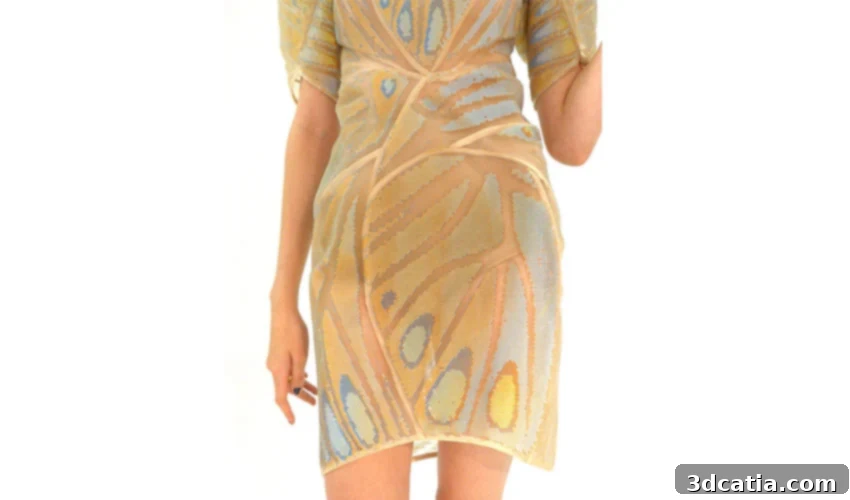
The collection that debuted this pioneering technology, aptly named “Chro-Morpho,” captivated audiences during Fashion Week with its exquisite beauty and profound conceptual depth. Inspired by the intricate and ever-changing color morphology of insects, particularly the iridescent qualities and natural camouflage mechanisms found in the insect kingdom, the collection was a vibrant testament to the fusion of nature, art, and cutting-edge technology. Adi Gill, co-founder and creative director of threeASFOUR, articulated the collection’s essence: “We’ve created the skin-like illusion of switching shades and depth to portray the insect’s innate camouflage, color diversion and luminosity. With 3D design and printing, we’ve embodied the fragility and light wing movement of the butterfly.” This remarkable illusion is achieved through an innovative printing process involving thousands of spherical and fish scale-sized cells, meticulously crafted from photopolymers and applied directly onto polyester fabric. These minute, delicate structures, distributed across the dress’s 27 individual parts, each consist of a clear lens encasing carefully arranged strips of color. The interplay of light with these clear lenses and internal color strips creates dynamic optical effects, mimicking the shifting hues and depths characteristic of insect wings. The entire, highly complex procedure to create these stunning garments typically spans an intensive 17 hours, a testament to the precision and intricacy involved in bringing such a sophisticated design vision to life.
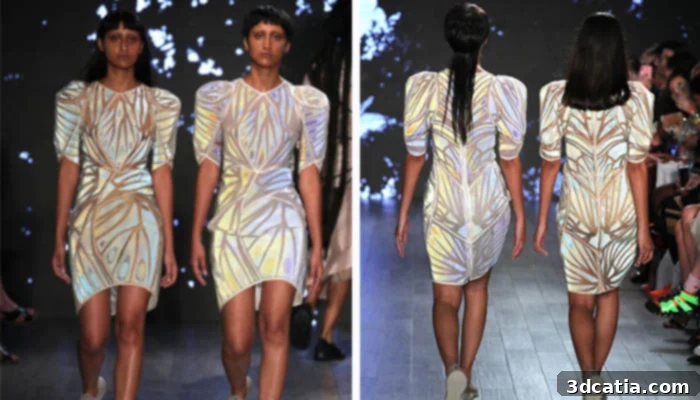
The Chro-Morpho Collection, showcasing direct-on-fabric 3D printing innovation.
At the heart of this groundbreaking innovation is the Stratasys J750 PolyJet 3D printer, a machine renowned for its unparalleled capabilities in multi-material, multi-color printing. This sophisticated system empowers designers with an almost limitless palette, capable of producing over 500,000 combinations of vibrant colors, intricate textures, seamless gradients, and varying transparencies, all within a single print job. Such an extensive range of aesthetic possibilities provides designers with unprecedented creative freedom, allowing them to translate the most complex and imaginative concepts into tangible reality without the traditional constraints of manufacturing. Beyond the immediate artistic benefits, this technology also paves the way for greater involvement of end-users in the design process, potentially ushering in an era of hyper-personalized fashion where garments can be tailored to individual tastes with extraordinary detail. Furthermore, the J750’s ability to create such a vast array of combinations directly and efficiently translates into significant advantages for the manufacturing process. It promises reduced production costs and significantly shorter lead times for developing unique pieces. The direct printing approach also streamlines the supply chain by minimizing the need for multiple manufacturing steps and external suppliers, representing a substantial benefit for fashion houses and brands aspiring to create truly distinctive and custom pieces that stand out from conventional offerings. This efficiency and design agility could democratize high-end fashion customization, making bespoke items more accessible and fostering innovation across the industry.
One of the persistent challenges in integrating 3D printing into wearable fashion has always been ensuring wearer comfort. While additive manufacturing excels at producing intricate designs and robust structures, the materials often used are not inherently soft or flexible, which can compromise the comfort of a garment when directly against the skin. Recognizing this critical hurdle, Stratasys and its design partners dedicated months to intensive collaboration and rigorous testing to devise an elegant solution for the Chro-Morpho collection. Naomi Kaempfer, Art, Design and Fashion Director at Stratasys, eloquently explained their approach: “Soft, lithe fabric touches the skin, while 3D printed designs adorn the outer garment. This approach, developed through months of collaboration and testing, was the only way to realize the designers’ vision.” This strategic design choice ensures that the innovative 3D-printed elements, while central to the garment’s aesthetic appeal and conceptual narrative, do not sacrifice wearability. By maintaining a soft textile layer against the skin, the collection successfully marries cutting-edge aesthetics with practical comfort, addressing a key consumer concern and demonstrating a thoughtful approach to wearable technology. This thoughtful integration underscores the maturity of the direct-on-fabric printing technique, proving that futuristic fashion can indeed be both visually stunning and comfortably functional.
This is not Stratasys’ first foray into the captivating and demanding world of high fashion. The company has a well-established history of pushing boundaries within the industry, having previously engaged in notable collaborations with visionary designers such as Iris Van Herpen, celebrated for her avant-garde sculptural garments, and other luminaries who consistently redefine the intersection of technology and art. These past partnerships underscore Stratasys’ ongoing commitment to exploring and expanding the potential of additive manufacturing in creative fields. The overarching mission driving these collaborations, as articulated by Naomi Kaempfer, extends far beyond merely creating visually striking garments. It is about fundamentally re-thinking design processes, manufacturing methods, and artistic expression. “We are always looking to revolutionize manufacturing methods, pioneer new design options, and inspire designers and students to create without boundaries. Our mission is to change the way people think about design and to redefine what’s possible,” Kaempfer states. This philosophy highlights Stratasys’ role not just as a technology provider, but as an enabler of creative revolution, fostering an environment where imagination is the only limit and where designers are empowered to explore uncharted territories in fashion design, leading to truly transformative outcomes that challenge conventional perceptions of what clothing can be.
The implications of direct-on-fabric 3D printing extend far beyond individual runway collections; they signify a profound shift in the broader fashion industry. This technology opens up avenues for unprecedented levels of customization and personalization, potentially allowing consumers to select specific patterns, colors, and textures to be printed directly onto their chosen garments, moving towards a truly on-demand and bespoke fashion experience. Moreover, it offers significant advantages in terms of sustainability. By printing only the necessary elements directly onto fabric, the technology can drastically reduce material waste associated with traditional textile cutting and embellishment processes. The ability to produce complex designs efficiently and locally could also shorten supply chains, lessen transportation emissions, and promote more ethical manufacturing practices. This innovation truly empowers designers to explore completely new aesthetic languages, creating dynamic, responsive, and visually complex surfaces that interact with light and movement in ways previously unimaginable. The Chro-Morpho collection is merely the initial glimpse into a future where garments are not just sewn but are intelligently grown and designed, piece by piece, layer by layer, directly onto the very fibers that touch our skin. This pioneering step marks a new era where technology seamlessly integrates with artistic expression, promising a future of fashion that is more innovative, personalized, and environmentally conscious than ever before.
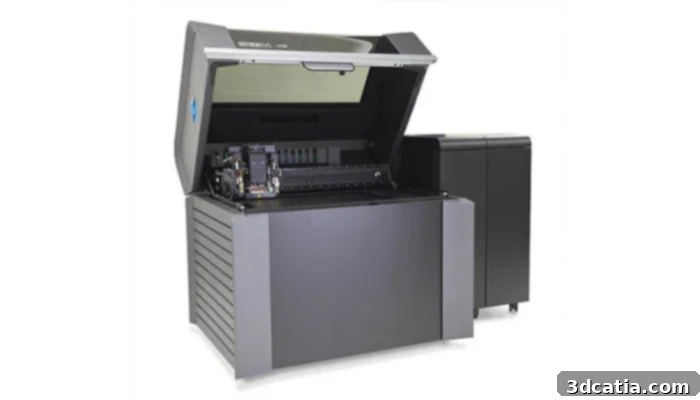
The Stratasys J750 PolyJet 3D printer, a key enabler of this fashion revolution.
What are your thoughts on this truly revolutionary collection and the potential impact of direct-on-fabric 3D printing on the future of fashion? We’d love to hear your perspective! Share your comments below or engage with us on our Facebook and Twitter pages. And to stay abreast of all the latest advancements, news, and insights in the dynamic world of 3D printing, remember to sign up for our free weekly Newsletter, delivered straight to your inbox.