
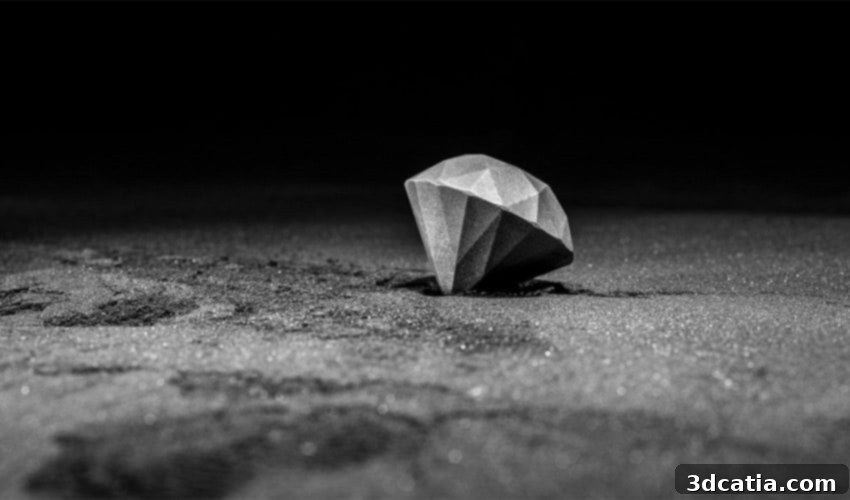
Sandvik Unveils Revolutionary 3D Printed Diamond Composite for Industrial Innovation
In a groundbreaking announcement at last week’s RAPID + TCT exhibition, global engineering giant Sandvik revealed an unprecedented achievement: the world’s first-ever 3D printed diamond composite material. This significant development marks another milestone for the company, further expanding its innovative portfolio of materials crafted through additive manufacturing. While Sandvik previously captured headlines with their expertise in metal additive manufacturing, notably creating an unsmashable guitar, their latest venture into 3D printing diamond represents a leap into a completely different realm of material science. This advanced diamond composite, though not designed for aesthetic sparkle, boasts an incredible range of properties making it exceptionally valuable across numerous industrial applications. Diamond, renowned as the hardest material found in nature, is a critical component in tools designed for extreme wear resistance, impacting sectors from heavy-duty mining and precision drilling to advanced machining and even specialized medical implants. The ability to 3D print such a material opens doors to unparalleled design freedom and functional optimization.
The production of synthetic diamond has been a reality since 1953, enabling its use in various industrial tools where natural diamond was either too scarce or too expensive. However, what does additive manufacturing bring to this already established field? The true transformative power lies in its capacity to form diamond composite materials into intricate and complex shapes – geometries that are virtually impossible to achieve using traditional synthetic diamond production methods. This capability fundamentally redefines the potential applications of diamond. Mikael Schuisky, Head of R&D and Operations at Sandvik AM, eloquently articulated this paradigm shift: “We now possess the unique ability to create incredibly strong diamond composites in highly complex shapes through additive manufacturing. This innovation will fundamentally **change** the way industries perceive and utilize this extraordinary material. At present, the only constraint on how this super-hard material can be shaped and applied is limited solely by the designer’s imagination.” This highlights a future where design complexity no longer limits material choice, pushing the boundaries of engineering and functionality.
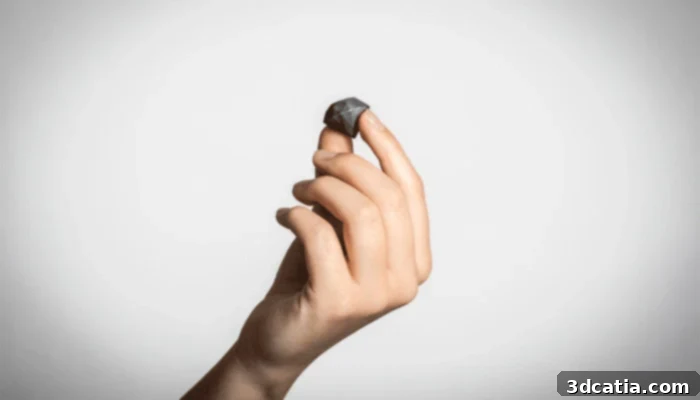
Photo Credits: Sandvik
It is crucial to understand that Sandvik’s pioneering material is a composite, not pure, single-crystal diamond. This distinction is vital for its printability and functionality. The composite primarily consists of diamond, but to facilitate its additive manufacturing process and ensure a dense, robust final product, the diamond particles are embedded and cemented within an exceptionally hard matrix material. This ingenious approach allows Sandvik to retain the most critical physical properties of pure diamond – especially its unparalleled hardness and wear resistance – while gaining the flexibility of 3D printing. Susanne Norgren, Adjunct Professor in Applied Materials Science at Uppsala University, underscored the magnitude of this breakthrough, stating, “Sandvik’s 3D printed diamond composite is a **true innovation**. It signifies that we can now begin to deploy diamond in applications and geometric forms that were previously unimaginable. Just consider the profound impact this could have on countless industries, when it becomes feasible to print virtually anything, in any configuration – all crafted from diamond.” This sentiment emphasizes the revolutionary potential of enabling complex geometries for the world’s hardest material.
The manufacturing process behind this advanced diamond composite involves a sophisticated slurry-based 3D printing technique. This process utilizes a specialized slurry, meticulously formulated to contain fine diamond powder suspended within a polymer binder. This mixture is then precisely deposited layer by layer, building up the desired three-dimensional shape. After the initial printing stage, which forms a “green part,” the company explains that the subsequent post-processing steps are even more critical for achieving the material’s remarkable final properties. Recognizing the complexity and precision required, Sandvik has invested heavily in developing a tailor-made, proprietary post-processing method. This highly specialized technique is essential to consolidate the printed part and ensure that the diamond composite achieves its full potential. Through this meticulous process, Sandvik is able to imbue the material with a suite of exceptional characteristics. These include not only the aforementioned extremely high hardness and wear resistance but also exceptional heat conductivity, making it ideal for thermal management solutions. Furthermore, it possesses a low density, contributing to lighter components, very good thermal expansion properties for stability under varying temperatures, and fantastic corrosion resistance, ensuring longevity in harsh environments. These combined properties make the 3D printed diamond composite incredibly versatile and robust for a wide array of demanding industrial uses.
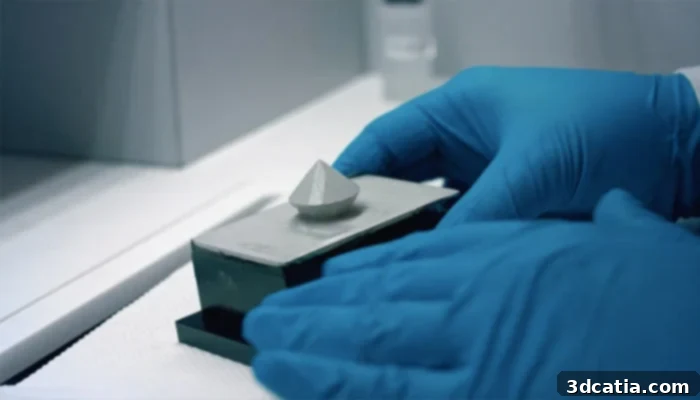
Photo Credits: Sandvik
The implications of being able to 3D print diamond composites extend far beyond conventional tooling. Imagine custom-designed cutting inserts with geometries optimized for specific materials and complex paths, or wear-resistant components for pumps and valves that drastically extend operational lifetimes in corrosive settings. Thermal management systems could become significantly more efficient with diamond heat sinks intricately shaped to dissipate heat from sensitive electronics in aerospace or automotive applications. The medical field could benefit from diamond-tipped surgical instruments with enhanced precision and durability, or even highly specialized implants tailored to individual patient anatomy, leveraging the material’s inertness and resistance. Sandvik’s innovation doesn’t just offer a new material; it introduces a new manufacturing paradigm for one of nature’s most extraordinary substances. This fusion of advanced material science with the unparalleled design freedom of additive manufacturing is poised to accelerate innovation across countless industries, fostering a new era of performance and efficiency in demanding applications.
This groundbreaking advancement from Sandvik, bridging the gap between the hardest known material and the flexibility of additive manufacturing, is set to inspire engineers and designers worldwide. The ability to craft diamond composite parts with custom shapes and properties unlocks a universe of possibilities for enhanced performance, durability, and efficiency in industrial applications. We are eager to hear your thoughts on this revolutionary 3D printed diamond composite and its potential impact on various industries. Please share your insights and predictions in the comments section below, or engage with us on our Facebook and Twitter pages! Don’t miss out on the latest advancements and news in the additive manufacturing sector. Be sure to sign up for our free weekly Newsletter, delivering all the essential updates directly to your inbox!