
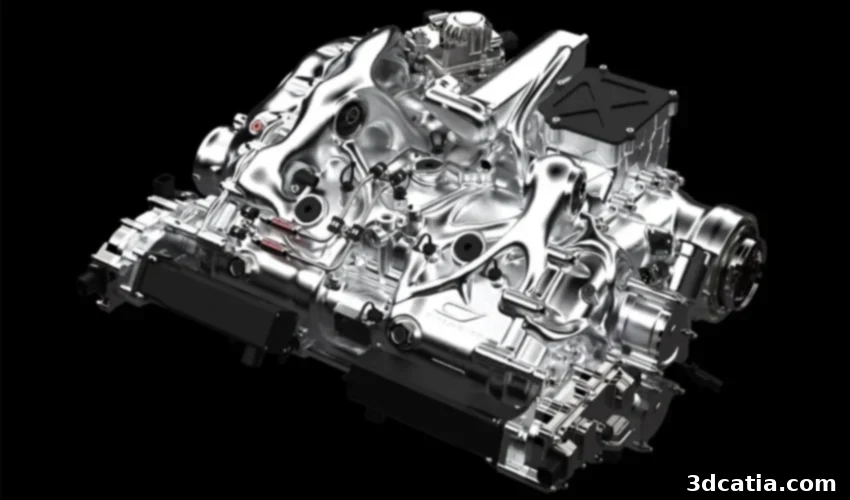
Revolutionizing Hypercar Engineering: Czinger and Xtrac Unveil Industry-First 3D Printed Gearbox
American automotive innovator Czinger Vehicles is once again setting new benchmarks in the high-performance car sector, this time by making a significant splash in the realm of additive manufacturing. The company has proudly unveiled a groundbreaking gearbox, meticulously crafted using advanced 3D printing techniques in conjunction with sophisticated topological optimization software. This pioneering development was the fruit of a strategic collaboration with Xtrac, a revered British firm renowned for its specialized expertise in developing high-performance gearboxes for the demanding world of motorsports.
The result of this cutting-edge partnership is an automated 7-speed semi-sequential gearbox, entirely 3D printed from a high-performance aluminum alloy. What makes this achievement particularly remarkable is its production without the need for traditional tooling, a testament to the transformative power of additive manufacturing. For Czinger, this innovation translates into multiple advantages: not only does it promise superior structural performance for their vehicles, but it also delivers substantial production efficiencies and significant cost savings. This advanced gearbox represents a pivotal moment for the automotive industry, showcasing how advanced manufacturing processes can redefine the limits of vehicle design and performance.
For those familiar with the forefront of automotive innovation, the name Czinger likely resonates deeply. The manufacturer operates under the umbrella of Divergent Technologies, a visionary company that has pioneered a revolutionary 3D printing platform designed to create the fundamental chassis structures for the next generation of automobiles. This commitment to pushing boundaries isn’t new; Czinger previously captivated the industry with its acclaimed 21C hypercar, a marvel of engineering whose intricate chassis was designed and optimized through a sophisticated blend of 3D printing and artificial intelligence. The development of the 21C firmly established Czinger’s profound mastery of 3D technologies, a capability they are now leveraging to revolutionize other critical vehicle components. This latest unveiling of a 3D printed gearbox isn’t just an exciting development; it’s an industry-first for the automotive sector, underscoring Czinger’s relentless pursuit of innovation and its intention to capitalize on its technological prowess.
Additive manufacturing, commonly known as 3D printing, offers unparalleled advantages in creating complex, high-performance parts. Unlike traditional subtractive methods that remove material from a block, 3D printing builds parts layer by layer, allowing for intricate geometries that were previously impossible to achieve. When combined with topological optimization, this process becomes even more powerful. Topological optimization algorithms analyze a component’s intended loads and performance requirements, then design the most efficient material distribution, often resulting in organic, lattice-like structures. For a gearbox, this means significant weight reduction without compromising strength, improved heat dissipation due to optimized internal channels, and the consolidation of multiple parts into a single, cohesive unit. These benefits are critical for hypercars where every gram saved contributes to enhanced acceleration, braking, and overall agility.
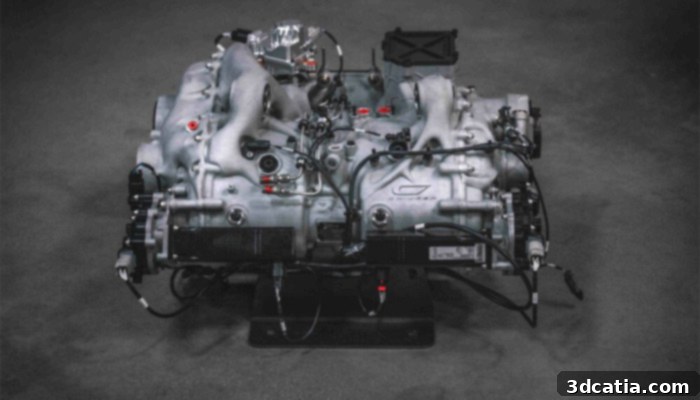
The groundbreaking 3D printed gearbox developed through the Czinger and Xtrac collaboration (photo credits: Czinger / Xtrac)
Lukas Czinger, co-founder and vice president of operations for Czinger, articulated the significance of this milestone, stating, “We are proud to team Czinger’s world-class engineers with those at Xtrac; together, we have developed an incredible, industry first, gearbox that is truly at the pinnacle of performance. We can’t wait to shatter more track records as we utilize this system in the 21C.” This quote highlights the synergy between Czinger’s innovative spirit and Xtrac’s deep engineering legacy. While both parties involved in the project have remained commendably tight-lipped about the exact printing method employed, they have confirmed that an advanced aluminum alloy was the material of choice. The selection of aluminum is crucial for a gearbox destined for a hypercar, offering an exceptional strength-to-weight ratio, excellent thermal conductivity for heat management, and durability under extreme operating conditions. Furthermore, the 3D printed gearbox boasts an impressive array of specifications designed to enhance driving dynamics, including dual barrel gear actuation and incredibly fast Sub‑100ms gear shifts, features that collectively guarantee an exceptionally smooth, responsive, and exhilarating ride, distinguishing it from conventional transmission systems.
The collaboration between Czinger and Xtrac exemplifies a powerful fusion of cutting-edge additive manufacturing capabilities with unparalleled expertise in high-performance automotive transmission systems. Xtrac, with its extensive experience in motorsports, brings a wealth of knowledge in designing gearboxes that can withstand the most rigorous conditions on track, ensuring reliability and peak performance. By integrating Czinger’s innovative approach to 3D printing and topological optimization, this partnership has managed to transcend the limitations of traditional manufacturing. The ability to prototype, test, and iterate complex designs rapidly, without the prohibitive costs and lead times associated with conventional tooling, has accelerated the development cycle and allowed for unprecedented levels of optimization. This strategic alliance not only yields a superior product but also sets a precedent for how specialized engineering firms can collaborate to unlock new potentials in automotive design and production.
Adrian Moore, CEO of Xtrac, emphasized the profound impact of this joint venture, concluding, “What our Xtrac engineers have accomplished in tandem with Czinger and Divergent is groundbreaking. Xtrac is pleased to be at the forefront of cutting-edge gearbox manufacturing by creating these 3D printed casings. It has been extremely interesting and very stimulating for our engineers working closely together to bring this cutting edge innovation to life.” Moore’s statement underscores the pioneering nature of this work, highlighting Xtrac’s commitment to staying at the vanguard of transmission technology. The successful realization of 3D printed casings for such a critical component as a gearbox signifies a paradigm shift in manufacturing methodologies, proving that additive manufacturing can move beyond prototyping to deliver production-ready parts for the most demanding applications. This collaborative effort has not only delivered a tangible, high-performance product but has also fostered an environment of innovation that promises to yield further breakthroughs in the future.
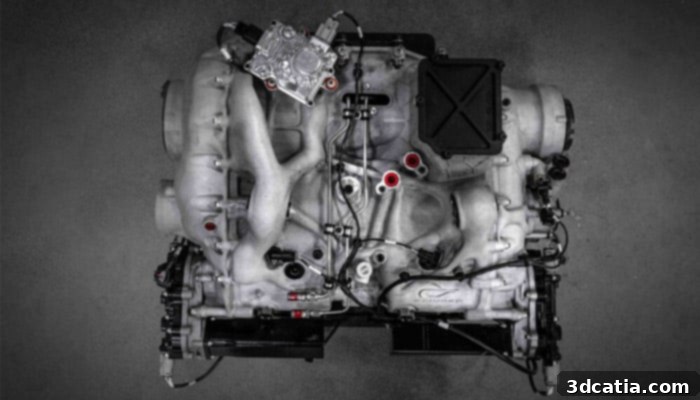
A closer look at the intricate design of the 3D printed gearbox from a top-down perspective (photo credits: Czinger/Xtrac)
As clearly demonstrated by this remarkable innovation, the newly developed 3D printed gearbox is destined for integration into Czinger’s flagship 21C hypercar. It’s imperative to remember the astonishing performance capabilities of this vehicle: the 21C is engineered to accelerate from 0 to 250 mph and then decelerate back to 0 in an astounding approximately 27 seconds. Such extreme performance demands components that are not only robust and reliable but also exceptionally lightweight and efficient. The 3D printed gearbox, with its optimized design, reduced mass, and rapid shifting capabilities, is a crucial enabler for achieving these mind-bending metrics. It’s a testament to how advanced manufacturing processes can directly translate into tangible performance gains, making the impossible, possible. This groundbreaking gearbox is more than just a part; it’s a core element of the 21C’s engineering philosophy, pushing the boundaries of what hypercars can achieve. For more detailed insights into Czinger’s commitment to innovation and their remarkable vehicles, you can find extensive information on the official Czinger website HERE.
This development by Czinger and Xtrac is poised to have a ripple effect across the automotive industry, particularly in high-performance and specialty vehicle segments. The ability to design and produce complex, optimized components with unprecedented speed and efficiency heralds a new era of automotive engineering. Beyond the immediate performance benefits, this approach also champions more sustainable manufacturing by reducing material waste and enabling localized production. It showcases a clear path forward for integrating advanced manufacturing into the core of vehicle development, moving beyond traditional prototyping to full-scale production of critical components. As vehicle electrification and lightweighting become increasingly important, the lessons learned from projects like Czinger’s 3D printed gearbox will undoubtedly inspire future innovations, proving that the future of automotive manufacturing is undeniably intertwined with additive technologies.
What are your thoughts on this revolutionary 3D printed gearbox and its potential impact on the automotive industry? We invite you to share your insights in a comment below or join the conversation on our LinkedIn, Facebook, and Twitter pages! Don’t forget to sign up for our free weekly Newsletter here, ensuring you receive the very latest 3D printing news directly to your inbox! You can also explore all our engaging videos on our YouTube channel.
*Cover Photo Credits: Czinger/Xtrac