
Revolutionizing Industries: Latest Advancements in 3D Printing Technology Across Defense, Bioprinting, and Sustainable Construction
The world of additive manufacturing continues to push boundaries, demonstrating its transformative power across an incredible range of sectors. From enhancing national defense capabilities and advancing medical science to pioneering sustainable construction methods and enabling rapid post-conflict rebuilding, 3D printing is at the forefront of innovation. Just yesterday, we highlighted the U.S. Defense Advanced Research Projects Agency’s (DARPA) significant investment of over $10 million into predicting the lifespan of 3D printed parts, a testament to the technology’s growing strategic importance. Today, the momentum continues with a wave of groundbreaking developments that underscore the versatility and impact of 3D printing. We delve into a crucial partnership between Velo3D and the U.S. Navy, the unveiling of TissueLab’s innovative new bioprinter, a revolutionary resin developed by scientists at UC Santa Barbara and Lawrence Livermore National Laboratory, and significant strides in sustainable construction through Ukraine’s rebuilding efforts using recycled concrete, culminating with the completion of the world’s largest 3D printed tower in Switzerland.
Velo3D Partners with the U.S. Navy to Boost Additive Manufacturing in Defense and Aerospace
In a move set to significantly accelerate the adoption of advanced manufacturing technologies within critical sectors, Velo3D, a prominent metal additive manufacturing company, has officially signed a four-year agreement with the Naval Air Warfare Center Aircraft Division (NAWCAD) and Fleet Readiness Center East (FRC East). This strategic collaboration is specifically designed to advance additive manufacturing capabilities, particularly for high-performance aerospace and defense components. The partnership aims to characterize new advanced materials, enabling the development and qualification of high-performance parts that not only meet but exceed the incredibly demanding standards inherent in the military sector.
Through this pivotal alliance, Velo3D’s state-of-the-art metal 3D printing capabilities, prominently featuring its renowned Sapphire line of printers, will be instrumental in producing military flight hardware. The Sapphire printers are celebrated for their exceptional precision, unparalleled repeatability, and robust scalability, crucial attributes for mission-critical applications where failure is not an option. This collaboration underscores a shared vision to leverage advanced manufacturing for enhanced operational readiness and technological superiority. By focusing on engineering-driven solutions and rigorous qualification processes, Velo3D is helping to bridge the existing gap toward qualifying AM flight hardware, thereby enabling the production of vital components that must consistently meet the stringent reliability and performance demands of modern defense applications. This partnership signifies a major step forward in integrating additive manufacturing directly into the defense supply chain, offering benefits such as faster lead times, reduced costs through on-demand production, and the ability to create complex, lightweight structures previously impossible with traditional manufacturing methods.
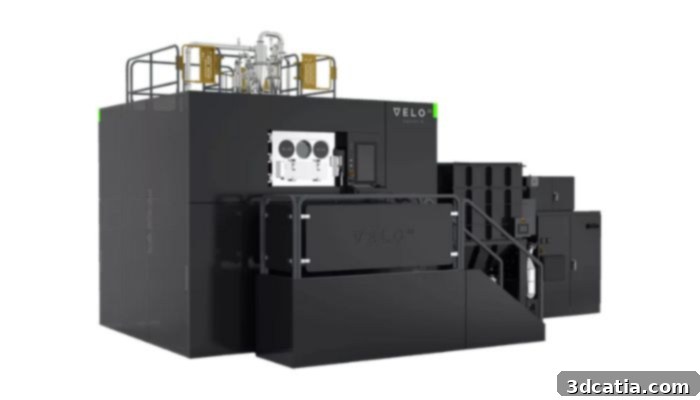
A Velo3D Sapphire XC metal printer. Photo Credits: Velo3D
TissueLabs Presents Its New TissuePro 3D Bioprinter for Advanced Medical Research
Building on their impressive trajectory since their introduction in 2022, TissueLabs, the innovative Swiss medical start-up, continues to make significant strides in the field of regenerative medicine. Known for its ambitious goal of creating functional organs using 3D bioprinters, the company has now unveiled its latest breakthrough machine: the TissuePro. This new bioprinter represents a culmination of TissueLabs’ expertise and dedication to advancing tissue engineering and regenerative therapies. The TissuePro operates on the robust extrusion process, a widely recognized method in bioprinting that allows for the precise deposition of biomaterials. What sets it apart is its sophisticated design, equipped with five independent print heads, each boasting its own piston. This innovative multi-head configuration provides unparalleled flexibility, enabling the simultaneous use of various biomaterials and offering an astonishing micron-level resolution, critical for replicating the intricate structures found in human tissues.
The TissuePro’s ability to combine multiple biomaterials, encompassing both transparent and non-transparent varieties, allows researchers to create increasingly complex and physiologically accurate tissue structures. This capability is paramount for pushing the boundaries of scientific discovery, particularly in areas like cancer research, where highly precise models are essential for understanding disease progression and testing novel treatments. Beyond this, the TissuePro is designed to facilitate the creation of more accurate organ models, which are invaluable for drug development and toxicity screening, significantly reducing the reliance on animal testing. TissueLabs founder and CEO, Dr. Gabriel Liguori, passionately articulates the vision behind this new innovation: “TissuePro is everything we’ve learned, reinvented, and reimagined. If you loved TissueStart, get ready. You’re about to fall in love all over again.” This sentiment highlights the continuous evolution of TissueLabs’ technology, promising exciting new possibilities for medical research and the eventual realization of bioprinted organs for transplantation.
New Resin Capable of Creating Both Solid Objects and Dissolvable Supports for 3D Printing
A significant breakthrough in vat photopolymerization 3D printing has been achieved by a collaborative team of scientists from the University of California Santa Barbara and the Lawrence Livermore National Laboratory (LLNL). They have successfully demonstrated a novel resin that possesses a remarkable dual functionality: it can be transformed into either solid structural objects or dissolvable support structures, depending solely on the specific type of light it is exposed to during the printing process. This innovation addresses a long-standing challenge in resin-based 3D printing. Traditionally, when fabricating complex geometries with unsupported features such as overhangs or bridges, solid supports are printed alongside the main object. These supports then require tedious and often damaging manual removal during post-processing, which can be time-consuming, expensive, and sometimes compromises the integrity of the final part.
This revolutionary new resin offers an elegant solution by providing the option to dissolve the supports after printing. The researchers achieved this by combining a base-degradable thermoset – a type of polymer that can be selectively broken down in a basic solution – with the primary structural material within a single, convenient one-pot formulation. The printing process itself utilizes a dual-wavelength negative imaging (DWNI) DLP (Digital Light Processing) printer. The degradable thermoset is precisely solidified using visible light, while the permanent structural material is cured with UV light. Crucially, both types of light can be simultaneously projected using a single digital micromirror device (DMD), allowing for intricate control over which parts of the resin form the main structure and which form the temporary supports. Once the printing is complete, the object undergoes a thermal post-processing step to fully set and strengthen the primary material. Following this, the thermoset supports are simply dissolved away in a basic liquid, leaving behind a clean, complex object with minimal post-processing effort. This pioneering DLP method holds immense potential to significantly broaden the range of 3D printable materials and structures, opening doors for more intricate designs, cleaner parts, and more efficient manufacturing workflows across various industries.
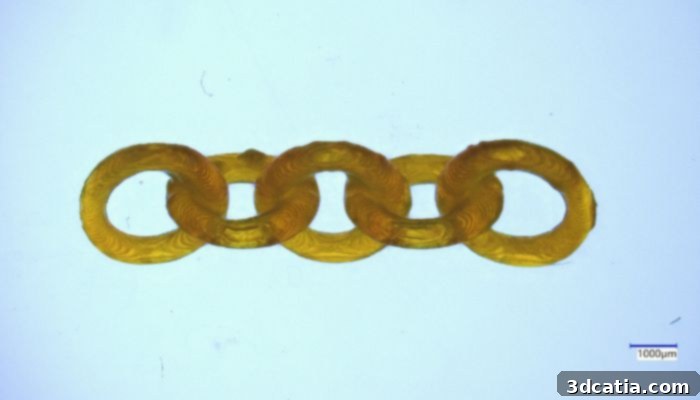
A chain 3D printed with the new vat photopolymerization technique. Photo Credit: Adapted from ACS Central Science 2025
Ukraine Boosts Reconstruction with Recycled Concrete for 3D Printing
Amidst the ongoing challenges, Ukraine is demonstrating remarkable resilience and ingenuity in its efforts to rebuild and recover. The Kyiv National University of Construction and Architecture (KNUBA) is at the forefront of a groundbreaking project that seeks to transform devastation into sustainable reconstruction. This ambitious initiative focuses on developing novel concrete mixtures derived directly from the rubble of destroyed buildings. The core objective is to integrate these recycled mixtures into both traditional construction practices and advanced 3D printing techniques, thereby dramatically accelerating the much-needed reconstruction of damaged infrastructure across Ukraine. This project not only addresses the immediate need for building materials but also tackles the significant environmental challenge of managing vast amounts of demolition waste.
The dedicated teachers and students at KNUBA are committed to utilizing waste materials not just from collapsed structures but also incorporating industrial and agricultural waste. This holistic approach aims to create innovative building materials that are not only environmentally friendly but also remarkably low-cost and highly resistant. The integration of 3D printing into this process is particularly significant, as it allows for the rapid, precise, and cost-effective construction of various structures, from housing units to critical infrastructure components. The two-year project has garnered substantial international backing, receiving vital financial support from the U.S. Office of Naval Research and the U.S. National Science Foundation. This international collaboration underscores the global recognition of Ukraine’s innovative approach to sustainable reconstruction and highlights the potential of 3D printing in humanitarian and disaster relief contexts. By turning debris into resources, KNUBA is paving the way for a more sustainable and efficient rebuilding process, setting a powerful example for post-conflict recovery worldwide.
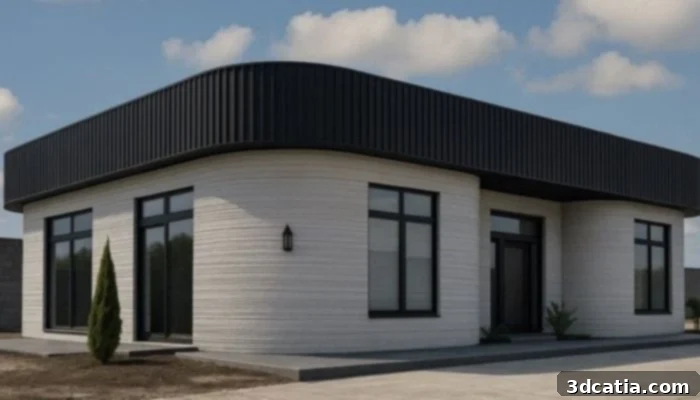
Kyiv National University of Construction and Architecture launches project to create a 3D-printed concrete from rubble. Photo Credits: Interfax Ukraine
Tallest 3D Printed Tower in the World Unveiled in Swiss Village
In a monumental achievement for construction 3D printing and a beacon of hope for a small Alpine community, the world’s tallest 3D printed tower, Tor Alva – meaning “White Tower” in Romansh – was officially unveiled on May 20th in the picturesque village of Mulegns, Switzerland. Standing at an impressive height of nearly 30 meters, this structure immediately captured global attention as a testament to the capabilities of modern additive construction. Nestled beautifully between the rolling green mountains of the Julier Pass, the tower presents a striking and harmonious blend of innovative technology and natural beauty. Its design is characterized by elegantly twisting white columns, meticulously 3D printed from soft concrete, creating a unique aesthetic that is both futuristic and organic.
This ambitious project was born out of a fruitful collaboration between the Origen cultural foundation, renowned for fostering innovative cultural experiences, and ETH Zurich, a leading institution in technology and engineering. The visionary design was conceived by architects Benjamin Dillenburger and Michael Hansmeyer, whose work often explores the intersection of computation and architecture. The Tor Alva is now open daily for guided tours, offering visitors a chance to experience this architectural marvel firsthand. Furthermore, it is slated to become a vibrant venue for staging performances starting this July, adding a dynamic cultural dimension to its existence. A key innovative aspect of the tower’s design is its modularity, which allows components to be easily disassembled. In a truly forward-thinking move, the tower is designed to be taken apart and relocated to another village in five years. This transient nature highlights its role as a movable cultural asset and a catalyst for development. For Mulegns, a village with a mere 11 inhabitants, facing the serious threat of depopulation, the Tor Alva is more than just a structure; it is a symbol of revitalization. Local leaders ardently hope that the tower will not only attract a steady stream of tourists but also inspire future residents to make Mulegns their home, thereby securing the village’s future and demonstrating how cutting-edge technology can address socio-economic challenges.

Photo Credit: Birdviewpicture / Nova Fundaziun Origen)
The innovations highlighted today – from strategic defense partnerships and advancements in bioprinting to revolutionary material science and sustainable architectural feats – underscore the relentless evolution and diverse impact of 3D printing technology. These developments are not just incremental improvements but represent transformative shifts in how we approach manufacturing, medicine, and construction.
What are your thoughts on Velo3D’s partnership with the U.S. Navy and the broader implications of these additive manufacturing advancements? Let us know in a comment below or join the conversation on our LinkedIn or Facebook pages! To stay at the forefront of the latest developments in additive manufacturing, don’t forget to sign up for our free weekly Newsletter, delivering the most important 3D printing news directly to your inbox. You can also explore all our insightful videos and engaging content on our YouTube channel. For more specialized news focusing on 3D printing within the aerospace and defense sectors, be sure to check out our dedicated page HERE.