
CASTOR: Driving Efficiency and Cost Savings in 3D Printing Manufacturing with Advanced Software Solutions
In the dynamic landscape of modern manufacturing, a pioneering Israeli startup named CASTOR is making significant strides. Recognized as our 3D startup of the month, CASTOR has engineered a sophisticated software solution designed to empower manufacturers by substantially reducing lead times and manufacturing costs specifically within the realm of 3D printing. The core objective of this innovative platform is to unlock and harness the full benefits of additive manufacturing, thereby enabling businesses to achieve greater competitiveness in an increasingly demanding global market. With CASTOR’s intuitive solution, users gain the ability to comprehensively analyze and confidently determine the printability of a given part, meticulously select the most appropriate 3D printing technology and material, and retrieve crucial real-time data on the performance and viability of their printed components. To delve deeper into the intricacies of this powerful platform and understand the transformative benefits it offers across various industries, we had the privilege of sitting down with Omer Blaier, the visionary CEO of CASTOR.
3DN: Can you introduce yourself and describe your journey and relationship with 3D printing technology?

Omer Blaier
Certainly. My name is Omer Blaier, and I currently serve as the CEO of CASTOR. My academic background is rooted in Mechanical Engineering, and I further augmented my expertise with an MBA specializing in Entrepreneurship and Innovation, both degrees proudly earned from Tel Aviv University. My involvement with the fascinating world of 3D printing began approximately a decade ago, marking a pivotal point in my career. I first entered this field when I joined Objet Geometries, a company that later merged with Stratasys, becoming one of the industry’s titans. During my tenure there as an R&D Project Manager, my responsibilities were extensive and multifaceted. I was actively involved in initiating groundbreaking projects, meticulously planning their execution, overseeing their development, and ultimately ensuring the successful delivery of innovative new products to the market. This hands-on experience provided me with an invaluable perspective on the capabilities, challenges, and immense potential within the additive manufacturing sector, laying the groundwork for what would eventually become CASTOR.
3DN: What was the inspiration behind creating CASTOR? And for whom is this innovative software primarily designed?
The fundamental principle guiding the development of any successful product is a deep understanding and responsiveness to people’s evolving needs. Throughout my decade-long immersion in the 3D printing industry, a recurring observation crystallized into a clear market gap: many manufacturers, despite the rapid advancements and transformative potential of 3D printing technology, were either lagging in adopting these innovations or simply lacked the requisite in-house expertise to effectively leverage this progress. This critical insight served as the genesis for the CASTOR software idea. Once the problem was clearly defined, the next crucial step was assembling the right team—a task that proved remarkably straightforward for me. I first met my co-founders, Elad Schiller and David Calderon, an impressive 18 years ago while we were serving in the Israeli Air Force. Our bond has remained strong ever since. Beyond the invaluable trust we share, I recognized in both Elad and David the exceptional technical prowess and acute business acumen that were absolutely essential to successfully build and scale CASTOR into the robust solution it is today.
CASTOR is thoughtfully designed to cater to a broad spectrum of users, encompassing both seasoned additive manufacturing experts and those who are new to the field. For non-experts, CASTOR offers an exceptionally user-friendly interface, requiring minimal input from the user while providing powerful insights that lead to more informed and strategic manufacturing decisions. This simplicity breaks down significant barriers to entry for companies exploring 3D printing for the first time. For experienced additive manufacturing professionals, the most compelling benefit of CASTOR lies in its unparalleled ability to automate what is currently a largely manual, highly complex, and incredibly time-consuming part screening and analysis process. By streamlining this critical initial phase, CASTOR drastically enhances efficiency, allowing experts to focus on optimization and innovation rather than repetitive manual tasks, thereby accelerating the entire additive manufacturing workflow.
3DN: How does the CASTOR software function, and what are the primary advantages it offers to the industry?
CASTOR operates by conducting a thorough and sophisticated technical and economic analysis of CAD (Computer-Aided Design) files. This deep analysis allows the software to provide highly detailed and actionable feedback, precisely identifying which parts would derive significant benefits from being produced via 3D printing methods, as opposed to conventional manufacturing techniques. The software doesn’t stop there; it intelligently recommends the most suitable combinations of 3D printer and printable materials, meticulously tailored to meet each part’s unique requirements, performance specifications, and economic considerations. Furthermore, CASTOR provides accurate estimations of production costs and lead times for every part, enabling manufacturers to forecast expenditures and schedules with greater precision. A standout feature is its ability to visualize the break-even points between 3D printing and traditional manufacturing, offering clear financial insights. Finally, to complete the end-to-end solution, CASTOR efficiently connects the manufacturer to a vetted network of service bureaus capable of printing and supplying the required parts, effectively bridging the gap between design and production.
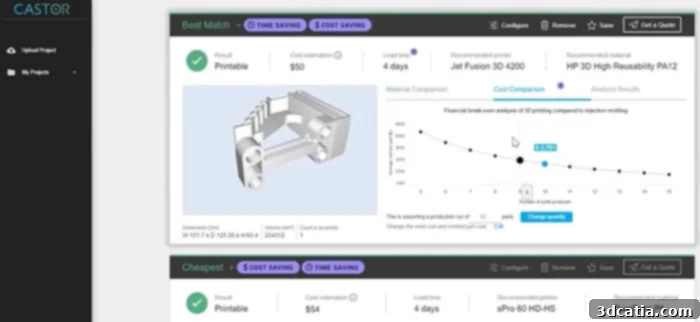
CASTOR’s software in action, showcasing analysis capabilities
Manufacturers can extract immense value from integrating CASTOR throughout their entire product lifecycle – from the nascent stages of initial design all the way through to mass production and the management of spare parts. During the critical design stage, the software empowers users to fully capitalize on the unique and advanced capabilities inherent in 3D production. This includes transformative possibilities such as consolidating multiple individual components into a single, optimized part, or significantly reducing the weight and complexity of designs without compromising structural integrity or functionality. In the various subsequent stages of production, CASTOR enables manufacturers to drastically mitigate the notoriously high costs frequently associated with producing small quantities of specialized parts. Critically, it also helps them achieve substantial reductions in lead time for part delivery. A compelling real-world example of this efficacy comes from Stanley Black and Decker, who, by utilizing CASTOR, were able to achieve remarkable savings of 8 weeks in lead time and a significant 50% reduction in cost across a family of parts at their Engineering Fastening facility located in Danbury, CT. Beyond immediate production benefits, CASTOR serves as an invaluable tool for inventory digitalization, leading to demonstrably lower costs associated with maintaining and managing spare parts inventories, improving supply chain resilience and efficiency.
Furthermore, CASTOR’s utility extends beyond direct manufacturers. It provides significant advantages to Additive Manufacturing (AM) providers, including 3D printer OEMs, specialized service bureaus, and material development companies. By offering a pulse on market demand and trends, our software enables these providers to strategically grow their AM businesses. Our recent and highly successful collaboration with Evonik, for instance, led to the development of a bespoke part screening tool. This tool, while retaining its unique brand identity and user experience, is powerfully underpinned by CASTOR’s sophisticated analytical expertise and algorithms. This partnership exemplifies how CASTOR can be customized and integrated to serve specific industry needs, offering unparalleled insights. We are proud to offer a free trial of this tool, allowing anyone to experience its benefits firsthand.
3DN: In your assessment, what is the current state of additive manufacturing adoption, and what do you identify as its primary limitations?
We are consistently observing a clear and sustained trend in the application of 3D printing, moving significantly beyond its traditional role in rapid prototyping. The industry is increasingly shifting towards the direct production of end-use parts, indicating a maturation of the technology and its acceptance in mainstream manufacturing. However, the exact magnitude and pace of this trend exhibit considerable variation, largely dependent on specific industries, vertical markets, and individual company strategies. Generally, we are witnessing a dramatic reduction in the price per part, a positive development primarily fueled by heightened competition, particularly within the plastics segment of additive manufacturing. We anticipate a similar, significant downward trend in metal 3D printing costs, projecting this shift to become pronounced in 2021 and beyond, making metal AM more accessible to a wider range of industries.
Despite these advancements, several key limitations continue to impede the broader adoption of additive manufacturing. A significant challenge arises from the fact that parts produced via 3D printing often exhibit different mechanical properties compared to those manufactured through traditional methods. This difference can frequently deter manufacturers, especially those in highly regulated or performance-critical sectors, from transitioning currently traditionally manufactured parts to additive processes. The perceived switching costs associated with adopting 3D printing are also considerably high. Companies express legitimate concerns about making substantial investments in new technology without absolute certainty regarding the outcome, especially when considering the rigorous validation and certification processes required for many applications. These costs extend beyond just machinery; they include expenses like hiring specialized experts in additive manufacturing, and the considerable time and resources required to screen thousands of potential parts and meticulously analyze vast amounts of data to determine AM suitability. By minimizing the inherent complexity and significantly shortening the duration of this crucial part screening process, solutions like CASTOR are inherently designed to lower these substantial transitional costs, thereby de-risking the adoption of 3D printing for a greater number of manufacturers.
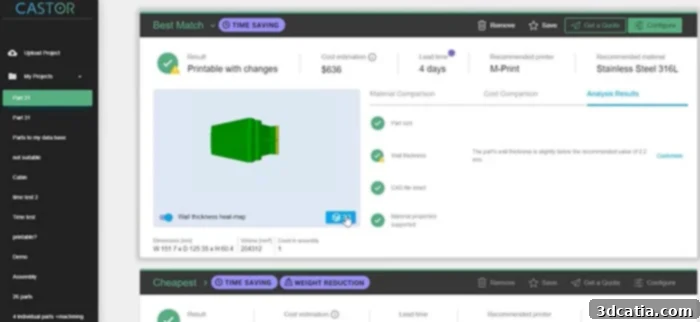
CASTOR’s core aim is to reduce manufacturing costs and lead times through additive manufacturing optimization
3DN: Where do you envision CASTOR in the next five years?
Our team is currently working at full throttle on the development of CASTOR Enterprise – an advanced and significantly more comprehensive version of our existing software. This next-generation platform will incorporate sophisticated integrations with various leading CAD/ERP software systems, creating a more seamless and interconnected digital manufacturing ecosystem. A key feature of CASTOR Enterprise will be its enhanced capabilities for providing intelligent recommendations specifically tailored for optimizing and even re-designing parts to maximize the benefits of additive manufacturing. This will enable a much more streamlined, effective, and automated part screening and optimization process, pushing the boundaries of what’s possible with AM. Our vision is to empower engineers and designers not just to identify printable parts, but to innovate designs specifically for AM processes, unlocking entirely new levels of performance and efficiency.
Looking ahead, I firmly believe that over the next five years, 3D printing will achieve significant milestones on its path towards widespread industrial adoption. We are on the cusp of witnessing an exponential emergence of an unprecedented number of new materials, advanced printers, and diverse additive manufacturing technologies entering the market. While this proliferation presents incredible opportunities, it will simultaneously present manufacturers with an increasingly difficult and complex task: choosing the absolute best-fit combination of these various options for each specific part and application. This is precisely the sophisticated problem that CASTOR will be expertly solving. Our mission will evolve to become the central intelligence hub for complexity management within additive manufacturing, guiding manufacturers through the vast landscape of choices to make optimal decisions that drive efficiency, reduce costs, and accelerate innovation. We aim to be the indispensable tool that transforms complexity into clarity, enabling every manufacturer to fully harness the power of 3D printing.
3DN: Do you have any final message for our readers?
We at CASTOR fundamentally believe that the process of accurate and efficient part identification is not merely a step, but the crucial stepping-stone and gateway to successfully embracing and integrating additive manufacturing within any organization. Automating this often laborious process, and critically, coupling it with dynamic, data-driven recommendations that are precisely tailored to a part’s unique properties, are the essential keys. These elements will unlock the potential for a greater number of manufacturers to confidently adopt this transformative technology and fully capitalize on its myriad benefits, from design flexibility to supply chain resilience. For those interested in exploring how CASTOR can revolutionize their manufacturing processes and unlock new efficiencies, you can find more detailed information and resources HERE. We invite you to discover how our software can streamline your additive manufacturing journey.
What are your thoughts on CASTOR’s innovative approach to optimizing additive manufacturing? We encourage you to share your insights in a comment below or connect with us on our Facebook and Twitter pages! Don’t miss out on the latest advancements and news in the world of 3D printing – remember to sign up for our free weekly Newsletter, delivering all the essential updates directly to your inbox!