

Additive Manufacturing Innovation Soars: A Deep Dive into Patent Growth and Leading Companies
In a rapidly evolving technological landscape, the ability to innovate and protect intellectual property is paramount for sustained growth and competitive advantage. A recent and highly anticipated study by IFI Claims Patent Services, a globally recognized authority in patent data analysis, sheds critical light on the innovation trends within the United States’ technology sector. This comprehensive analysis meticulously examined patent applications filed between 2016 and 2020, identifying the ten most significant growth categories. Among these high-potential fields, one technology stands out for its remarkable trajectory and future promise: Additive Manufacturing (AM).
The study reveals that additive manufacturing, often referred to as 3D printing, secured the 9th position among these top-growth technology sectors. This ranking is not merely a statistical anomaly but a profound indicator of the industry’s dynamism. According to IFI Claims, the number of patents filed within the AM market experienced an astounding annual growth rate of 27.14% over the five-year period. Such robust expansion unequivocally demonstrates not only the sector’s inherent resilience in the face of economic shifts but also its unparalleled capacity for continuous innovation. This surge in patent activity underscores the strategic investments being made in research and development, signalling a maturation of the additive manufacturing ecosystem and its increasing relevance across diverse industries. Companies such as HP, General Electric, and Kinpo Electronics emerged as some of the most prolific patent filers, spearheading this wave of innovation.
Unpacking the IFI Claims Study: AM’s Prominent Position in Emerging Tech
The IFI Claims Patent Services report serves as a crucial benchmark for understanding the forefront of technological advancement. The study meticulously highlighted ten high-potential technologies poised for significant impact. While our primary focus remains on additive manufacturing, it’s insightful to contextualize its growth within this broader landscape. The top position was claimed by computer systems based on biological models, a testament to the burgeoning field of bioinformatics and AI. Following closely were electronic cigarettes, indicating rapid innovation in consumer health technologies. Other notable mentions in this influential ranking include quantum computers, signaling a new era in computational power; machine learning, a cornerstone of modern artificial intelligence; and angiosperms, highlighting advancements in agricultural and biological sciences. This diverse list underscores the breadth of innovation currently underway, with additive manufacturing carving out a significant niche among these transformative fields.
What makes additive manufacturing’s performance particularly compelling is its resilience, especially when considering the global challenges faced during the study period. Despite the unprecedented impact of the pandemic in 2020, the overall number of patents granted across all sectors saw only a marginal decrease of barely 1% compared to 2019. More strikingly, patent *applications* for the same year actually *increased* by 5%. This dichotomy suggests that while the processing of grants might have faced minor delays, the pipeline of innovation remained robust, with companies continuing to invest heavily in R&D and securing their intellectual property for future technologies. Additive manufacturing’s strong growth within this context is a clear testament to its perceived long-term value and strategic importance.
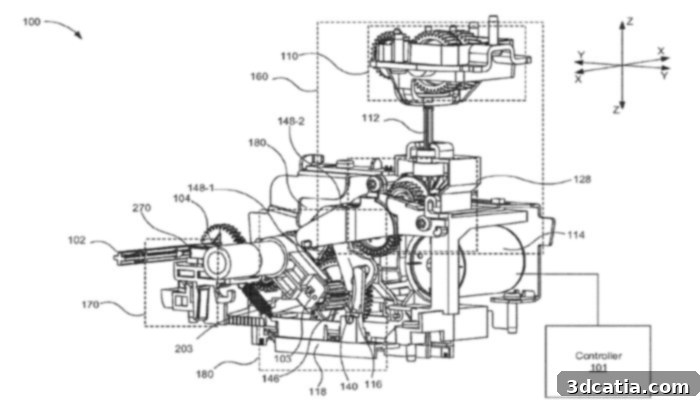
A representative patent filed by HP | Image Credits: US Patent
The Powerhouses of Patenting: Leading Innovators in Additive Manufacturing
Delving deeper into the additive manufacturing sector, the IFI Claims report meticulously identifies the companies at the forefront of patent innovation. These entities are not just adopters of 3D printing technology but are actively shaping its future through their extensive research and development efforts. Their patent filings provide a window into the strategic directions and technological advancements that are defining the industry.
HP: A Dominant Force in AM Patents
Leading the pack in 2020 was HP, with an impressive 470 patents filed in the additive manufacturing space. This significant number underscores HP’s aggressive strategy and deep commitment to becoming a leader in industrial 3D printing. Since its entry into the AM market with Multi Jet Fusion (MJF) technology, HP has consistently invested in enhancing its hardware, software, materials, and post-processing solutions. Their patents likely cover advancements in printhead technology, new material formulations, automation of the printing process, and integration with broader digital manufacturing workflows. HP’s sustained patent activity signals a concerted effort to expand the applications and accessibility of its 3D printing solutions, moving beyond prototyping into mass production of end-use parts. This aggressive intellectual property strategy is key to securing their position in a competitive market.
General Electric (GE): Driving Innovation in High-Value Applications
Following closely behind HP, General Electric (GE) filed 331 patents, solidifying its strong presence in the additive manufacturing landscape. GE has been a pioneer in integrating AM into critical high-value applications, particularly within its aviation and healthcare divisions. Their patents often focus on advanced metal additive manufacturing processes, such as DMLM (Direct Metal Laser Melting), for producing complex components for jet engines, gas turbines, and medical implants. Innovations in material science, part qualification, process monitoring, and design for additive manufacturing are likely key areas of their patent portfolio. GE’s investment in AM patents highlights its dedication to leveraging 3D printing for performance optimization, weight reduction, and supply chain resilience in highly demanding sectors.
Kinpo Electronics and XYZPrinting: A Combined Force
An intriguing aspect of the study is the combined strength of Kinpo Electronics and its subsidiary, XYZPrinting, which together filed 273 and 272 patents respectively. This effectively positions their collective efforts as a formidable force in the AM patent arena. Both companies belong to the same group, and their combined patent count indicates an aggressive and broad-ranging strategy in additive manufacturing. XYZPrinting has historically been known for its accessible desktop 3D printers and consumer-grade solutions, suggesting that their patents might cover advancements in user-friendly interfaces, cost-effective printing technologies, and a wider array of materials for personal and small business use. Kinpo Electronics, as a diversified manufacturing giant, likely contributes patents related to industrial-scale production, automation, and broader integration of AM into various electronics and manufacturing processes. Their joint approach suggests a comprehensive strategy, targeting both the entry-level and more advanced segments of the AM market.
Boeing: Pioneering Aerospace Additive Manufacturing
Aerospace giant Boeing secured the 5th position with a total of 195 patents. This strong showing is entirely consistent with the aerospace sector’s long-standing reliance on and continuous innovation in additive manufacturing. AM offers unprecedented advantages for aerospace applications, including the ability to produce lightweight, highly complex components with optimized geometries, which are crucial for fuel efficiency and performance. Boeing’s patents are particularly focused on the methods developed to treat powder particles using plasma radiation, a critical aspect of ensuring material integrity and part quality in metal AM. This innovation aims to enhance the mechanical properties and surface finish of printed parts, making them suitable for the stringent requirements of flight-critical components. The aerospace industry’s adoption of AM is a powerful testament to the technology’s capability to deliver performance benefits and revolutionize manufacturing processes for mission-critical applications.
Beyond the Top Filers: Broad Industry Adoption and Diverse Applications
While the spotlight often falls on the leading patent holders, the IFI Claims study also broadened its scope to examine the top 1,000 companies receiving patents in the United States, specifically identifying those with significant activity in 3D printing. This wider view reveals a healthy and diverse ecosystem of innovation, extending beyond the most prolific filers to a variety of specialized and established industry players. These companies represent the extensive reach of additive manufacturing across different applications and market segments, from advanced composites to consumer products.
Among the manufacturers recognized for their active role in 3D printing are pioneers such as Continuous Composites, which is pushing the boundaries of continuous fiber 3D printing for high-strength, lightweight structures. Xerox, a company with a long history in imaging and printing, has also made significant strides into additive manufacturing, exploring liquid metal printing technologies. Concept Laser, now part of GE Additive, remains a foundational name in metal additive manufacturing, with patents likely covering advancements in their laser melting systems. Furthermore, Carbon has distinguished itself with its Digital Light Synthesis (DLS) technology, focusing on engineering-grade materials and high-volume production of end-use parts, indicating a robust patent strategy around their unique process and material science.
The study also highlighted significant growth in patent applications from companies not traditionally considered core additive manufacturing players but who are increasingly leveraging the technology. Automotive giant Ford, for example, has recorded very strong growth in its AM-related applications. Ford is integrating 3D printing into its manufacturing processes for rapid prototyping, tooling, jigs and fixtures, and even for producing specialized end-use components, demonstrating how AM can streamline production and enable greater design flexibility in the automotive sector. Similarly, Align Technology, renowned for its Invisalign clear aligners, has shown remarkable growth in patent filings, underscoring the critical role of additive manufacturing in mass-customized medical and dental devices. This broad adoption across diverse industries is compelling proof that more and more companies are relying on additive manufacturing to develop their solutions, taking full advantage of this technology’s unique benefits—from accelerated product development to enhanced performance and personalized production.
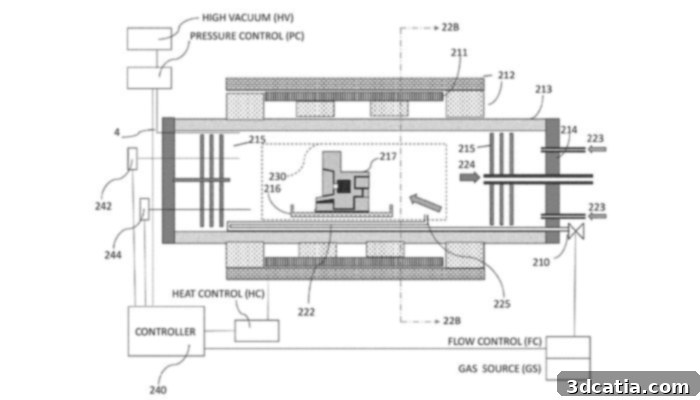
Markforged has filed a patent for its advanced sintering furnace technology | Image Credits: US Patents
The Future of Innovation in Additive Manufacturing
The IFI Claims study paints a clear picture of additive manufacturing as a vibrant and rapidly expanding field of innovation. The consistent growth in patent filings, especially from diverse industry leaders and specialized AM firms, suggests a future where 3D printing becomes an even more integral part of global manufacturing. This surge in intellectual property indicates a maturation of the technology, moving beyond its initial prototyping applications into serious production roles across industries like aerospace, automotive, medical, and consumer goods. We can anticipate further breakthroughs in materials science, automation, artificial intelligence integration with design and manufacturing, and enhanced post-processing solutions, all of which will continue to drive patent activity.
The commitment shown by companies like HP, GE, Kinpo Electronics, Boeing, and many others, to continuously invest in and protect their AM innovations, is a strong indicator of the technology’s long-term potential. As the barriers to adoption decrease and the capabilities of 3D printing expand, we are likely to see an even broader range of companies leveraging its advantages, leading to more sustainable, efficient, and customized manufacturing processes globally. The patent landscape will remain a crucial battleground for competitive advantage, pushing the boundaries of what’s possible with additive manufacturing.
For those interested in a deeper dive into these fascinating developments, the full IFI Claims Patent Services study is an invaluable resource and can be accessed HERE. We encourage you to explore the detailed findings and statistics that underscore the incredible growth and innovation within the additive manufacturing sector. What are your thoughts on these significant developments in the AM sector? How do you foresee these trends shaping the future of manufacturing and technology? We invite you to share your insights and engage in the conversation by leaving a comment below, or by connecting with us on our Facebook and Twitter pages! To stay abreast of the very latest news, breakthroughs, and analyses in 3D printing, remember to sign up for our free weekly Newsletter, delivered straight to your inbox.