
Revolutionizing Endometriosis Treatment: The Promise of 3D Printed Ovules and Targeted Drug Delivery
Endometriosis is a debilitating chronic condition affecting millions of women worldwide, characterized by the growth of endometrial-like tissue outside the uterus. This often leads to severe pelvic pain, infertility, and significant reduction in quality of life. Despite its widespread impact, research into effective, targeted treatments for endometriosis has historically lagged, leaving many women with limited therapeutic options and often inadequate drug delivery systems. A recent groundbreaking study, published in the esteemed European Journal of Pharmaceutical Sciences, heralds a new era for endometriosis management by spotlighting an innovative approach: 3D printed ovules designed for precise, localized drug delivery. This research leverages the rapidly advancing field of additive manufacturing, a technique gaining considerable traction in medical applications, to overcome some of the unique challenges prevalent in gynecology and women’s health.
Addressing Unmet Needs in Women’s Reproductive Health
Diseases impacting the female reproductive system, such as various gynecological cancers, uterine fibroids, and particularly endometriosis, frequently suffer from insufficient research attention compared to other medical conditions. This disparity often translates into a scarcity of truly effective treatment paradigms and optimized drug delivery methods for women grappling with these conditions. For endometriosis, current treatments range from pain management to hormonal therapies and surgical interventions, all of which come with their own set of limitations, including systemic side effects, recurrence rates, and varying degrees of efficacy. The critical need, therefore, is to develop therapeutic strategies that not only enhance treatment effectiveness but also significantly minimize undesirable systemic side effects. This necessitates the creation of drugs and drug delivery systems specifically tailored to local physiological environments, such as the vaginal mucosa, where they can exert their therapeutic effects directly and efficiently, circumventing broader systemic distribution.
3D Printing: A Game-Changer for Personalized Gynecological Therapies
The researchers at the University of Bern have harnessed the power of 3D printing technology to create bespoke oocytes and suppositories, offering a highly customizable and precise drug delivery platform. This pioneering approach holds immense promise within the medical domain, primarily because it facilitates the production of intricate, gel-like, and temperature-sensitive formulations perfectly suited for vaginal administration. Such capabilities are often unattainable with conventional manufacturing methods. 3D printing allows for unprecedented control over the dosage, geometry, and release profile of a drug, paving the way for truly personalized medicine. By employing extrusion technology, the research group successfully fabricated a 3D printed, semi-solid vaginal capsule. This innovative capsule was designed to contain pirfenidone, a molecule known for its potent anti-fibrotic and anti-inflammatory properties, making it a compelling candidate for endometriosis treatment, despite not yet being officially approved for this specific indication. The additively manufactured suppository was meticulously engineered to remain in place within the vaginal environment for an extended period, ensuring optimal and sustained therapeutic action. To provide a comparative benchmark, the researchers also produced standard vaginal capsules from conventional substances, allowing for robust evaluation of the 3D printed ovules’ performance.
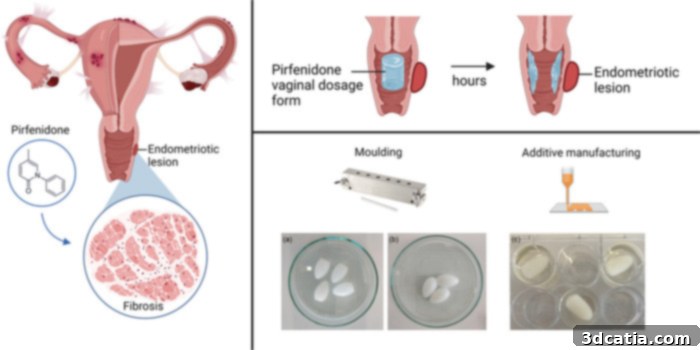
The researchers explored the potential of using Pirfenidone as a treatment for endometriosis in their study. They achieved this by implementing 3D printed ovules for the controlled release of the drug directly in the affected area (photo credits: Sarah Teworte, Simone Aleandri, Jessica Weber, Marianna Carone, Paola Luciani, University of Bern)
Pirfenidone: A Promising Candidate for Endometriosis Therapy
Pirfenidone is a well-established drug primarily utilized in the treatment of idiopathic pulmonary fibrosis, a severe chronic lung disease characterized by progressive scarring of the lungs. Its efficacy in mitigating fibrosis and inflammation has garnered significant attention, prompting its investigation for other fibrotic and inflammatory conditions. Given that endometriosis is fundamentally an inflammatory condition often involving the development of fibrotic lesions, pirfenidone emerges as a highly promising therapeutic agent. Its anti-fibrotic actions could potentially reduce lesion growth and scar tissue formation, while its anti-inflammatory properties could alleviate the chronic pain and inflammation associated with the disease. The challenge, however, lies in delivering pirfenidone effectively and locally to the affected areas without causing systemic side effects. This is precisely where the innovation of 3D printed ovules proves invaluable, offering a targeted delivery mechanism that maximizes pirfenidone’s therapeutic potential where it is needed most, directly within the vaginal mucosa and potentially in close proximity to pelvic endometrial lesions.
Superior Performance: The Advantage of Controlled Release and Mucoadhesion
The advanced capabilities of the 3D printed ovule were unequivocally demonstrated during rigorous standard pharmaceutical tests and sophisticated biorelevant evaluations. A critical requirement for an optimal pirfenidone delivery system is a delayed and sustained drug release profile. This is because pirfenidone’s metabolic activity, crucial for its therapeutic effect, benefits from approximately 24 hours of continuous exposure to the target tissue. The 3D printed ovule brilliantly met this demanding criterion, exhibiting a remarkably controlled release profile where only 90% of the drug was released after a substantial 8-hour period. This stands in stark contrast to the control capsules, which released their entire drug content within a mere 3 hours, indicating a rapid, uncontrolled release that would likely be suboptimal for pirfenidone’s action. This sustained release characteristic is a cornerstone of effective long-acting therapies, enhancing patient compliance and therapeutic outcomes by requiring less frequent dosing.
3D Printed Ovules Emerge as Clear Winners Across all Tests
Beyond their impressive controlled release kinetics, the 3D printed ovules also demonstrated exceptional physical and functional characteristics. They exhibited remarkable consistency in terms of mass and content, vital for ensuring uniform dosing and predictable therapeutic effects. Crucially, the ovules did not completely disintegrate during testing; instead, they softened gradually, perfectly aligning with the requirements of vaginal administration where comfort and prolonged residence time are paramount. This gradual softening mechanism is a significant advantage over complete disintegration, which could lead to a rapid washout of the drug. Furthermore, the additively manufactured ovule showcased favorable ex vivo performance due to its inherent mucoadhesive properties. These properties are key to the ovule’s success, enabling it to adhere effectively to the vaginal mucosa. This adherence significantly facilitates the sustained release of pirfenidone over an extended period, thereby profoundly and positively impacting treatment efficacy by ensuring continuous drug exposure at the site of action. In stark contrast, the standard oocytes, lacking these advanced characteristics, yielded notably inferior outcomes across all these crucial metrics.
The Future of Endometriosis Treatment: A Personalized Approach
Achieving these superior results involved the meticulous creation of the 3D printed ovules using specialized mucoadhesive polymers through a precise extrusion process. While this manufacturing process might require more time compared to the rapid fabrication of standard oocytes, the clinical advantages offered by the 3D printed ovules far outweigh this initial investment. Their ability to deliver drugs in a controlled, sustained, and localized manner makes them vastly more promising as advanced vaginal drug delivery systems. Consequently, the localized vaginal administration of pirfenidone via these innovative 3D printed ovules holds immense potential to significantly contribute to improved treatment outcomes for endometriosis patients in the foreseeable future. This advancement is particularly crucial given the staggering prevalence of the disease; researchers estimate that at least 11% of women, translating to more than 6.5 million individuals in the USA alone, are affected by endometriosis. Despite this high prevalence, truly effective and well-tolerated therapeutic approaches remain woefully insufficient, leaving a substantial unmet medical need. This groundbreaking research offers a beacon of hope for millions, potentially transforming the landscape of endometriosis care by providing a more targeted, effective, and patient-friendly treatment option.
This study not only underscores the transformative potential of 3D printing in personalized medicine but also highlights the critical importance of dedicated research into women’s health issues. The ability to customize drug formulations, control release profiles, and enhance local delivery dramatically opens new avenues for tackling complex conditions like endometriosis with unprecedented precision. Further research and clinical trials will be essential to translate these promising laboratory findings into approved therapies, ultimately bringing relief to countless women suffering from this challenging disease. More detailed information about the study and its comprehensive results can be found by following the link HERE.
What are your thoughts on this exciting research into 3D printed ovules for endometriosis treatment? We’d love to hear from you! Please share your insights and comments below or join the conversation on our LinkedIn, Facebook, and Twitter pages! Don’t forget to sign up for our free weekly Newsletter here to receive the latest 3D printing news directly in your inbox! You can also explore all our informative videos on our YouTube channel for more insights into additive manufacturing innovations.
*Cover photo credit: Pixabay