
The Future of Sight: University of Minnesota Pioneers 3D Printed Bionic Eyes on Curved Surfaces
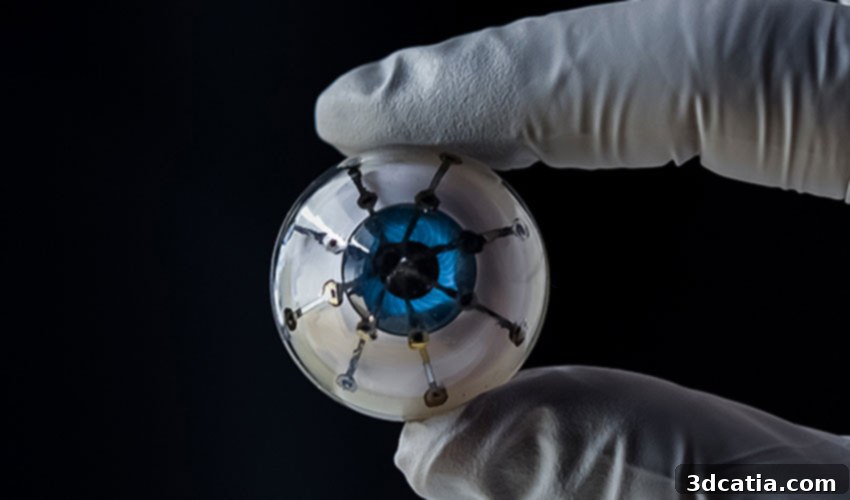
In a groundbreaking development that promises to redefine the landscape of vision restoration, the University of Minnesota (UMN) McAlpine research group has achieved a significant milestone. They report the successful 3D printing of advanced optoelectronic devices, specifically using polymeric photodetectors, directly onto hemispherical surfaces. This innovative approach has led to the creation of the first prototypes of what could ultimately become a fully 3D printed bionic eye, offering immense hope to millions worldwide grappling with various forms of visual impairments. This technological leap forward harnesses the power of additive manufacturing to create complex structures with unparalleled precision and customization, paving the way for truly personalized medical solutions.
The ability to precisely print active electronic components on a curved, dome-like surface is a critical step. Human eyes are inherently spherical, and traditional flat electronics struggle to conform to such intricate biological geometries without compromising performance. By demonstrating this capability, the UMN team has overcome a major hurdle in the development of sophisticated ocular prosthetics and advanced bio-integrated electronics. This research not only pushes the boundaries of what’s possible with 3D printing technology but also accelerates the timeline for bringing functional bionic eyes from the realm of science fiction into tangible reality for those who need them most.
The concept of a bionic eye, capable of restoring or enhancing vision, has long been a staple of futuristic narratives. Yet, what once seemed purely speculative is increasingly becoming a medical reality. Globally, several patients have already received bionic eye implants, experiencing varying degrees of success, from regaining basic light perception and object recognition to, in some fortunate cases, recovering a remarkable portion of their natural vision. These early successes underscore the transformative potential of such devices and fuel ongoing research.
In this burgeoning field, additive manufacturing holds a uniquely strong position, particularly when considering the need for intricate, patient-specific designs. For instance, recent reports have highlighted how Korean researchers successfully developed an artificial eye through 3D printing, further illustrating the global push in this area. Dr. Michael McAlpine, a co-founder of the study and a distinguished professor in the mechanical engineering department at UMN, eloquently articulates this shift: “Bionic eyes are usually thought of as science fiction, but now we are closer than ever using a multimaterial 3D printer.” His statement encapsulates the profound impact that advanced 3D printing techniques are having on accelerating medical innovation, especially in complex areas like neuroprosthetics and sensory replacement.

Unlocking Enhanced Efficacy: The Advantages of a 3D Printed Bionic Eye
The UMN McAlpine research group is no stranger to pioneering applications of 3D printing. Known for their innovative spirit, they have been at the forefront of numerous transformative projects, including the direct printing of electronic components onto human skin. This prior expertise in bio-integrated electronics and advanced materials positioned them uniquely for their latest endeavor: exploring the capabilities of additive manufacturing on rounded and complex surfaces, specifically with the human eye in mind.
To achieve their ambitious goal, the team employed a specialized 3D printer engineered to extrude fine silver nanoparticle ink. This highly conductive material was meticulously deposited onto a hemispherical glass dome, serving as a foundational layer for the sophisticated electronic components. A crucial aspect of this process was ensuring that the ink adhered consistently to the curved surface without dripping or flowing due to gravity. According to the research team, the silver nanoparticle ink demonstrated remarkable stability, remaining precisely in place and drying uniformly, which is a testament to the optimized material properties and printing parameters. This precision is vital for creating functional electronic pathways on non-planar substrates, a challenge that often limits conventional manufacturing techniques.
Following the successful deposition of the conductive silver traces, the researchers advanced to the next critical phase: integrating light-sensing elements. They utilized advanced semiconductor polymer materials to print photodiodes – specialized electronic components that are adept at converting light energy into electrical signals. These photodiodes were strategically placed within the glass dome, supported by a thin plastic film, mimicking the intricate layers of a biological eye. The entire intricate fabrication process, from the initial silver ink deposition to the final integration of the semiconductor photodiodes, was remarkably efficient, taking approximately one hour to complete. This speed and precision highlight the scalability and potential for rapid prototyping inherent in advanced 3D printing techniques.
A particularly exciting outcome of this research is the demonstrated efficiency of the printed components. Dr. McAlpine reported that the conversion of light into electricity achieved by these 3D printed semiconductors was an astonishing 25% more efficient compared to similar components produced through traditional methods. This significant improvement in efficiency is not just a technical detail; it translates directly into potentially brighter, more responsive, and more energy-efficient bionic eyes, enhancing the quality of vision restoration for future patients. Such a gain could mean the difference between basic light perception and clearer, more detailed visual information, fundamentally improving the user’s interaction with their environment.

3D printing on the rounded surface
Dr. McAlpine further emphasized the trajectory and competitive edge of their method, stating, “We have a long way to go to routinely print active electronics reliably, but our 3D-printed semiconductors are now starting to show that they could potentially rival the efficiency of semiconducting devices fabricated in microfabrication facilities.” This statement acknowledges the ongoing challenges in achieving industrial-scale reliability but also points to the immense promise of their additive approach. He then highlighted a key differentiator that provides a significant advantage for bionic eye development: “Plus, we can easily print a semiconducting device on a curved surface, and they can’t.” This ability to seamlessly integrate electronics onto non-planar, biologically relevant shapes is where 3D printing truly shines, offering customization and conformity that traditional, planar microfabrication struggles to achieve, especially for organic interfaces like the human eye.
The implications of this research extend far beyond just bionic eyes. The ability to efficiently print advanced optoelectronic devices on curved surfaces opens doors for a new generation of smart medical implants, wearable sensors, and human-machine interfaces that can perfectly conform to the body’s natural contours. This innovation could revolutionize fields ranging from prosthetics and rehabilitation to diagnostics and continuous health monitoring, creating devices that are more comfortable, less intrusive, and significantly more effective due to their tailored fit and function.
Looking ahead, the next crucial steps for the UMN McAlpine research group involve creating prototypes equipped with even more sensitive and efficient light receivers. This continuous improvement in light detection is essential for translating basic light perception into detailed, high-resolution visual input, which is the ultimate goal of a truly functional bionic eye. Furthermore, researchers are actively seeking methods to print these intricate electronic components onto flexible hemispherical materials. This development is critical, as a flexible substrate would allow the device to be safely and effectively implanted into a real eye, moving beyond glass models to biocompatible solutions. Such an achievement would bring the prospect of restoring complex vision to millions of visually impaired individuals significantly closer.
The convergence of advanced materials science, cutting-edge 3D printing technologies, and deep understanding of human physiology is propelling medical innovation at an unprecedented pace. The work at the University of Minnesota serves as a powerful testament to this progress, offering a beacon of hope for those awaiting breakthroughs in vision restoration. This research exemplifies how intelligent application of additive manufacturing can overcome complex bio-integration challenges, creating possibilities that were once confined to the realm of speculative fiction. For more detailed information about the UMN’s pioneering work, you can explore the official website of the university. Additionally, a compelling video outlining their research is available below, offering a visual journey into the future of sight.
What are your thoughts on UMN’s remarkable project and the ongoing development of a 3D printed bionic eye? Do you believe this technology will fundamentally change how we approach visual impairments? We invite you to share your insights and comments below. Engage with us further on our social media channels; you can find us on Facebook and Twitter to join the conversation. Don’t forget to sign up for our free weekly Newsletter, ensuring you receive all the latest news, breakthroughs, and updates in the exciting world of 3D printing directly in your inbox!