
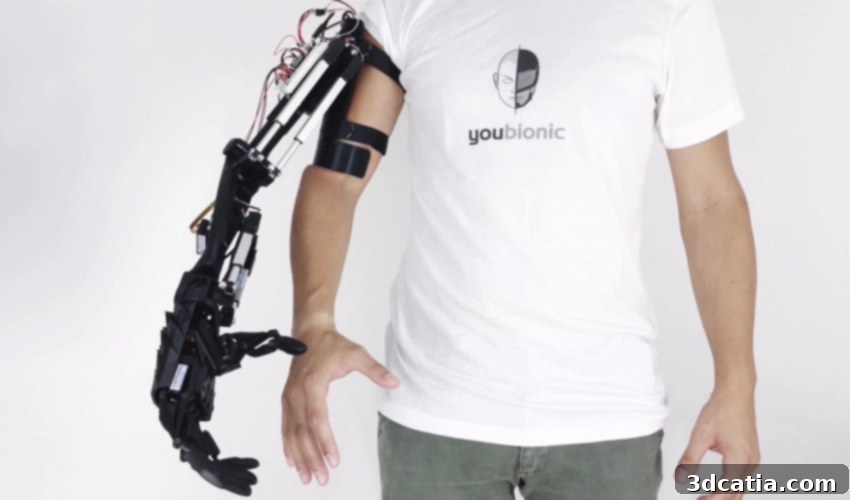
Youbionics Unveils Revolutionary 3D Printed Bionic Arm for Human Augmentation and Rehabilitation
Youbionics, an innovative Italian company, first captured global attention several years ago with its groundbreaking bionic prosthesis, securing a prominent position in our rankings of the best 3D printed prostheses. Building on the success and insights gained from that development, Youbionics has now unveiled its latest ambitious project: a sophisticated 3D printed bionic arm. This new creation pushes the boundaries of assistive technology and human augmentation, offering unprecedented possibilities for both enhancing natural capabilities and restoring lost functions.
Founded in Pavia in 2014, Youbionics is driven by a profound mission: to leverage cutting-edge technologies, particularly additive manufacturing, to significantly expand human capabilities. The company meticulously designs and builds advanced devices aimed at empowering individuals, enabling them to perform daily tasks with greater skill, efficiency, and ease. This vision resonates with other pioneering projects in the field of human augmentation, such as the “Third Thumb,” which explores adding an extra digit to the hand to facilitate multitasking and complex interactions. Youbionics, however, takes this concept a significant step further, proposing an entire additional limb designed to seamlessly integrate with the user’s existing anatomy and cognitive processes.
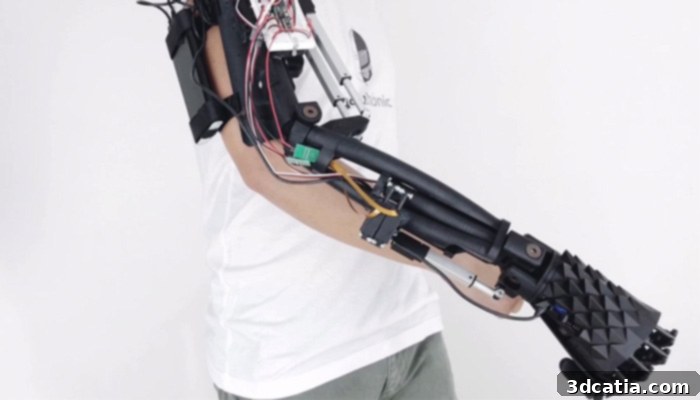
The newly introduced 3D printed bionic arm is ingeniously engineered to function as an additional limb, seamlessly integrating with the user’s body. Crafted using advanced additive manufacturing techniques, the arm boasts an exceptionally lightweight construction, ensuring comfort and ease of use. At its initial stage, the movements of this extra arm can be externally controlled, offering a robust and functional augmentation. However, Youbionics’ ultimate ambition is far more revolutionary: to enable users to control the bionic arm with their minds, utilizing direct neural interfaces to achieve fluid, intuitive, and natural movements. This advanced level of control would transform the device from a mere tool into an almost organic extension of the user’s will, blurring the lines between human and machine.
Federico Ciccarese, the visionary founder of Youbionics, articulated the dual potential of these innovative devices to 3DPrint. He stated, “These devices can increase people’s abilities when they are in a healthy body, but they can also recover skills if they replace parts of the body that do not work.” This powerful statement encapsulates the core philosophy behind Youbionics’ work: to provide solutions that not only enhance human potential but also profoundly improve the quality of life for individuals facing physical challenges. Whether it’s enabling someone to perform complex tasks with an extra limb or empowering an amputee to regain autonomy, the technology is designed to be transformative.
Empowering Users: The DIY 3D Printed Bionic Arm
A cornerstone of Youbionics’ philosophy since its inception has been the democratization of advanced technology. Following the successful precedent set with their initial bionic hand, the company has maintained an open and accessible approach with the new 3D printed bionic arm. Youbionics shares its designs, allowing individuals around the globe to download and 3D print the components themselves from home. This open-source model drastically reduces the barriers to entry for advanced bionic technology, making it available to a much wider audience than traditional, high-cost medical prosthetics.
The affordability of this innovative solution is remarkable, with the digital blueprint for the bionic arm priced at just $149. This represents a modest increase from the $99 cost of their earlier bionic hand, reflecting the added complexity and functionality of the arm while still keeping it within reach for many. According to Youbionics, the primary structural components of the arm can be printed using readily available PLA plastic, a common and inexpensive material for desktop 3D printers. Users then only need to acquire a few non-printable, off-the-shelf electronic and mechanical elements, which are typically easy to source. This DIY approach not only empowers individuals to take control of their assistive technology but also fosters a community of makers and innovators who can contribute to the ongoing development and customization of these devices. The revenue generated from the sale of these digital designs plays a crucial role, helping Youbionics fund its continuous research and development efforts, enabling them to create even more advanced prostheses and expand the reach of their transformative technologies.
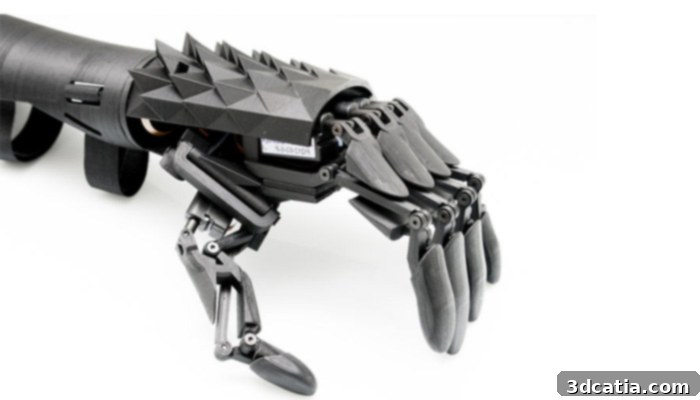
Detail of the bionic hand component of the arm
The Transformative Impact of 3D Printing in Medical and Assistive Fields
The advent of 3D printing in the medical field has initiated a paradigm shift, unlocking a vast array of new developments and opportunities that were previously unimaginable. This technology has revolutionized the production of prosthetics, implants, surgical guides, and anatomical models, making personalized medicine more accessible and effective. For Youbionics’ bionic arm, additive manufacturing is not just a production method; it is an enabling force that allows for rapid prototyping, complex geometries, and custom fitting tailored to each individual user. This level of customization ensures maximum comfort and functionality, a critical factor for devices designed for long-term use and integration with the human body.
Beyond personalization, 3D printing significantly drives down manufacturing costs and speeds up the production process, directly impacting accessibility. This affordability and speed are particularly crucial in the realm of assistive devices, where traditional manufacturing often leads to prohibitive costs and long waiting times. Youbionics’ model exemplifies how this technology can guarantee access to state-of-the-art developments, potentially saving lives and drastically improving the quality of life for millions. The company’s vision extends beyond mere augmentation; it deeply commits to helping individuals who have lost a limb. By providing accessible and functional bionic solutions, Youbionics empowers amputees to regain independence, perform daily activities, and ultimately reintegrate into their daily lives with confidence and renewed capabilities. This blend of cutting-edge innovation and humanitarian accessibility positions Youbionics at the forefront of the assistive technology revolution.
Future Prospects and the Ethical Landscape of Human Augmentation
The journey of Youbionics from an innovative bionic hand to a fully functional, 3D printable bionic arm highlights the rapid progression of both additive manufacturing and human-machine interface technologies. As research continues into more intuitive control mechanisms, particularly mind-controlled interfaces, the potential for these devices becomes even more profound. Imagine a future where an additional limb is not just externally controlled but an organic extension of thought, responding instantly to neural commands. This future, while exciting, also brings forth important discussions regarding the ethical implications of human augmentation. Questions around identity, societal integration, and the definition of ‘human’ will inevitably arise as such technologies become more commonplace.
Youbionics, through its open-source and affordable approach, is not only contributing to technological advancement but also actively shaping the conversation around the accessibility and democratic distribution of such powerful tools. By making the designs available, they invite global collaboration and innovation, fostering a community that can collectively push the boundaries of what is possible. This collaborative model ensures that these life-changing innovations are not confined to a privileged few but are within reach for anyone with access to a 3D printer, thereby driving forward a more inclusive future for advanced bionics. The ongoing development promises to continue expanding the horizon of human potential, offering hope and practical solutions for both augmentation and rehabilitation.
To better understand the intricate functioning and impressive capabilities of the Youbionics bionic arm, we encourage you not to miss the insightful video embedded below. For more comprehensive information about Youbionics and their pioneering work, please visit the official website of the Italian company here. Their platform offers detailed insights into their mission, products, and future endeavors.
What are your thoughts on Youbionics’ latest innovation, the 3D printed bionic arm? Do you foresee a future where human augmentation becomes commonplace, or do you believe such technologies should primarily focus on rehabilitation? We’d love to hear your perspective! Share your opinions and insights in a comment below or engage with us on our Facebook and Twitter pages. And don’t forget to sign up for our free weekly Newsletter to receive all the latest news and updates in the exciting world of 3D printing, delivered directly to your inbox!