
Revolutionizing Industries: Unveiling the Power of 3D Printing in Manufacturing, Construction, and Beyond
Welcome to our weekly dive into the fascinating world of additive manufacturing, where we explore groundbreaking innovations and practical applications of 3D printing technology. This compilation showcases how this transformative technology is not just a futuristic concept but a vital tool revolutionizing diverse sectors, from automotive giants to housing solutions and even space exploration. This week, prepare to be amazed as we discover how Ford Motor Company is leveraging large-format 3D printing to achieve unprecedented efficiency, slashing manufacturing times by over 90%. We’ll then go behind the scenes with Mighty Buildings, an American pioneer utilizing concrete 3D printing to construct sustainable and affordable homes. Following that, we’ll journey into the realm of rapid injection molding, witness the ambitious strides in aerospace with 3D-printed rockets, and finally, embark on an imaginative adventure contemplating a world where anything you need can be 3D printed – from the food on your plate to your entire living space and means of transportation. Join us as we explore how 3D printing is shaping our present and defining our future, proving that innovation knows no bounds.
Top 1: Ford’s Large-Format 3D Printing Spearheads Manufacturing Efficiency
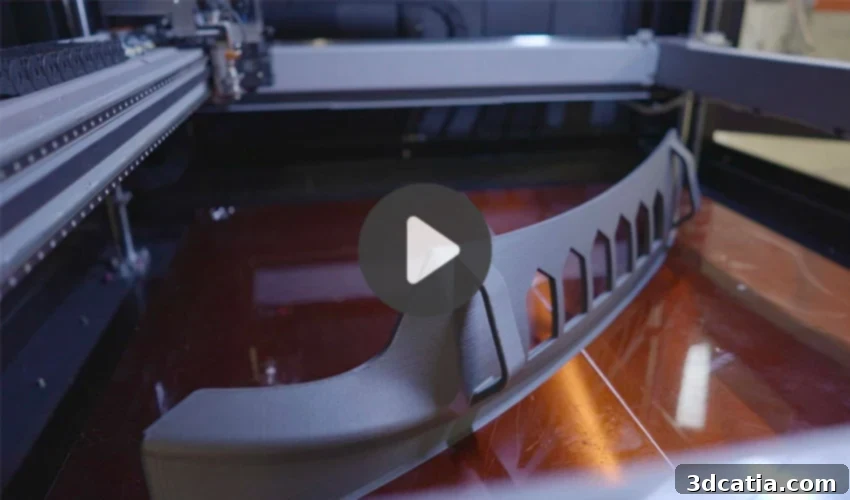
For over three decades, the venerable American car manufacturer, Ford Motor Company, has been at the forefront of integrating additive manufacturing into its operations, utilizing it for a myriad of applications across its vast global enterprise. One of the most significant and impactful uses has been in the creation of highly functional, custom-made tools and prototypes, dramatically enhancing their production lines and development processes. To push these capabilities further, Ford made a strategic investment in a state-of-the-art large-format 3D printer: the BigRep One. This industrial-grade machine empowers Ford to design and produce an extensive array of tools, jigs, and fixtures, perfectly tailored to specific vehicle models and assembly requirements.
Consider the example of positioning parts on typical vehicles, such as hatchbacks. Ford has ingeniously 3D printed a complete series of ergonomic and highly effective tools that technicians can easily handle, ensuring precise alignment and fitment. This bespoke tooling significantly streamlines assembly tasks, reducing potential for error and improving overall quality. A core advantage of large-format 3D printing for Ford lies in its capacity to fabricate substantial parts or multiple components in a single print job. This eliminates the need for more complex and time-consuming multi-part assemblies, which are often characteristic of traditional manufacturing methods. The ability to produce large, intricate parts as monolithic units not only simplifies the workflow but also enhances the durability and integrity of the tools themselves.
The quantifiable benefits are astounding: thanks to the integration of its advanced 3D printing capabilities, Ford has successfully reduced its production times for factory tooling by an incredible 94%. This dramatic reduction translates into substantial cost savings, faster iteration cycles for new designs, and increased agility in adapting to evolving production demands. It underscores 3D printing’s crucial role in fostering innovation and efficiency within one of the world’s leading automotive companies, paving the way for more responsive and sustainable manufacturing practices in the future of mobility.
Top 2: Revolutionizing Prototyping with 3D Printed Molds for Rapid Injection Molding
Traditional injection molding, while indispensable for mass production, presents significant hurdles during the product development phase, especially for low-volume runs or rapid prototyping. The initial investment required for tooling – the creation of precision molds from robust materials like steel or aluminum – is exceptionally high. This substantial upfront cost, coupled with lengthy lead times for mold fabrication, can severely slow down the introduction of new products to the market, hindering agility and responsiveness in a competitive landscape. Businesses often face a dilemma: invest heavily for a product that might still need design revisions, or endure prolonged waits that delay market entry.
However, 3D printing technology has emerged as a game-changer, offering a sophisticated yet remarkably cost-cutting and agile solution for rapidly designing and fabricating molds. This innovative approach is particularly effective for small series production of thermoplastic prototypes or even functional end-use parts. Instead of waiting weeks or months and spending tens of thousands on traditional molds, designers and engineers can now 3D print injection molds in a matter of hours or days, at a fraction of the cost. These 3D printed molds, typically made from high-resolution resins, can withstand the pressures and temperatures of low-volume injection molding, enabling quick iterations and design validation.
This capability drastically accelerates the product development cycle. Companies can test multiple design variations, validate functionality, and gather real-world feedback on parts made from actual production-grade thermoplastics, long before committing to expensive hard tooling. This de-risks the entire process, allowing for greater innovation and a faster path to market. To delve deeper into this transformative process, we recommend checking out an insightful 3Dnatives webinar featuring Juliette Combe from Formlabs. Formlabs is a leader in resin 3D printing and has been instrumental in developing materials and workflows that make 3D printed injection molds a viable and powerful tool for modern manufacturing. Their expertise illuminates how businesses can leverage this technology to bridge the gap between prototyping and mass production with unparalleled efficiency.
Top 3: Relativity Space: Building the Future of Space Travel with 3D Printed Rockets
With an audacious and inspiring goal of enabling humanity to become a multi-planetary species by putting one million people on Mars, Relativity Space stands as a trailblazing American startup that is rapidly reshaping the aerospace industry. At the core of their revolutionary approach is the formidable power of additive manufacturing, which they leverage to build rocket ships with unprecedented speed, efficiency, and design flexibility. Relativity Space is not just using 3D printing for small components; they are pioneering the concept of entirely 3D printing entire rocket structures.
Their flagship innovation, the Terran 1 and later the Terran R, represents the world’s first-ever 3D-printed rocket. This isn’t merely a rocket with a few 3D-printed parts; it is designed to be predominantly manufactured using their proprietary large-scale 3D printers, known as Stargate. The Stargate machines are robotic arms equipped with immense metal 3D printing capabilities, allowing them to print an entire rocket fuselage in one continuous process. This approach dramatically reduces part count – from thousands of traditionally manufactured components to mere hundreds – which in turn simplifies supply chains, minimizes assembly time, and reduces potential points of failure.
The advantages are manifold. By automating the manufacturing process with 3D printing, Relativity Space can iterate on designs much faster, respond to market demands with greater agility, and significantly shorten the lead time from raw material to launch-ready rocket. This enables a rapid, agile, and cost-effective approach to building the next generation of launch vehicles, making space access more frequent and economical. Their vision extends beyond Earth’s orbit; the ability to 3D print complex structures on demand holds immense potential for in-space manufacturing, allowing future Martian colonists to print habitats and tools directly on the red planet using local resources. Take a moment to witness the incredible process behind the creation of the world’s first-ever 3D-printed rocket and appreciate the groundbreaking engineering that is literally launching us into a new era of space exploration.
Top 4: Behind the Scenes of Sustainable Home Building with Mighty Buildings
In a compelling 15-minute report, we’re granted an exclusive look behind the scenes at Mighty Buildings, an American company that is pioneering a revolutionary approach to home construction. This innovative firm is leveraging the power of concrete 3D printing to erect the walls of its houses, fundamentally transforming how we think about building and affordability in the housing sector. Mighty Buildings’ primary objective is to produce Accessory Dwelling Units (ADUs), which are versatile, small mobile cabins designed for a variety of uses, from comfortable living spaces to efficient home offices or even guest houses. These units are an increasingly popular solution to housing shortages and the demand for flexible living arrangements.
Beyond simply building structures, the company harbors an ambitious vision: to significantly facilitate access to housing for a broader population, and crucially, to introduce a more sustainable and environmentally friendly construction method. By utilizing advanced concrete 3D printing technology, Mighty Buildings can drastically reduce construction waste compared to traditional building practices. This automated process optimizes material usage, minimizes errors, and creates robust structures with greater precision. The benefits extend to significant cost reductions, making housing more attainable and less burdensome for homeowners. Their innovative approach tackles the dual challenges of housing affordability and environmental impact head-on.
The video below provides an extraordinary insight into the operational heart of Mighty Buildings. You’ll witness the mesmerizing work of their state-of-the-art 3D printers as they meticulously layer concrete to form the robust walls of houses. It showcases not just the mechanics of how these homes are built, but also articulates the broader vision that drives Mighty Buildings: a future where sustainable, high-quality, and affordable housing is accessible to everyone. This detailed look illuminates how 3D printing is not just an industrial tool but a powerful force for social good, creating greener communities and more equitable living opportunities.
Top 5: What If You Could 3D Print Anything? Exploring a Hypothetical Future
Prepare to unleash your imagination and let it soar into the boundless possibilities of 3D printing. This thought-provoking video invites you to envision a world where the concept of “anything” truly means anything when it comes to additive manufacturing. What if every item you desired or needed, from the most mundane to the most complex, could be materialized instantly by a personal 3D printer? This isn’t just about printing plastic trinkets; it’s about a fundamental shift in production, consumption, and even survival.
Imagine a future where a 3D printer in your kitchen could produce a nutritious, customized meal with specific dietary requirements, eliminating food waste and ensuring universal access to sustenance. Picture houses being constructed on demand, tailored to individual preferences and local environmental conditions, making housing shortages a relic of the past. Envision advanced transportation systems, from personal vehicles to public transit, being manufactured locally and sustainably, reducing resource consumption and ecological footprints. Consider the profound implications for healthcare: organs bioprinted for transplantation, personalized medicines created on the spot, and medical supplies produced in remote areas during emergencies, revolutionizing access to life-saving care.
But here’s the pivotal question posed by the video: do we already inhabit this mystical place where the ability to print food, cars, houses, and complex medical supplies is within our grasp? While the full realization of such a utopian vision might still be a distant dream, the truth is, we are closer than ever before. Scientific advancements are rapidly pushing the boundaries of what’s possible. Bioprinting is making strides in creating human tissues; construction 3D printing is building houses in a matter of days; and sophisticated additive manufacturing is already producing high-performance components for aerospace and automotive industries. This exploration serves as a reminder of the incredible progress already made and the even more astonishing potential that awaits, urging us to consider the ethical, economic, and societal implications of a truly on-demand, 3D-printed world.
What are your thoughts on this week’s incredible selection of 3D printing videos and the transformative potential they represent? From drastically cutting manufacturing times with Ford’s large-format printing to building sustainable homes with Mighty Buildings, enabling interstellar travel with Relativity Space, optimizing industrial processes with rapid injection molding, and imagining a world where anything can be printed – the future of additive manufacturing is vibrant and full of promise. We’d love to hear your insights, predictions, and any questions you might have. Share your comments below or engage with us on our Facebook and Twitter pages. For all the latest news, breakthrough innovations, and exclusive content in the world of 3D printing, don’t forget to sign up for our free weekly newsletter, delivered straight to your inbox!