
Wohlers Report 2025: Additive Manufacturing Market Surges Past $21 Billion Despite Headwinds
The renowned Wohlers Report, the international market study that meticulously analyzes the health and trajectory of the additive manufacturing sector, has officially released its highly anticipated 2025 edition. This landmark 30th annual publication serves as a critical barometer for the global 3D printing industry. The findings reveal a landscape characterized by robust growth: according to Wohlers Associates, the industry experienced a significant expansion of 9.1%, pushing the total 3D printing market value to an estimated $21.9 billion by 2024. Looking further into the future, projections within the report paint an even more ambitious picture, forecasting that this figure could skyrocket to $115 billion by 2034. These impressive statistics might initially come as a surprise when considering the various economic uncertainties and sector-specific difficulties the industry has encountered over the past two years. Yet, the Wohlers Report 2025 delivers an overwhelmingly positive outlook, affirming that additive manufacturing is poised for a bright future, driven primarily by the strength of service providers, the dynamic growth within the Asian market, and continuous innovation in materials.
Last year, the Wohlers Report highlighted an 11.1% market growth, with metal additive manufacturing notably gaining ground. However, the new 2025 edition of the study shifts its focus somewhat, emphasizing the enduring dominance of polymer 3D printing, asserting that it remains the most widely employed process family across the industry. This continued prevalence is clearly reflected in machine distribution data: 67.1% of all additive manufacturing machines on the market today are polymer solutions, followed by 29.7% for metal systems, and 3.2% designated as “other 3D printers.” One of the significant emerging trends observed by 3Dnatives, and echoed in the report, is the rapidly growing interest in ceramic additive manufacturing, a segment now capable of mass-producing complex industrial parts with advanced properties.
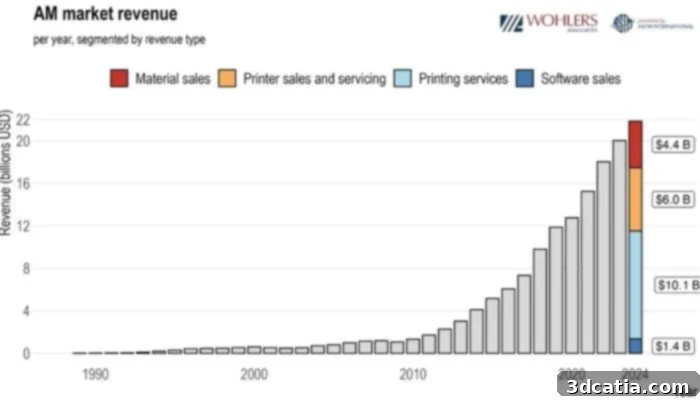
Key revenue figures for the additive manufacturing market (photo credits: Wohlers Associates/ASTM)
Market Dynamics and Key Growth Drivers
While the headline growth figures are compelling, a deeper dive into the report’s data reveals the intricate mechanisms driving this expansion. The additive manufacturing market’s resilience and forward momentum are largely attributable to three interconnected pillars: the burgeoning role of printing service providers, the escalating demand for diverse and advanced materials, and the undeniable rise of the Asian market as a global manufacturing powerhouse.
The Indispensable Role of Service Providers
Service providers continue to represent the largest and most dynamic segment of the additive manufacturing market, accounting for a significant 47% of total revenue recorded over 2024. These companies play a pivotal role in democratizing access to cutting-edge 3D printing technologies, allowing businesses of all sizes – from small startups to large enterprises – to leverage advanced manufacturing capabilities without the substantial upfront investment in equipment or the need for extensive in-house specialized training. From rapid prototyping and concept validation to small-batch production, custom tooling, and even end-use parts, service bureaus offer invaluable expertise, flexibility, and scalability. Their ability to cater to a broad spectrum of industrial needs, quickly adapt to new technological advancements, and provide specialized post-processing services makes them a cornerstone of the industry’s sustained expansion. As more companies explore additive manufacturing for various applications, relying on external service providers often becomes the most efficient, cost-effective, and low-risk pathway to integrating 3D printing into their workflows.
Materials: The Fuel for Innovation and Adoption
Following closely behind services, materials stand out as a formidable growth engine, commanding 20% of the market share in terms of 2024 revenue. This segment’s robust performance is particularly significant, as underscored by Mahdi Jamshid, Director of Market Intelligence at ASTM, who observes “the strongest growth of the materials sector as an indication of further adoption of the AM industry.” The sheer diversity and continuous advancement in 3D printable materials are unlocking entirely new applications across virtually every industrial sector. From high-performance polymers, advanced metal alloys, and innovative composites to biocompatible resins and high-temperature ceramics, materials innovation directly translates into enhanced part functionality, improved mechanical properties, and the ability to meet stringent industry standards. As the range of available materials expands, so too does the scope of what additive manufacturing can achieve, fostering wider adoption in critical sectors like aerospace, automotive, medical, consumer goods, and energy. This relentless drive for specialized, application-specific materials ensures that AM solutions are not just viable but often optimal for an increasing number of complex manufacturing challenges.
Technological Focus and Evolving Trends
The Wohlers Report 2025 provides an insightful look into the dominant technological trends shaping the additive manufacturing landscape. While past reports might have highlighted the ascendance of metal AM, this edition places a renewed emphasis on the enduring strength and widespread utility of polymer 3D printing, while also noting crucial developments in other material categories.
Polymer 3D Printing Maintains its Dominance
Polymer-based processes remain the most widely employed family of additive manufacturing technologies. The report confirms that an overwhelming 67.1% of all 3D printing machines currently on the market are polymer solutions. This enduring prevalence is due to several key factors, including the relative accessibility and cost-effectiveness of polymer printers, their immense versatility across a vast range of applications from rapid prototyping and functional validation to end-use parts, and the continuous innovation in polymer materials and sophisticated processing techniques. Technologies such as FDM (Fused Deposition Modeling), SLA (Stereolithography), SLS (Selective Laser Sintering), and other photopolymerization and extrusion-based methods continue to be workhorses for designers, engineers, and manufacturers globally, enabling rapid iteration and efficient production of diverse plastic components. The continuous development of engineering-grade polymers with enhanced mechanical and thermal properties further solidifies this segment’s leading position.
The Continued Importance of Metal Additive Manufacturing
Despite the strong showing from polymers, metal additive manufacturing remains a critical, albeit smaller, segment, accounting for 29.7% of machines. Metal AM is indispensable for applications requiring high strength-to-weight ratios, exceptional durability, extreme temperature resistance, and complex geometries that traditional manufacturing methods struggle to achieve or cannot produce at all. Industries like aerospace, medical devices, defense, and high-performance tooling heavily rely on processes such as DMLS (Direct Metal Laser Sintering), SLM (Selective Laser Melting), and binder jetting for producing high-performance, critical components. However, the report also indicates challenges for machine manufacturers in this sector, noting a concerning 26% decline in metal machine sales year-on-year. This downturn could be attributed to factors such as higher capital expenditure requirements, longer adoption cycles, increased market competition, and potentially a recalibration of investment strategies amidst broader economic uncertainties impacting large-scale industrial investments. Yet, the long-term potential of metal AM for high-value industrial applications remains undeniable, with ongoing research focused on reducing costs, increasing production speeds, and improving process reliability.
The Emerging Potential of Ceramic Additive Manufacturing
Beyond polymers and metals, the report highlights an exciting and rapidly accelerating trend: the growing interest in ceramic additive manufacturing. While categorized under the “other 3D printers” segment (which represents 3.2% of machines), ceramic AM is quickly gaining traction, particularly for its newfound ability to mass-produce complex industrial parts. Ceramics offer unique and highly desirable properties such as extreme hardness, superior high-temperature resistance, excellent chemical inertness, electrical insulation, and even biocompatibility, making them ideal for highly specialized applications in demanding sectors. These include aerospace (e.g., lightweight, heat-resistant turbine components), biomedical (e.g., dental implants, bone scaffolds), and high-performance industrial tooling (e.g., molds, dies). The advancements in ceramic printing technologies, including vat photopolymerization, binder jetting, and extrusion-based methods for ceramics, are overcoming traditional manufacturing limitations and opening entirely new frontiers for materials engineering and design. This emerging segment signals a future where highly specialized and extreme-environment parts can be produced with unprecedented complexity and precision, previously unattainable with conventional methods.
Geographical Shifts and Global Dynamics
The geographical landscape of the additive manufacturing market is undergoing a significant transformation, with the Wohlers Report 2025 underscoring the growing importance and influence of the Asian market, and specifically China, on a global scale.
Asia and China: A Manufacturing Powerhouse
The results for 2024 clearly indicate an ascendancy of the Asian market, fueled by rapid expansion and relentless innovation from countries like China. It is no surprise to witness the meteoric rise of Chinese manufacturers, exemplifying this trend with brands like Bambu Lab making significant waves and capturing substantial market share on the international 3D printing stage. The report specifically notes that China has substantially increased its machine exports, signaling a growing influence on global supply chains and technological adoption. This exponential growth is often attributed to a combination of factors: robust government support for advanced manufacturing initiatives, a vast and highly skilled domestic industrial base, aggressive investment in research and development, and competitive pricing strategies that appeal to a diverse global customer base. The strategic emphasis on localized production and technological self-sufficiency further propels China’s dominance and expanding footprint in this evolving global market.
Navigating Geopolitical Crosscurrents
The increasing prominence of Chinese manufacturers in the additive manufacturing space, however, also introduces new considerations and complexities, particularly concerning international trade relations and geopolitical strategies. The report implicitly raises questions about how various governments, especially in Western economies like the USA, will react to these significant shifts in manufacturing power and market share. With growing trade discussions and potential policy adjustments, such as those anticipated from a Trump administration, the global additive manufacturing market could face evolving regulations, tariffs, export controls, or strategic alliances aimed at balancing international competitiveness with national security and economic interests. These geopolitical factors will undoubtedly shape investment patterns, influence supply chain strategies, and impact collaborative efforts in the years to come, influencing where additive manufacturing capabilities are developed and deployed worldwide.
A Decade of Growth and Future Outlook
For over a decade, the Wohlers Report has consistently provided a positive and forward-looking outlook for the additive manufacturing market, showcasing its relentless capacity for growth and innovation. While certain years have presented more formidable challenges and periods of slowdown have been felt across various segments, the overall trajectory remains unequivocally upward. The current “temperature” of the industry is robust, and the signs of future expansion are exceptionally encouraging. The comprehensive data and expert analysis within the Wohlers Report 2025 reinforce the notion that additive manufacturing is not merely a niche technology but a transformative force steadily integrating into the global industrial fabric. With continuous innovation in materials science, expanding applications facilitated by agile service providers, and the dynamic rise of new geographical powerhouses, the future of 3D printing appears brighter and more impactful than ever before.
To gain full access to these invaluable insights and detailed market analyses, you can download the complete Wohlers Report 2025 by clicking HERE.
What do you think of the Wohlers Report 2025 findings and the state of the additive manufacturing market? Let us know in a comment below or on our LinkedIn, Facebook, and Twitter pages! Don’t forget to sign up for our free weekly Newsletter here to get the latest 3D printing news straight to your inbox! You can also find all our videos and engaging content on our YouTube channel.
*Cover Photo Credits: Artempo