
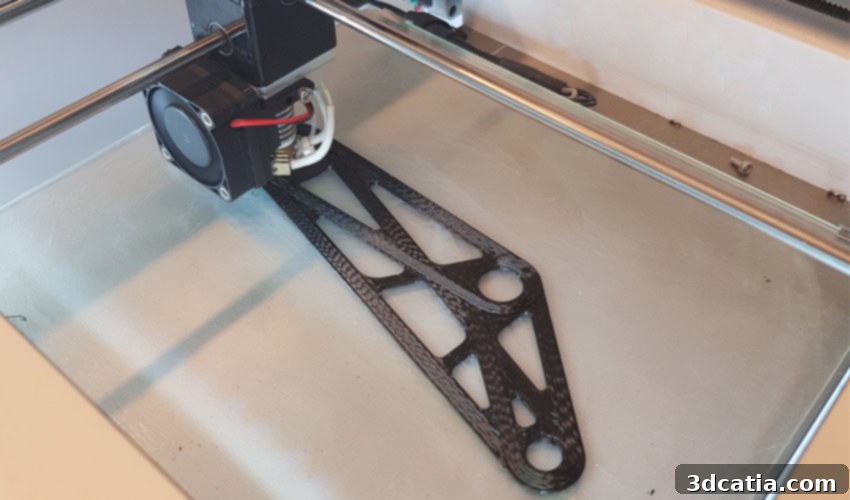
9T Labs: Revolutionizing Industrial Production with Advanced Carbon Fiber Composite 3D Printing
9T Labs, an innovative Swiss startup, is at the forefront of transforming manufacturing with its groundbreaking 3D printing method for creating high-performance carbon fiber composite structures. Their approach is comprehensive, optimizing the entire production chain from initial design to post-treatment. This holistic strategy enables professionals across various industries to achieve industrial-quality components with unparalleled efficiency and cost-effectiveness. The core of 9T Labs’ innovation lies in its ability to design parts with an impressive 60% volumetric carbon composite content. Carbon composites are celebrated for their exceptional strength-to-weight ratio, offering properties often compared to, and sometimes exceeding, those of traditional metals while being significantly lighter. Beyond material excellence, the startup places a strong emphasis on process automation and material recyclability, striving to provide viable, sustainable solutions that dramatically boost productivity for industrial clients. We had the opportunity to sit down with Martin Eichenhofer, Co-Founder and CEO of 9T Labs, to delve deeper into their pioneering technology, the key sectors benefiting from it, and their ambitious plans for the future.
Could you please introduce yourself and share more about your connection to 3D printing technologies?
My name is Martin Eichenhofer, and I am one of the Co-Founders and CEO of 9T Labs. The company was officially founded in February 2018 alongside my esteemed colleagues, Chester Houwink and Giovanni Cavolina. Our journey began as a spin-off from the distinguished CMASLab chair of Professor Ermanni at ETH Zurich, Switzerland – a renowned institution for materials science and engineering. Our collective mission from the outset has been ambitious yet clear: to democratize access to industry-grade carbon fiber composites by leveraging the transformative power of 3D printing technology. In this context, 3D printing isn’t just an additive manufacturing process; it’s a paradigm shift. It introduces unprecedented levels of automation and sophisticated software capabilities into what has historically been an $80 billion industry. This integration is fundamentally rethinking the established methods of producing fiber composites, offering a path to efficiency, design freedom, and cost reduction that was previously unimaginable. We believe this technological convergence is key to unlocking the full potential of advanced materials for a broader range of applications.
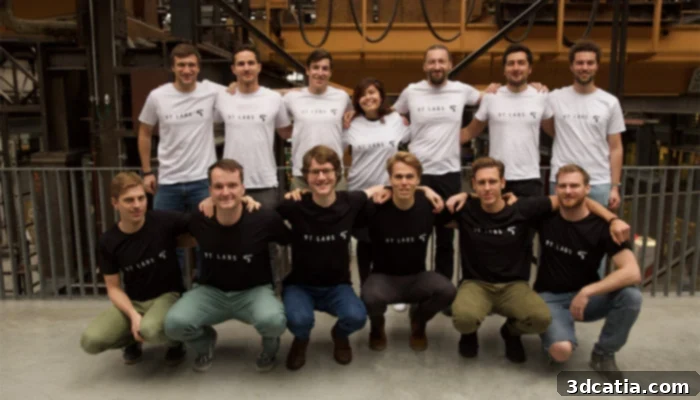
The dedicated 9T Labs team driving innovation in advanced composite manufacturing.
What was the inspiration behind the creation of 9T Labs?
The genesis of 9T Labs stemmed from a clear recognition of both the immense potential and the significant challenges surrounding carbon fiber composites. These materials represent a superior class in terms of weight-to-performance ratio when compared to their metal counterparts. Imagine a material that combines the incredible lightness of plastic with the remarkable strength, or even superior strength, of metal. This is the promise of carbon fiber. However, despite their undeniable advantages, the widespread adoption of these high-performance materials has historically been hindered by the limitations of traditional manufacturing routes. These limitations primarily manifest as extremely long and prohibitively expensive development cycles, coupled with a notable lack of automation in production processes. This often necessitates extensive manual labor and specialized tooling, escalating both time and cost. During our academic pursuits and research at ETH Zurich, we precisely identified this critical gap: a substantial market potential and an urgent industry need for fully automated production systems seamlessly integrated with advanced software solutions. We observed that engineers and manufacturers were constantly making compromises between optimal part design and manufacturing feasibility due to these constraints. Realizing the profound impact a streamlined, automated, and software-driven approach could have on unlocking the true potential of carbon composites, we were compelled to launch 9T Labs. Our vision was to eliminate these traditional barriers and make high-performance composite manufacturing more accessible, efficient, and cost-effective for a broad range of industrial applications, thereby kick-starting the company to address this unmet need.
Could you elaborate on the unique technology that 9T Labs has developed?
At its core, 9T Labs’ technology is engineered to fully automate the manufacturing process of carbon fiber composites, which has traditionally been characterized by intensive manual labor and complex, time-consuming steps. By automating this entire workflow, we achieve a significantly higher degree of freedom in utilizing the full capability of fiber directionality. This is a critical advantage, as the strength and stiffness of composite parts are highly dependent on how the fibers are oriented within the material. Conventionally, achieving ideal fiber placement is often impractical due to the massive compromises required between intricate fiber design and prohibitive manufacturing costs. Our systems effectively lift this constraint, empowering engineers and designers with unprecedented control. Our solution comprises advanced 3D printing systems coupled with our proprietary `Fibrify` software. `Fibrify` is an intelligent design and optimization tool that allows for precise control over fiber placement, leading to parts that are not only extremely lightweight but also incredibly strong and cost-competitive. Through this process, we commonly see structural weight reductions of more than 50% compared to traditionally manufactured metal parts, translating into significant savings in both material resources and operational costs. However, we recognized that simply having a highly optimized and 3D printed part is not enough to truly revolutionize series production within this industry. A common limitation of many 3D printing technologies is achieving a part quality that is truly comparable to components manufactured through established, traditional processes. To address this crucial challenge, 9T Labs introduced a novel and essential processing step: the fusion process. This innovative post-consolidation step is designed to dramatically enhance the quality of the printed part. It ensures superior mechanical properties, excellent surface finish, and consistent performance, effectively elevating the 3D printed components to a standard suitable for demanding end-use applications in series production. This unique combination of automated 3D printing, advanced software optimization, and our proprietary fusion process sets 9T Labs apart, making industrial-scale, high-performance carbon fiber composite manufacturing a reality.
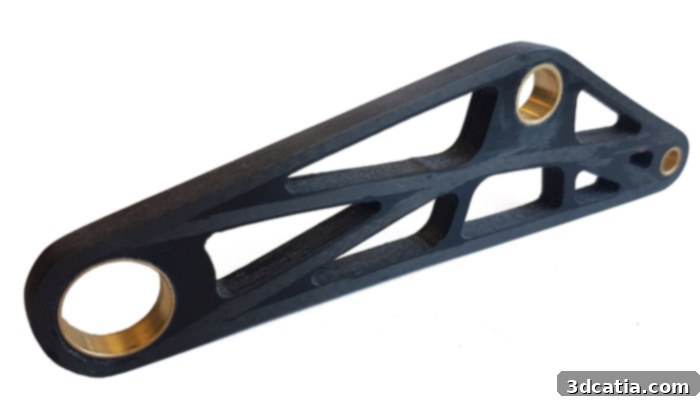
A highly optimized 3D printed part manufactured by 9T Labs, demonstrating precision and material integrity.
What are the primary benefits of utilizing carbon fiber composites in manufacturing?
The advantages of carbon fiber composites extend far beyond their superior and undisputed mechanical performance. While their exceptional strength-to-weight ratio and stiffness are inherently attractive, for commercial viability, products also need to demonstrate compelling economic benefits. Traditionally, the widespread adoption of carbon fiber composites has been hampered by two significant constraints: the high costs associated with their manufacturing and the excessively long lead times involved in production. These factors have often confined advanced composites primarily to niche, high-value applications like aerospace, where performance outweighs cost considerations. 9T Labs addresses these long-standing issues head-on. By integrating advanced 3D printing technology into the manufacturing process, we provide fully integrated and automated workflows. This significantly reduces the need for expensive tooling, extensive manual labor, and lengthy prototyping cycles, thereby achieving manufacturing at minimal capital expenditure. The outcome of our innovative approach is truly twofold and transformative for industries. Firstly, it enables the creation of superior, lighter parts. These components offer enhanced performance, fuel efficiency, and reduced operational costs across their lifecycle due to their inherent lightness and strength. Secondly, and equally important, our methods lead to significantly lower production costs. This makes carbon fiber composites a much more viable and attractive contender for metal substitution, extending their applicability far beyond just traditional aerospace applications. Now, industries like automotive, medical, sports, and even general industrial machinery can seriously consider carbon fiber composites as a cost-effective alternative, unlocking new possibilities for innovation and efficiency that were previously out of reach.
Which industrial sectors are showing particular interest in these advanced materials and technologies?
The global fiber composite industry is experiencing robust growth, expanding at a healthy 5% Compound Annual Growth Rate (CAGR), projected to reach a substantial $100 billion market by 2020. Within this expanding industry, the segment of carbon fiber reinforced composites stands out with the strongest growth, boasting an impressive 11% CAGR. This rapid expansion is driven by several key macro trends that are reshaping modern manufacturing. Currently, the most dominant trends attracting significant interest are automation, the adoption of thermoplastic composites, and a growing emphasis on recyclability. 9T Labs’ technology is uniquely positioned to address and capitalize on all three of these pivotal trends simultaneously. The use of thermoplastic composites, for instance, is a game-changer. Unlike thermoset composites, thermoplastics can be melted and reformed, which not only facilitates superior mechanical performance and impact resistance but critically enables the recyclability of the material at the end of its life cycle – a significant advantage in today’s environmentally conscious market. By harnessing the inherent merits of 3D printing alongside thermoplastic composites, 9T Labs provides solutions that are highly automated, sustainable, and deliver exceptional performance. This unique combination of features makes our technology particularly appealing and vital for industries where high performance, lightweighting, and efficiency are paramount. These sectors include, but are not limited to, aerospace, where every gram saved translates to significant fuel savings and increased payload capacity; automotive, seeking to reduce vehicle weight for improved fuel efficiency and electric vehicle range; leisure, where lightweight and strong components enhance user experience in sports equipment; and medical, for custom prosthetics, orthotics, and devices requiring biocompatibility and precision. The ability to rapidly produce complex, high-performance parts with excellent mechanical properties and a lower environmental footprint is driving widespread interest and adoption across these diverse and demanding industrial landscapes.
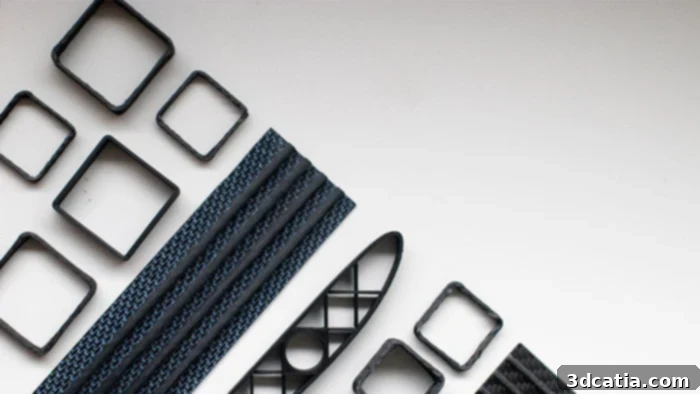
Carbon composites produced by 9T Labs possess mechanical properties highly comparable to, and often surpassing, those of traditional metals, offering both strength and extreme lightness. | Credits: 9T Labs
What are 9T Labs’ future projects and long-term vision?
Our long-term vision at 9T Labs is centered around providing a fully integrated and seamless solution for our customers, encompassing the entire product development and manufacturing lifecycle – from initial CAD design all the way to the final, ready-to-use part. We are committed to empowering engineers and designers across the value chain with advanced tools and intelligent systems. A cornerstone of this vision is our proprietary `Fibrify` software. `Fibrify` is continuously being developed to help engineers rapidly explore and identify the most optimal designs for composite parts, ensuring maximum performance with minimal material usage. Beyond design, we are intensely focused on automating repetitive and labor-intensive tasks throughout the production process. This automation significantly increases productivity on the shop floor, enhances worker comfort and safety, and dramatically reduces potential for human error. Furthermore, our future projects include the deeper integration of sophisticated quality control mechanisms and advanced logistics solutions directly into our manufacturing workflow. This will ensure consistent, high-quality output and efficient delivery. Ultimately, our ambition is to drastically cut down the lead time for producing a final part. Through our integrated approach, we aim to reduce the time from design conception to finished product to a mere few hours, a monumental improvement compared to the weeks or even months typically required when using conventional composite manufacturing technologies. This rapid turnaround, coupled with our commitment to automation, quality, and sustainability, is set to redefine efficiency and accessibility in the high-performance composite industry. For those interested in learning more about our innovative solutions and future endeavors, additional information can be found HERE.
What are your thoughts on 9T Labs’ innovative approach to carbon fiber composite manufacturing? We invite you to share your insights and comments below, or engage with us on our Facebook and Twitter pages! Don’t miss out on the latest advancements and news in the world of 3D printing. Sign up for our free weekly Newsletter to receive all the essential updates directly in your inbox!