
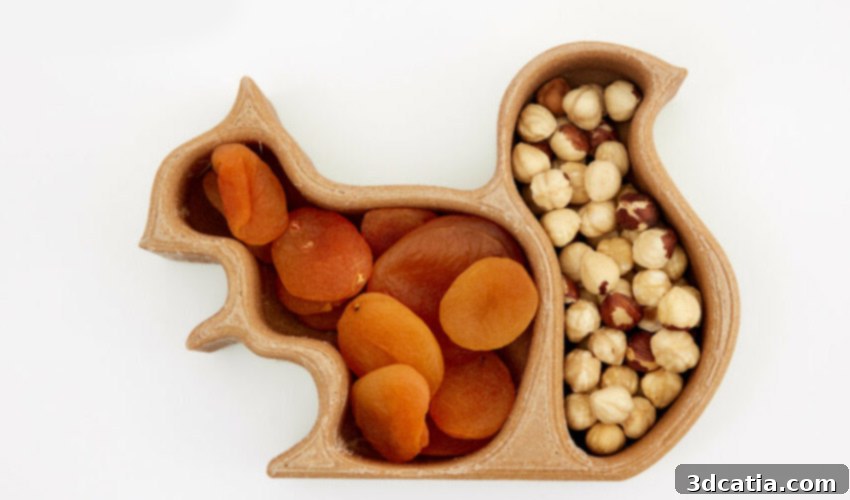
GREENFILL3D: Leading the Charge in Sustainable 3D Printing with Biodegradable Wheat Bran Filaments
In a world increasingly focused on sustainability, GREENFILL3D stands out as a pioneering Polish startup, dedicated to revolutionizing 3D printing with ecological and truly biodegradable materials. We previously highlighted their innovative work, particularly their GF3D Branfill3D filament, a groundbreaking material derived from wheat bran. This development perfectly embodies the principles of zero waste and the circular economy, transforming a common byproduct from pasta manufacturing into a valuable resource. GREENFILL3D leverages this unique filament to 3D print its own Point of Sale (POS) displays, designed to showcase and sell pasta packages – creating a complete lifecycle from production waste back to the product’s promotion. This remarkable initiative is a collaborative effort with the MASPEX Group, one of Europe’s largest food producers. To delve deeper into GREENFILL3D’s mission, its innovative materials, and future aspirations, we sat down with the company’s visionary director, Pawel Slusarczyk.
3DN: Could you introduce yourself and your connection to 3D printing?
Pawel Slusarczyk
Pawel Slusarczyk, a veteran with over nine years of experience in the dynamic 3D printing sector, leads GREENFILL3D. His journey began in January 2013 with the establishment of Centrum Druku 3D, which rapidly grew to become Poland’s premier 3D printing platform. This platform played a pivotal role in nurturing and advancing the Polish additive manufacturing industry, serving as the launchpad for many of the nation’s leading companies, including Zortrax, Sinterit, Zmorph, Omni3D, 3DGence, Technology Applied, Spectrum Filaments, and Fiberlogy. Mr. Slusarczyk’s extensive background is marked by a consistent drive for innovation; notably, in 2019, he spearheaded the creation of the SKAFFOSYS 3D bioprinters and subsequently launched a dedicated 3D bioprinting laboratory in Poland. This groundbreaking bioprinting project transitioned to an independent team in 2020, allowing him to focus on new ventures.
3DN: How did the idea to create GREENFILL3D come about? What is its mission?
The genesis of GREENFILL3D traces back to a significant collaboration initiated in 2021 with the MASPEX Group, a powerhouse in the European food industry. MASPEX approached us with a forward-thinking proposal: to explore the possibility of transforming their various post-production waste materials into innovative advertising assets. Their diverse waste streams included organic byproducts such as vegetable waste and wheat bran, alongside conventional materials like cardboard and plastics. After careful evaluation, wheat bran emerged as the ideal candidate for our pilot project. This decision paved the way for developing a novel filament specifically tailored for FDM/FFF 3D printing technology. A formal cooperation agreement was solidified in July 2021, marking the official commencement of intensive research and development efforts.
Recognizing the immense potential and distinct nature of this initiative, we made the strategic decision to spin off this ambitious project from Centrum Druku 3D. Thus, in July 2021, GREENFILL3D was formally established as an independent entity, dedicated solely to sustainable material innovation. Our endeavors received crucial support through participation in the EU-funded ScaleUp project, which provided essential financial backing for our comprehensive research and development activities. Further validating our approach, we secured a prestigious collaboration with the Polish Academy of Sciences (PAN) – Poland’s foremost scientific institution, with whom we had a prior successful partnership on the 3D bioprinter project. This synergistic alliance with PAN enabled us to formulate a unique, proprietary chemical composition for our filament, combining wheat bran with PLA and other carefully selected compounds, all meticulously engineered to be fully biodegradable and environmentally benign.
Ultimately, GREENFILL3D’s core mission is twofold: first, to diligently identify and develop environmentally friendly materials, with a particular emphasis on bioplastics that are genuinely biodegradable and compostable. Second, and equally important, we are committed to discovering and implementing applications where these sustainable materials offer practical functionality and genuine value. We operate with a clear understanding that, currently, bioplastics cannot universally replace high-performance engineering plastics like polyamides or polycarbonate in every scenario. Therefore, our focus is on creating objects, such as those derived from wheat bran, that are not only eco-conscious but also maintain robust functionality for their intended purpose. We firmly believe in responsible innovation, meaning we will not advocate for the use of bioplastics in applications where they are technically unsuitable or would compromise performance.
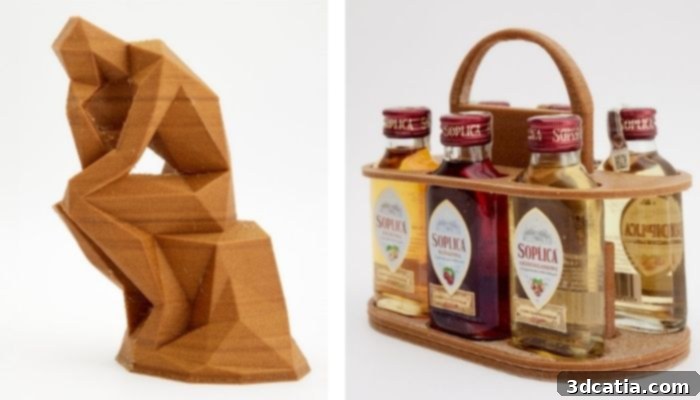
This decoration and kitchen utensil were both printed using the wheat bran filament (photo credits: GREENFILL3D)
3DN: What are the main benefits of turning wheat waste into filament for 3D printing? What are its limitations?
The inherent properties of wheat bran offer truly remarkable advantages for 3D printing filament. Initially, there were understandable concerns within the project team regarding the potential brittleness and fragility of a bran-based material. However, thanks to the fibrous nature of wheat bran, the resulting GF3D Branfill3D filament produces 3D prints that exhibit a surprising degree of flexibility and resilience. While not possessing the elastomer-like qualities of polypropylene or TPU, these prints demonstrate exceptional resistance to breakage. During rigorous testing of our display stands, for instance, a shelf was subjected to several pounds of weight. Over the course of a week, both the shelf and its sidewalls showed significant bending but crucially, no signs of fracturing. Even more impressively, when the shelf was inverted and the same weight reapplied, it remarkably straightened out within 2-3 days before conforming to the new stress on the opposite side, again without any evidence of cracks or structural failure. This self-recovering flexibility underscores the material’s durability.
Beyond these impressive physical characteristics, the fundamental appeal of GF3D Branfill3D lies in its embodiment of the circular economy. The concept of repurposing industrial production waste – in this case, wheat bran from pasta manufacturing – into a functional 3D printing material is inherently captivating. What makes it truly compelling is how this material is then utilized to create point-of-sale displays that directly promote the very pasta products from which the bran originated, closing the loop in a tangible and impactful way. This innovative approach not only reduces waste but also creates a compelling narrative for sustainable product promotion.
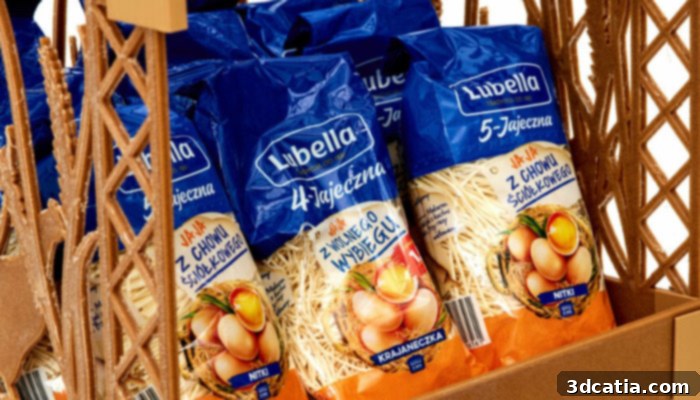
The filament is used to print displays for pasta (photo credits: GREENFILL3D)
Regarding the current limitations of GF3D Branfill3D filament, we are pleased to report that they are minimal and, we believe, entirely solvable with ongoing development. Presently, optimal printing performance is achieved using 3D printers equipped with larger diameter nozzles, typically ranging from 0.5 mm to 0.8 mm. While the filament can indeed be printed with a standard 0.4 mm nozzle, utilizing larger apertures ensures a more consistent and reliable material extrusion, yielding higher quality prints. Another current consideration is the filament’s diameter: our existing offering is 1.75 mm. This diameter, combined with the material’s specific properties, makes it less ideal for Bowden extruder systems, leading us to recommend direct drive extruders for the best results. However, GREENFILL3D is actively addressing this. We have concrete plans to introduce a 2.85 mm diameter filament, which will undergo thorough testing on popular platforms like Ultimaker and BCN3D. We are confident that this larger diameter will significantly improve compatibility with Bowden extruders, effectively resolving the current limitation and broadening accessibility for users.
3DN: Do you at GREENFILL3D plan to develop other filaments from food waste in the future?
Absolutely. At GREENFILL3D, our commitment to innovation is underpinned by a clear and detailed roadmap for future research and development initiatives. Our immediate priority is to enhance the sustainability profile of our existing materials by increasing the percentage of wheat bran content to 40% at full production scale. Following this milestone, we aim to diversify our product portfolio significantly. While we anticipate continuing to utilize wheat bran as a core sustainable component, we are actively exploring and experimenting with a wide array of other bioplastics and complementary materials. The field of bioplastics is rich with promising alternatives, and we are excited to integrate new, interesting compounds to create even more versatile and environmentally friendly filament options for the 3D printing community.
3DN: Where do you see the future of zero waste in 3D printing?
The future of zero waste in 3D printing, in my view, is ubiquitous – it will be integrated into every aspect of the industry. My recent, in-depth exploration into the production of plastics from environmentally friendly materials has revealed a profound shift: virtually every major chemical company globally is now heavily invested in researching this critical domain. We are undoubtedly standing at the precipice of a monumental revolution in plastic materials, with a significant portion of these innovations rooted firmly in the principles of zero waste and sustainability. While the full impact of these changes may take a few years to fully materialize, their arrival is both certain and inevitable, reshaping how we perceive and utilize materials in manufacturing.
Currently, however, the landscape of industrial 3D printing is far from truly ‘green.’ The prevalent focus remains on substituting traditional metals with high-performance plastics to achieve lighter, stronger, or more complex components. While beneficial for performance, these advanced plastics are not perpetually sustainable. Moreover, the promise of recycling these high-performance polymers often proves to be more theoretical than practical. Globally, a disheartening statistic reveals that merely 10% of plastic waste is successfully recycled. The vast majority – a staggering 90% – ends up in landfills, incinerated, or tragically, polluting our precious seas and oceans, contributing to an escalating environmental crisis.
Until comprehensive, large-scale solutions for plastic waste management are globally implemented – which would necessitate colossal waste processing facilities and infrastructure – GREENFILL3D firmly asserts that bioplastics offer the most effective and immediate pathway towards sustainability. Our conviction stems from the fundamental design of bioplastics: they are engineered to naturally decompose and reintegrate into the environment from their very inception. It’s crucial to understand that this perspective extends far beyond the confines of 3D printing, which, despite its growth, remains a niche industry. The imperative for truly biodegradable alternatives applies universally to all plastic production and consumption across the globe, addressing a planetary challenge.
3DN: Any last words for our readers?
To conclude, I urge all our readers to embrace responsibility, both in their personal 3D printing pursuits at home and within their professional environments. Whenever feasible, and particularly when high-performance conventional plastics aren’t strictly necessary, prioritize the adoption of environmentally friendly materials. Extend this mindful approach to your everyday consumption habits and consider the pervasive presence of plastics in our daily lives. While recent global crises have captured significant attention, it’s vital to recognize that an equally profound, albeit often overlooked, threat is the relentless inundation of plastic waste in our environment. This existential plastic pollution represents one of the most significant yet underestimated challenges facing humanity. I encourage everyone to actively seek information, critically evaluate their choices, and commit to making meaningful changes. The time for action is now; we cannot afford to passively await solutions from others. For those interested in exploring our innovative projects further, please visit the GREENFILL3D website HERE.
What are your thoughts on the groundbreaking developments pioneered by GREENFILL3D? We encourage you to share your perspectives in the comments section below. Stay updated on all our latest content by subscribing to our YouTube channel or by following us on Facebook and Twitter!
*Cover Photo Credits: GREENFILL3D