
Revolutionizing Multicolor 3D Printing: Chameleon-Inspired Ink for Sustainable Manufacturing
The landscape of additive manufacturing is continually evolving, pushing the boundaries of what’s possible in design and production. A significant leap forward has recently emerged from the innovative minds at the Beckman Institute in the U.S. Researchers there have unveiled a groundbreaking 3D printing technique that promises to redefine multicolor printing by producing a spectrum of hues from a single, specially formulated ink. Drawing inspiration from the captivating ability of chameleons to seamlessly shift their skin coloration, this team has engineered a more sustainable and efficient process for true multicolor 3D printing, marking a pivotal moment in the quest for eco-friendly manufacturing.
Traditionally, the vibrant palette of colors we encounter daily is derived from pigments or chemical dyes. The industrial production of these colorants is often energy-intensive and can carry a substantial environmental footprint, contributing to pollution and resource depletion. The world of additive manufacturing, despite its numerous advantages, has largely mirrored these challenges when it comes to color. While advanced 3D printers exist that can print in multiple colors by automatically switching between different material cartridges, these machines are typically complex, expensive, and require a separate supply for each desired color. This often leads to material waste and limitations in color gradients or intricate color patterns. However, this innovative breakthrough from the Beckman Institute team holds the potential to dramatically reduce energy consumption and material waste in color production, offering a path towards a more sustainable future for 3D printing.
Overcoming Current Limitations in Multicolor 3D Printing
Before delving into the specifics of this new technology, it’s crucial to understand the current state and limitations of multicolor 3D printing. Most existing methods for achieving multiple colors involve either multi-extrusion systems, material jetting, or binder jetting. Multi-extrusion FDM printers, for example, use several nozzles or a single nozzle with multiple material feeds, requiring precise calibration and often leading to filament waste during color changes or purging. Material jetting technologies, while capable of producing high-resolution color, operate by jetting tiny droplets of colored resins which are then cured by UV light. These systems utilize multiple print heads, each dedicated to a primary color, which are then mixed to create a broader spectrum. While effective, the initial investment and running costs are substantial, and they still rely on a collection of distinct colored resins. Binder jetting, which uses a liquid binder selectively applied to a powder bed, can also create colored parts by printing colored binders. However, all these methods share a common thread: they necessitate multiple distinct color inputs, each with its own material handling and potential for waste. The Beckman Institute’s approach offers a fundamentally different paradigm, moving away from multiple material inputs to dynamic, on-the-fly color generation from a single source.

This innovative color-changing process can be implemented on a modified FDM 3D printer, making advanced multicolor capabilities more accessible. (Photo credits: Beckman Institute)
Chameleon-Inspired Structural Color: A New Frontier for 3D Printing Ink
The 3D printing process proposed by the researchers at the Beckman Institute draws its core inspiration from the natural world, specifically from chameleons. Unlike many animals that change color by distributing or concentrating pigment granules within their cells, chameleons achieve their remarkable transformations through structural color. This phenomenon occurs when microscopic structures interact with light, scattering specific wavelengths and reflecting others, much like how a prism separates white light into its constituent colors. By dynamically adjusting the spacing of tiny crystals in their skin, chameleons can manipulate how light is reflected, thus altering their visible color. This sophisticated mechanism allows for rapid and dramatic color shifts without requiring different pigments.
Translating this biological marvel into a technological solution, the researchers developed a “direct writing” 3D printing technique capable of altering the printed object’s color in real-time during the fabrication process. The heart of this innovation lies in a specialized, UV-assisted ink and a modified FDM (Fused Deposition Modeling) 3D printer. To enable this dynamic color change, a standard FDM printer was ingeniously adapted by integrating a UV guide and a pressure moderator for ultraviolet light. This custom-designed UV guide precisely radiates light directly onto the material as it exits the extruder nozzle. The intensity and duration of this UV light exposure are critical, as they dictate the final color of the ink as the material hardens. Depending on the concentration and application of the UV rays, the unique ink, composed of specially designed copolymers, undergoes a structural change that results in a distinct color. This technique, while distinct in its execution, shares a conceptual similarity with some resin printing processes where UV light is used to cure and solidify liquid photopolymer resins, but here, the UV light actively *modulates* the structural color of the extruded material.
The initial results achieved with this chameleon-inspired ink were nothing short of astonishing. Just as a chameleon can fluidly transition from its base green to more vivid and striking colors, the research team successfully demonstrated the creation of a succession of vibrant colors during a single 3D printing operation, all utilizing just one type of ink. Dr. Ying Diao, an associate professor of chemistry and chemical and biomolecular engineering at the University of Illinois Urbana-Champaign and a leading researcher at the Beckman Institute for Advanced Science and Technology, emphasized the significance of this achievement, stating, “By designing new chemistries and printing processes, we can modulate structural color on the fly to produce color gradients not possible before.” This statement underscores not only the technical prowess but also the unprecedented creative freedom this technology unlocks for designers and engineers. The ability to generate intricate color gradients and complex patterns in a single print job, without pauses or material changes, opens up a new realm of possibilities for aesthetic and functional applications.
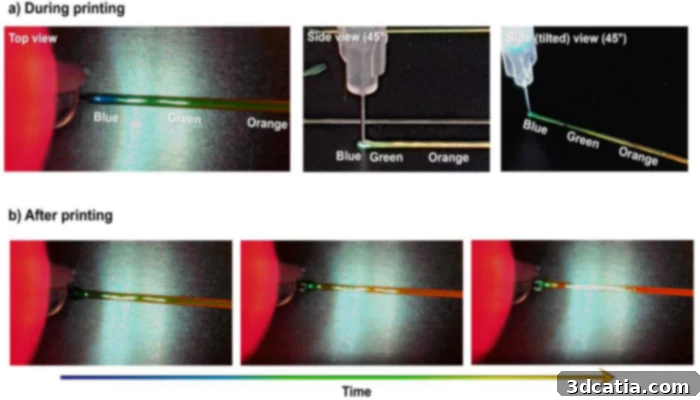
The revolutionary ink, named c-BBCP, demonstrates impressive color progression, transitioning from blue to red within seconds under UV light exposure. (Photo credits: Beckman Institute)
The Sustainable Impact and Future Potential of c-BBCP Ink
Beyond the impressive technical feat, the most compelling aspect of this research is its profound implication for sustainability in manufacturing. The ability to produce an extensive range of colors from a single, base ink formulation fundamentally disrupts the traditional color production chain. Currently, manufacturing relies on the extensive synthesis, processing, and transportation of countless distinct pigments and chemical dyes, each with its own environmental burden. By requiring only one ink, the entire logistical and production overhead associated with these multiple colorants would be considerably reduced. This translates directly into substantial savings in production time, raw material costs, and manufacturing waste. The vision of an infinite number of colors being created merely through the precise application of light, rather than a myriad of chemical compounds, represents a paradigm shift towards truly eco-friendly additive manufacturing.
Moreover, the sustainability benefits extend to reduced energy consumption in pigment synthesis and fewer chemical byproducts. The simplicity of managing a single ink inventory compared to dozens or hundreds of different colored filaments or resins also presents logistical and economic advantages for businesses. This innovation paves the way for a more circular economy in 3D printing, where materials are used more efficiently and waste is minimized. The research team is optimistic about the future, expecting continued progress that will lead to an even broader variety of achievable colors and refined control over the color-changing process. This advancement could impact industries ranging from fashion and consumer goods to medical devices and architectural models, enabling unparalleled customization and reducing the environmental footprint of physical products. For those eager to delve deeper into the scientific intricacies of this groundbreaking work, the full study is available HERE.
The implications of this chameleon-inspired multicolor 3D printing process are vast and exciting, promising a future where vibrant, custom-colored objects can be created with unprecedented efficiency and environmental consciousness. What are your thoughts on this innovative approach to sustainable 3D printing? Let us know in a comment below or connect with us on our LinkedIn, Facebook, and Twitter pages! Don’t forget to sign up for our free weekly newsletter here to receive the latest 3D printing news straight to your inbox! You can also find all our videos and interviews on our YouTube channel.
*Cover Photo Credits: Pixabay.