
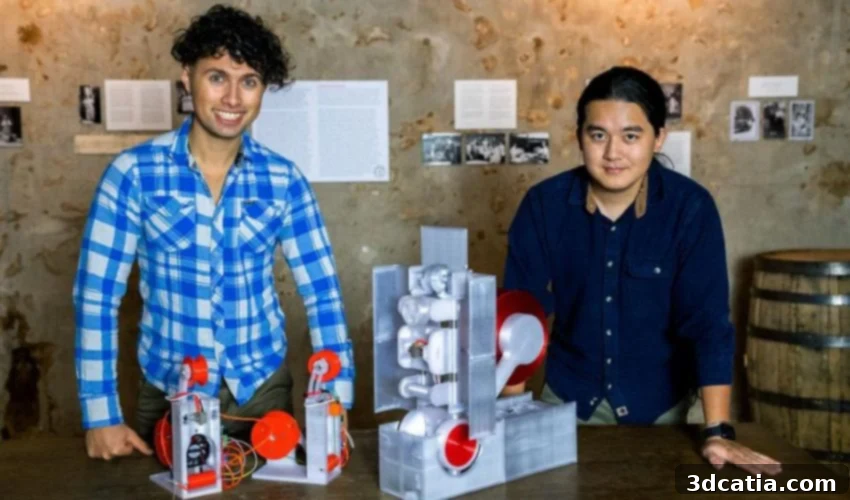
Polyformer: Transforming Plastic Waste into Accessible 3D Printer Filament for a Sustainable Future
The global challenge of plastic waste is immense, with billions of plastic bottles ending up in landfills and oceans each year, contributing significantly to environmental degradation. Concurrently, the burgeoning field of 3D printing, while offering incredible potential for innovation and local manufacturing, often faces a significant barrier in many regions: the high cost and limited availability of specialized filament. This dual problem inspired a groundbreaking solution: the Polyformer, a project that brilliantly addresses both environmental sustainability and technological accessibility. Developed by the visionary duo Reiten Cheng and Swaleh Owais, the Polyformer is an innovative, open-source machine designed to recycle used plastic bottles directly into high-quality filament suitable for FDM 3D printing. This ingenious creation caught the attention of the prestigious James Dyson Award, an international competition recognizing engineering and design projects that “solve a problem,” and was deservedly honored with the Sustainability division award, cementing its place as a truly transformative invention.
The inception of Polyformer was fueled by a deep commitment to sustainability and a desire to empower communities, especially in developing nations. Cheng and Owais were particularly inspired by stories of recycling and eco-conscious innovation within the 3D printing community, recognizing the untapped potential in waste materials. Their core motivation was to bridge the gap between abundant waste and advanced manufacturing capabilities, enabling individuals and organizations in regions with limited resources to harness the power of 3D printing without prohibitive material costs. Swaleh Owais, in particular, pursued this project in Rwanda at the Deutsche Gesellschaft für Internationale Zusammenarbeit (GIZ) GmbH, directly confronting the practical challenge of exorbitant shipping costs for traditional 3D printer filament into Africa. The Polyformer represents not just a machine, but a powerful tool for economic empowerment, environmental stewardship, and localized innovation, promising to make 3D printing truly accessible and sustainable worldwide.
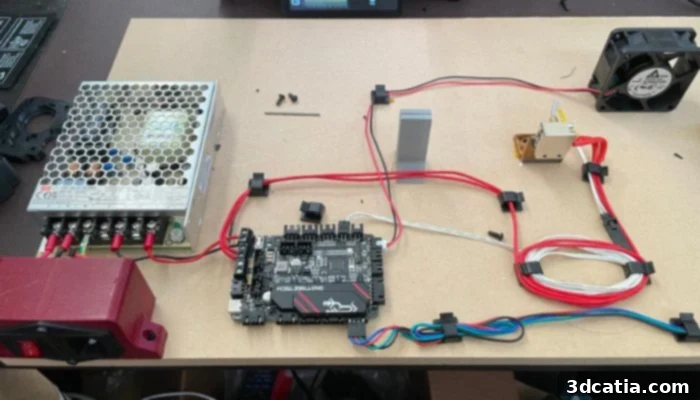
The Polyformer machine under construction, showcasing its modular design for transforming plastic waste. (Photo credit: Reiten Cheng)
Global Recognition and Future Impact: The James Dyson Award Validation
The James Dyson Award is renowned globally for celebrating cutting-edge designs and engineering solutions that tackle real-world problems with ingenuity and practicality. Its recognition of the Polyformer with the coveted Sustainability award, personally chosen by Sir James Dyson himself, underscores the profound importance and innovative potential of this project in addressing both environmental and technological divides. This accolade is not merely an honor but a crucial catalyst for the Polyformer’s continued development, deployment, and expansion. Reiten Cheng and Swaleh Owais plan to strategically utilize the substantial prize money to manufacture and deploy more Polyformer machines in various 3D printing labs across Rwanda. This initial rollout will serve as a vital pilot program, allowing the team to gather invaluable user feedback directly from the communities benefiting from the technology. This feedback loop is essential for refining the design and optimizing the system for diverse local conditions. The long-term vision is ambitious yet achievable: to expand the Polyformer project to other developing countries, creating a network of localized plastic recycling and 3D printing hubs that can significantly reduce plastic litter while fostering self-sufficiency and local economies.
Sir James Dyson, Founder and Chief Engineer at Dyson, eloquently summarized the project’s transformative impact, stating, “By turning used plastic bottles into 3D printer filament, Polyformer helps reduce the amount of waste going to landfill and provides a cheap and plentiful material for engineers and designers, especially in developing countries. Their idea will provide new opportunities for other inventors to prototype their ideas using 3D printing.” This powerful endorsement from a titan of innovation highlights Polyformer’s dual role: an environmental savior and an enabler of future ingenuity. The project not only offers a tangible solution to the pervasive problem of plastic pollution but also democratizes access to prototyping and manufacturing tools, empowering a new generation of inventors, entrepreneurs, and problem-solvers in regions that stand to gain the most from such advancements. It fosters a localized circular economy where waste becomes a valuable resource, driving innovation from the ground up.
Building a Comprehensive 3D Printing Ecosystem: Beyond the Core Polyformer
The innovators behind Polyformer envision a complete, integrated system for sustainable 3D printing, extending far beyond just filament creation. Recognizing the need for a robust and user-friendly experience when working with recycled materials, they are actively developing several complementary side projects. These innovations are meticulously designed to enhance the utility, efficiency, and overall print quality when using Polyformer-produced filament, creating a truly holistic recycling ecosystem. For instance, the **Polyjoiner** is an ingenious device that will automatically connect multiple strands of filament together, ensuring uninterrupted printing from various recycled sources. This is crucial for maximizing the output from different bottle types and sizes. The **Polydryer** addresses a critical challenge: evaporating residual water from PET plastic before extrusion. Moisture absorption is a common issue with plastics and can lead to significant print quality issues like bubbles, inconsistent extrusion, and weakened parts; the Polydryer ensures consistent, high-quality material. Finally, the **Polyspooler** is an automated system that will efficiently create neatly wound spools of the newly produced filament, ensuring ease of storage, handling, and crucially, compatibility with standard 3D printers, which typically require spooled material. Together, these thoughtful innovations aim to establish a seamless, user-friendly, and highly effective ecosystem for transforming plastic waste into reliable 3D printing material, effectively closing the loop on plastic bottle waste and making accessible 3D printing a practical reality for communities worldwide.
The Technical Ingenuity Behind Polyformer’s Modular and Open-Source Design
At the heart of the Polyformer’s widespread appeal and efficacy is its meticulously engineered modular architecture, a design choice that profoundly contributes to its global accessibility, maintainability, and adaptability. The filament creation process begins with a specially designed slicing tool that precisely cuts a discarded plastic bottle into a continuous, consistent ribbon. This ribbon is then carefully fed into a heated extrusion module, often referred to as a ‘hot end,’ where it undergoes thermoforming. Through a controlled heating and drawing process, the plastic ribbon is uniformly reshaped and compressed into a consistent 1.75mm diameter filament – the industry-standard size compatible with the vast majority of FDM 3D printers. Once formed, this fresh filament is automatically wound onto a motorized spool, ready for immediate use. The genius of Polyformer’s construction lies in its self-replicating nature; it is predominantly built using 3D printed parts itself, embodying a true circular economy principle. This design choice significantly reduces manufacturing costs and complex supply chain dependencies, making it easier to produce and repair locally, even in remote or resource-limited areas.
Furthermore, Reiten Cheng and Swaleh Owais made a deliberate and impactful decision to release all the Polyformer technology as **open-source**. This means that the designs, detailed instructions, and associated software are publicly available without patent restrictions. This unwavering commitment to open-source development fosters a vibrant global community of innovators, allowing others to freely access, modify, improve upon, and adapt the Polyformer design to suit specific local needs and available materials. Their core criteria for the design emphasized a simplified assembly process, minimizing the need for complex supports or extensive post-processing during its construction. The result is a compact, easy-to-assemble, and highly modifiable machine, ensuring that individuals and communities with varying technical expertise can build, maintain, and even customize their own Polyformer units, truly democratizing access to this transformative technology and enabling widespread adoption and adaptation.

The Polyformer machine in action, illustrating its compact form factor and ease of use. (Photo credits: Reiten Cheng)
Pioneering a Circular Economy in 3D Printing and Beyond
The Polyformer’s true innovation lies in its powerful dual benefits: it actively contributes to **waste prevention** by giving new life and value to discarded plastic bottles, and it dramatically **improves the accessibility of 3D printing** technologies, particularly for developing nations where traditional materials are scarce or expensive. This synergy creates a powerful model for a localized circular economy, where waste is transformed into valuable resources, fostering self-sufficiency, reducing reliance on costly imported materials, and minimizing environmental impact. The impact extends beyond just environmental cleanup; it creates tangible opportunities for local entrepreneurship, technical education, and the development of custom solutions to unique local challenges, from medical prototypes and educational tools to essential spare parts and construction components.
While Polyformer is a groundbreaking example of localized plastic recycling for 3D printing, the broader movement to integrate waste products into additive manufacturing is gaining significant traction worldwide, pointing towards a more sustainable future for the industry. For instance, a pioneering US company is actively building 10 homes using recycled plastic, showcasing the immense potential for large-scale construction using sustainable, repurposed materials. On a more granular but equally innovative scale, researchers in Singapore have ingeniously utilized recycled glass for sand 3D printing, opening new avenues for architectural, artistic, and industrial applications. These diverse examples, alongside the Polyformer, highlight a growing global commitment to reimagining manufacturing processes through the critical lens of sustainability and circular economics. Polyformer stands out by making this revolutionary approach directly accessible at the community level, empowering individuals to be active participants in the circular economy, thereby fostering a more resilient and sustainable future for all. To delve deeper into the project and its ongoing developments, you can find more information on the designer’s dedicated website HERE, and additional details about the esteemed James Dyson Award and its past winners are available HERE.
Join the Conversation and Stay Informed About Sustainable 3D Printing!
What are your thoughts on the Polyformer’s immense potential to revolutionize both waste management and 3D printing accessibility in developing regions and beyond? Do you believe open-source hardware solutions like this are the key to fostering truly sustainable development and innovation globally? We invite you to share your valuable insights, opinions, and comments below, contributing to a vibrant discussion around this exciting technology. You can also engage with us and our passionate community on our LinkedIn, Facebook, and Twitter pages, where we regularly share updates and news. Don’t miss out on the latest advancements, breakthroughs, and essential news in the additive manufacturing world; sign up for our free weekly Newsletter here to receive direct updates straight to your inbox. For more visual content, in-depth discussions, and fascinating demonstrations of 3D printing innovations, be sure to visit and subscribe to our YouTube channel, where you can find all our videos and interviews on cutting-edge 3D printing technologies.