
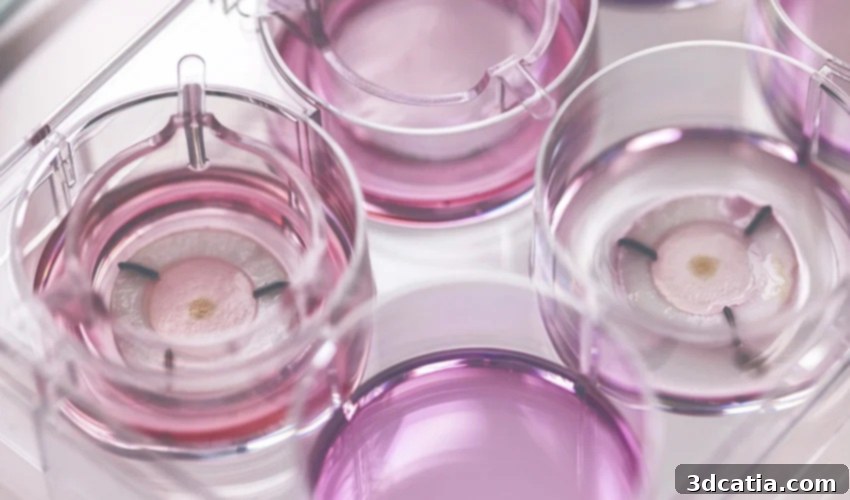
Chanel’s Pioneering Leap: 3D Bioprinting for Advanced Skincare Innovation
The integration of 3D printing technology into the cosmetics industry has moved beyond nascent experimentation to become a firmly established and transformative force. Leading beauty brands are increasingly leveraging additive manufacturing for a diverse array of applications, revolutionizing everything from product development cycles to personalized consumer experiences. For instance, companies like Cosmogen have embraced metal 3D printing not just for customizing their applicators but also for conceiving intricate geometries that were previously unattainable through conventional manufacturing methods. This capability allows for unprecedented design freedom, leading to more ergonomic, aesthetically pleasing, and functionally superior tools for makeup application. Similarly, Albéa, a global leader in packaging, is heavily investing in additive manufacturing as a cornerstone for creating the cosmetic packaging solutions of tomorrow. Their focus is on sustainable, innovative, and highly functional designs that can adapt quickly to market trends and consumer demands, significantly reducing waste and development time.
A prime example of this widespread adoption comes from L’Oréal, a colossal figure in the beauty sector, which has prominently integrated 3D printing into its operational framework. The company extensively utilizes this technology to dramatically accelerate its product development timeline, reportedly halving the time required to bring new innovations to market. L’Oréal’s commitment to additive manufacturing is evident in its impressive array of 3D printers, encompassing various cutting-edge technologies. These include Fused Deposition Modeling (FDM) for rapid prototyping and functional parts, Stereolithography (SLA) for high-resolution models and master patterns, and Multi Jet Fusion (MJF) for producing durable, complex parts with excellent surface finish. This diverse arsenal allows L’Oréal to explore new formulations, test packaging designs, and refine product aesthetics with unparalleled speed and precision. While these industry giants have been actively innovating with 3D printing for some time, the luxury sector has also begun to embrace these advancements, with Chanel, a renowned name in high-end beauty, now making its own significant strides into this technological frontier.
The Dawn of Bioprinting in Luxury Beauty: Chanel’s Pioneering Move
Chanel’s engagement with 3D printing is not entirely new. The esteemed luxury brand has previously leveraged the technology for specific product enhancements, most notably in the creation of innovative mascara brushes. These earlier applications demonstrated the potential of additive manufacturing to redefine product performance and user experience, enabling the design of brush geometries impossible to achieve with traditional molding techniques, leading to superior lash separation and volume. However, Chanel has recently unveiled its most audacious and scientifically profound innovation yet: the development of 3D bioprinted reconstructed human skin featuring a central pigment spot. This groundbreaking achievement represents a significant leap forward, not just for Chanel but for the entire skincare research community.
This pioneering creation was brought to fruition through a strategic collaboration with LabSkin Creations, a dynamic French biotechnology start-up that specializes in the advanced 3D engineering of both skin and fat tissue. The primary objective behind this ambitious project is to gain a deeper, more nuanced understanding of the complex biological mechanisms underlying various skin imperfections, particularly those related to pigmentation irregularities. By accurately modeling these conditions in a controlled, in vitro environment, Chanel aims to drastically improve its ability to formulate and develop more effective and targeted skincare products. According to Chanel, this sophisticated 3D bioprinted skin model is a world first, pushing the boundaries of scientific research in dermatology. It is the sophisticated outcome of synergistically combining cutting-edge cell culture techniques with advanced 3D bioprinting methodologies, resulting in a model that closely mimics real human skin biology.
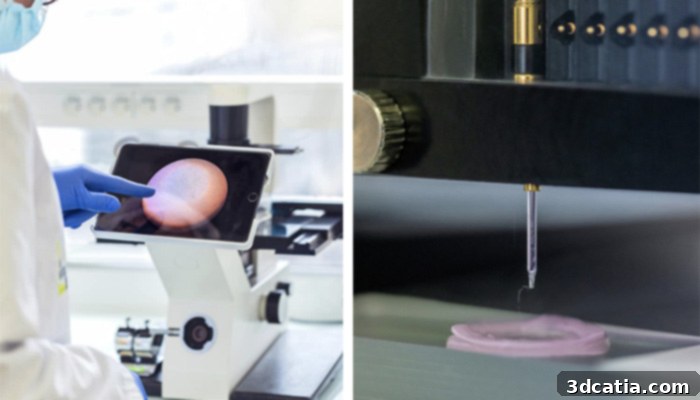
LabSkin Creations’ technology makes it possible to reproduce the epidermis and dermis of the skin (photo credits: LabSkin Creations)
Understanding Skin Pigmentation with 3D Bioprinting
The intricate process behind the creation of this 3D bioprinted skin model involved the careful use of a specialized bio-ink. The French company, LabSkin Creations, elaborated that this innovative bio-ink contains melanocytes – specialized cells inherently responsible for human skin pigmentation. These melanocytes achieve this crucial function by synthesizing melanin, the natural pigment that determines skin, hair, and eye color. Within the bioprinted skin construct, the pigment spot manifests gradually, emerging visibly after a carefully controlled maturation stage. This allows researchers to observe the development of pigmentation irregularities in real-time, under precise experimental conditions. Chanel emphasized the significance of this development, stating, “This exclusive model, designed using human cells in their microenvironment, allows us to explore and better understand the biological mechanisms linked to skin pigment irregularities, to evaluate the effectiveness of preventive and corrective active ingredients in order to select the most effective ones.” This direct quote underscores the profound research capabilities offered by such an advanced, biologically relevant model, paving the way for targeted and highly effective skincare solutions for conditions like hyperpigmentation.
As highlighted, the sophisticated 3D bioprinted skin itself originates from the cutting-edge laboratories of LabSkin Creations. The French start-up’s proprietary technology is capable of producing human tissue models that are significantly more complex and biologically precise than those achieved through traditional methods. This superiority stems from a crucial distinction: while more conventional tissue engineering techniques are often limited to reproducing only the epidermis – the outermost layer of the skin – LabSkin Creations’ technology can also successfully produce the dermis. The dermis is the vital connective tissue layer situated between the epidermis and the hypodermis, rich in collagen, elastin, and other structural components that give skin its strength and elasticity. The ability to replicate both these crucial layers results in a far more accurate and comprehensive model of human skin, providing a truly holistic testing platform for cosmetic and dermatological products.
Beyond structural complexity, LabSkin Creations’ innovation also delivers remarkable efficiency in terms of production speed. The company boasts the ability to grow these advanced skin models in a mere 21 days, a significant acceleration compared to the typical 45 days required for more traditional cell culture methods. This substantial reduction in cultivation time allows Chanel to obtain highly detailed and biologically relevant 3D bioprinted skin models much more rapidly. The speed and sophistication of these models enable faster iteration in research and development, allowing for quicker screening of active ingredients and more agile product formulation. This not only streamlines the development process but also ensures that the products being developed are tested on models that closely mimic human physiological responses, leading to more reliable and impactful skincare solutions. For those interested in delving deeper into the specifics of this remarkable innovation, further details can be found by clicking HERE.
The Broader Impact: Ethical Skincare and Product Innovation
The development of advanced 3D bioprinted human skin models, particularly those capable of replicating complex conditions like pigmentation spots, carries profound implications for the cosmetics and pharmaceutical industries. One of the most significant impacts is on ethical testing. For decades, the development of new skincare products often relied on animal testing, a practice that has faced widespread ethical opposition and has been banned in many regions globally. 3D bioprinted skin offers a highly viable, humane, and often more accurate alternative. Unlike animal models, which may not always perfectly mimic human physiological responses, bioprinted human skin models provide a direct and relevant platform for assessing product safety and efficacy. This allows companies like Chanel to uphold ethical standards while still conducting rigorous scientific research, ensuring that their innovations are both cutting-edge and conscientious.
Furthermore, these sophisticated in vitro models are not just ethical but also incredibly powerful tools for product innovation. By providing a highly controlled and reproducible environment, researchers can precisely evaluate how different active ingredients interact with skin cells, how they penetrate various skin layers, and their overall impact on specific conditions. This capability extends beyond basic toxicity testing, allowing for the comprehensive analysis of ingredient performance in areas such as anti-aging, hydration, UV protection, and, as demonstrated by Chanel, pigmentation correction. The ability to simulate conditions like hyperpigmentation and observe the effects of potential treatments on melanocyte activity and melanin production directly translates into the development of more targeted, effective, and scientifically validated skincare products for consumers.
The Future Landscape of 3D Printing in Cosmetics
The advancements made by Chanel and LabSkin Creations, alongside the broader adoption of 3D printing by industry leaders like L’Oréal, signal a transformative future for the cosmetics sector. Beyond bioprinted skin models for R&D, 3D printing is poised to unlock entirely new possibilities. Imagine personalized cosmetics created on demand, tailored precisely to an individual’s skin type, concerns, and even environmental factors. This could involve bespoke serum formulations, custom-fit masks, or makeup products with unique textures and pigment blends, all produced by advanced additive manufacturing systems. The technology’s ability to handle intricate geometries and diverse materials opens doors to innovative product forms, dispensers, and packaging that are not only aesthetically unique but also enhance product preservation and user experience.
Looking ahead, we can anticipate further exploration into multi-material printing, allowing for products with layered functionalities or variable textures. The rapid prototyping capabilities inherent in 3D printing will continue to shorten development cycles, enabling brands to respond to market trends with unprecedented agility. Moreover, as sustainability becomes an increasingly critical focus, 3D printing offers advantages in reducing material waste through additive processes and potentially enabling localized, on-demand manufacturing that minimizes transportation footprints. Chanel’s venture into 3D bioprinting is not just an isolated innovation; it is a clear indicator of a paradigm shift, illustrating how scientific rigor, technological prowess, and a commitment to ethical practices are converging to redefine the very essence of luxury beauty and skincare in the 21st century.
What do you think of this 3D bioprinted skin innovation and its implications for the future of skincare? We’d love to hear your thoughts! Let us know in a comment below or join the conversation on our LinkedIn, Facebook, and Twitter pages! Don’t forget to sign up for our free weekly Newsletter here to get the latest 3D printing news straight to your inbox! You can also find all our videos on our YouTube channel for more in-depth content.
*Cover Photo Credits: Chanel