
Revolutionizing Footwear Manufacturing: ECCO and Stratasys Forge a Strategic 3D Printing Partnership
The global footwear industry is experiencing a profound transformation, with additive manufacturing, commonly known as 3D printing, at its forefront. While industry giants like Adidas and Nike have notably integrated advanced 3D technologies into their shoe production lines, they are by no means the only innovators in this space. Back in 2018, we highlighted the pioneering efforts of ECCO, a renowned Danish shoe manufacturer that has long embraced both 3D scanning and 3D printing to deliver highly customized and meticulously crafted products. Continuing its commitment to innovation and expansion, ECCO recently announced a significant strategic alliance that promises to further accelerate its product development: a major partnership with the American additive manufacturing powerhouse, Stratasys. This collaboration is set to redefine how ECCO designs and manufactures its future range of shoes and footwear components, leveraging cutting-edge 3D printing solutions to enhance speed, efficiency, and design flexibility.
ECCO’s decision to align with Stratasys and adopt its sophisticated additive manufacturing technologies, particularly the Origin One 3D printer, is no mere coincidence. The Origin One is powered by Stratasys’ proprietary P³ (programmable photopolymerization) technology, a system celebrated for its exceptional precision, speed, and surface finish. This advanced technology enables the production of high-quality parts with impressive mechanical properties, making it ideal for demanding industrial applications such as footwear manufacturing. Jakob Møller Hansen, Vice President of Research and Development at ECCO, articulated the strategic rationale behind this move: “Our innovative approach to footwear development and desire to put customer experience as a priority made additive manufacturing a logical next step in the evolution of our development process.” He further emphasized the rigorous selection process, stating, “In our search to find the right partner, we tested a variety of 3D printers for surface quality, print speed, and accuracy. Among the printers we tested, the Stratasys Origin One was the 3D printer that best met our stringent requirements.” This meticulous evaluation underscores ECCO’s dedication to quality and performance, ensuring that the chosen technology would seamlessly integrate into and significantly enhance their already advanced manufacturing workflows.

The Origin One 3D printer (photo credits: Origin)
Innovating Footwear Production: ECCO and Stratasys Leverage Cutting-Edge Technologies
The core of ECCO’s manufacturing philosophy lies in its Direct Injection Process (DIP), a method renowned for creating incredibly durable, flexible, and comfortable footwear. DIP involves injecting a liquid polyurethane or thermoplastic elastomer directly into a mold where the shoe upper is already positioned, thereby bonding the upper and sole seamlessly without stitching or glue. This process results in a lightweight, long-lasting, and anatomically precise fit. With the integration of additive manufacturing from Stratasys, ECCO aims to not only streamline its development process but also significantly increase automation and efficiency within its DIP operations.
Enhancing the Direct Injection Process (DIP) with 3D Printed Molds
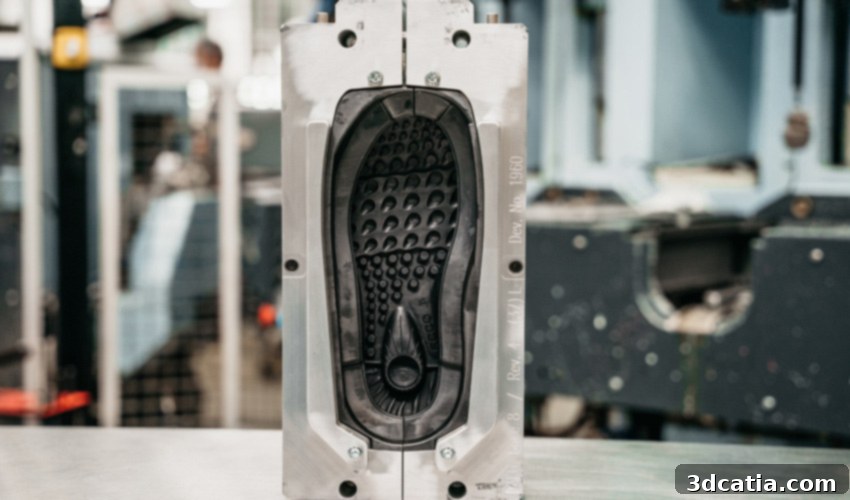
While the DIP method itself offers unparalleled benefits for shoe construction, the traditional creation of molds for this process can be time-consuming and costly. Historically, these molds were primarily manufactured using aluminum CNC machining, a subtractive process that involves significant material waste, extended lead times, and high production expenses. Additive manufacturing fundamentally changes this paradigm. By utilizing 3D printing, ECCO can now rapidly produce highly precise molds from advanced photopolymers at a fraction of the cost and time associated with traditional methods.
This shift to 3D printed DIP molds offers numerous strategic advantages. For instance, a single pair of mold inserts can now be printed overnight, dramatically accelerating the prototyping and production cycles. This speed is invaluable in the fast-paced fashion industry, allowing ECCO to respond more quickly to market trends and consumer demands. Furthermore, the cost-efficiency of 3D printing molds is substantial. The ability to produce molds on-demand and without the overhead of complex machining operations translates directly into significant savings. Perhaps most critically for product innovation, designers and developers are empowered to test functional shoe prototypes much earlier in the development process. This capability allows for more rapid iteration, immediate feedback on design concepts, and the refinement of ergonomic features, ultimately leading to superior products reaching the market faster and with greater confidence.
The Critical Role of Advanced Materials in 3D Printed Footwear Molds
To realize the full potential of 3D printed molds for the demanding Direct Injection Process, the selection and development of specialized materials are paramount. For this partnership, ECCO and Stratasys are utilizing customized materials developed in collaboration with Henkel, a global leader in adhesive technologies and functional materials. These custom Henkel materials are engineered to meet the rigorous performance requirements of DIP, specifically designed to withstand the high temperatures, pressures, and chemical interactions inherent in the injection molding process. According to the press release, these advanced photopolymer resins allow ECCO to create shoe molds that are capable of enduring thousands of shots with zero visible degradation. This remarkable durability ensures that the 3D printed molds are not just for prototyping but can also be used for short-run production or even integrated into larger-scale manufacturing lines without compromising quality or requiring frequent replacements.
The ability of these materials to maintain their structural integrity and precision over extended production runs is a game-changer. It directly contributes to the significant cost savings and reduced production times that ECCO anticipates. By eliminating the need for expensive, time-consuming metal molds for many applications, ECCO can rapidly iterate designs, test new concepts, and bring innovative footwear to market with unprecedented agility. This goal of achieving substantial cost efficiencies and accelerating product cycles while maintaining high quality is shared by a growing number of companies across various sectors that are increasingly adopting additive manufacturing to design and produce a wide array of everyday goods. The synergy between Stratasys’s cutting-edge 3D printing technology and Henkel’s advanced material science is critical to unlocking new possibilities in footwear manufacturing, pushing the boundaries of what is achievable in terms of design, performance, and production efficiency. You can find out more about this groundbreaking partnership and its implications HERE.
The Broader Impact: Unlocking Unprecedented Design Freedom and Market Agility
The partnership between ECCO and Stratasys represents more than just an technological upgrade; it signifies a fundamental shift in ECCO’s approach to product development and market responsiveness. By integrating the Origin One 3D printer and its P³ technology, coupled with Henkel’s high-performance materials, ECCO is set to achieve a multitude of strategic advantages. Firstly, the drastic reduction in mold production time and cost empowers designers with unparalleled creative freedom. They can now experiment with more radical designs, intricate geometries, and functional features that would be prohibitively expensive or time-consuming with traditional manufacturing methods. This accelerates the design iteration process, allowing for numerous prototypes to be produced, tested, and refined in a fraction of the time, fostering a culture of continuous innovation.
Secondly, the ability to produce functional molds overnight means that ECCO can bring new products to market with incredible speed. This market agility is crucial in today’s dynamic retail landscape, enabling the brand to capitalize on emerging trends and consumer preferences more effectively. The cost savings extend beyond just mold production; reduced lead times also mean lower inventory holding costs and a more streamlined supply chain. Furthermore, the enhanced automation introduced by 3D printing in the mold-making process minimizes human error, improves consistency, and frees up skilled labor to focus on more complex, value-added tasks.
This collaboration also positions ECCO at the forefront of the personalization trend. With highly flexible and cost-effective mold production, the potential for mass customization becomes a tangible reality. Imagine shoes tailored precisely to individual foot shapes, gait patterns, or aesthetic preferences, all made possible by efficient, on-demand mold creation. This level of customization can significantly enhance customer experience and loyalty, offering unique products that truly stand out in a crowded market.
The Future of Footwear: Sustainable and Customer-Centric Manufacturing
Looking ahead, the alliance between ECCO and Stratasys points towards a future where footwear manufacturing is not only more efficient but also more sustainable. Additive manufacturing inherently reduces material waste compared to subtractive methods like CNC machining, as it only uses the material needed for the part. As 3D printing technologies continue to evolve, there is potential for localized production, reducing transportation emissions and allowing for a more responsive, demand-driven manufacturing model. This focus on efficiency, reduced waste, and the potential for on-demand production aligns perfectly with global sustainability initiatives and consumer demand for more environmentally responsible products.
For Stratasys, this partnership with a respected global brand like ECCO further solidifies its position as a leading provider of industrial 3D printing solutions. It demonstrates the real-world applicability and tangible benefits of its P³ technology and the Origin One printer in demanding manufacturing environments. For ECCO, it’s a strategic move that reinforces its commitment to innovation, quality, and customer satisfaction, ensuring that the brand remains a pioneer in combining traditional craftsmanship with state-of-the-art technology. Together, they are not just creating shoes; they are engineering the future of footwear, one precisely 3D-printed mold at a time.
Conclusion: Paving the Way for Next-Generation Footwear
The partnership between ECCO, the Danish footwear innovator, and Stratasys, the additive manufacturing titan, marks a significant milestone in the evolution of shoe production. By leveraging Stratasys’s advanced Origin One 3D printer and its P³ technology, complemented by customized materials from Henkel, ECCO is poised to redefine its Direct Injection Process. This collaboration promises substantial benefits, including accelerated product development cycles, significant cost reductions in tooling, and unprecedented flexibility in design and prototyping. It underscores the transformative power of 3D printing in enabling faster iterations, reducing waste, and ultimately delivering superior, more customized products to consumers. As the footwear industry continues to embrace digital manufacturing, the strategic alliance between ECCO and Stratasys serves as a compelling blueprint for how innovation, technology, and strategic partnerships can drive an entire sector forward into a more efficient, agile, and sustainable future.
*Cover Photo Credits: Stratasys
What do you think of the partnership between ECCO and Stratasys? Let us know in a comment below or on our Linkedin, Facebook, and Twitter pages! Don’t forget to sign up for our free weekly Newsletter here, the latest 3D printing news straight to your inbox! You can also find all our videos on our YouTube channel.