
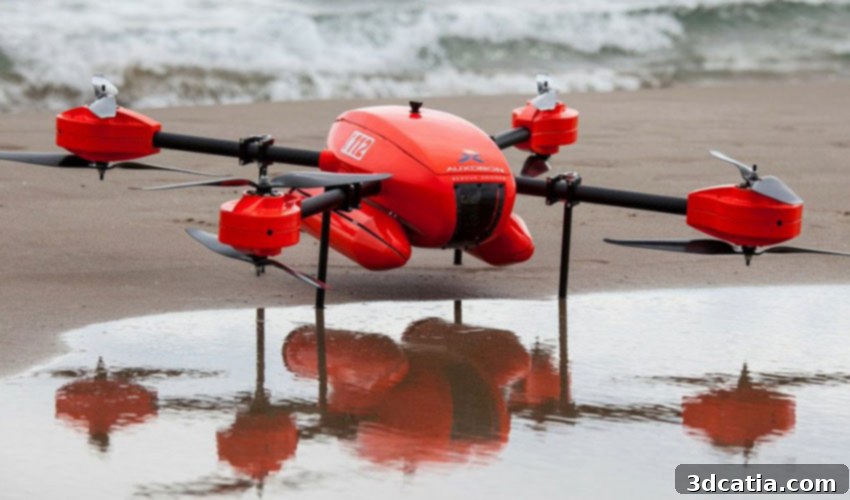
Revolutionizing Beach Safety: How 3D-Printed Drones Like Auxdron Lifeguard are Transforming Coastal Rescue
This summer marks a significant leap forward in beach safety, thanks to the pioneering deployment of advanced 3D-printed drones. Leading this innovation is the Valencian company General Drones, whose groundbreaking creation, the Auxdron Lifeguard, has already made waves by enhancing surveillance and rescue operations on the bustling beaches of Port de Sagunt and Palma de Mallorca. This initiative represents not just a local success story but the crucial first step in a visionary project aiming for widespread implementation across all Spanish beaches, bolstered by the invaluable support of the Marine Rescue service. The integration of such sophisticated aerial technology promises to usher in an era where coastal environments are safer for everyone, minimizing risks for swimmers and providing crucial assistance to human lifeguards.
The rapid evolution of drone technology continues to amaze, with these versatile aerial vehicles being assigned an ever-increasing array of tasks designed to improve various aspects of our daily lives. From logistics and infrastructure to emergency services, drones are proving indispensable, and many of these innovative solutions leverage the power of 3D printing. We’ve previously explored how drones could contribute to self-repairing cities, where autonomous flying robots assist in maintaining urban infrastructure. Beyond that, the concept of drone delivery has moved from concept to near-reality, with projects like Flirty’s collaboration with Domino’s aiming to deliver pizzas directly to your doorstep using specially designed 3D-printed drones. Furthermore, the construction industry is eyeing drones equipped with onboard 3D printers, potentially enabling them to construct elements of your next home in previously unimaginable ways. These examples are merely a glimpse into the vast potential of drone technology, particularly when combined with the design freedom and material efficiency offered by additive manufacturing.
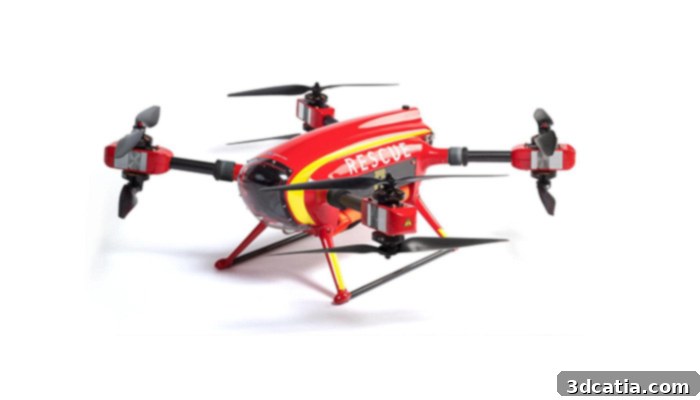
The Auxdron Lifeguard, a game-changer for beach safety, captured during operations.
The official presentation of the Auxdron Lifeguard took place at Las Naves, a dynamic innovation center affiliated with the Valencia City Council, underscoring the city’s commitment to fostering technological advancements. The event was spearheaded by Rosalía Machín, Lieutenant of the Civil Guard and a key representative of the Area of Technological Innovation. During her address, Lieutenant Machín eloquently highlighted the critical importance of integrating cutting-edge technologies like the Auxdron Lifeguard into beach surveillance and rescue protocols. She emphasized the drone’s unparalleled speed, which can drastically reduce response times in emergencies, and its exceptional capacity to reach areas that are otherwise inaccessible or hazardous for human rescuers. This includes treacherous rocky coastlines, areas with strong rip currents, or overcrowded zones where ground access is difficult. The ability to deploy a rescue device quickly, assess situations from an aerial perspective, and even deliver flotation aids before human teams arrive, significantly increases the chances of successful outcomes in critical situations. This drone acts as a vital first responder, bridging the crucial gap between an incident occurring and human lifeguards reaching the scene, thereby enhancing the overall effectiveness and safety of beach operations.
Auxdron Lifeguard: Engineering Excellence Through Additive Manufacturing
The development of a sophisticated rescue drone like the Auxdron Lifeguard presented a unique set of engineering challenges. Its operational environment – open seas, direct sunlight, and humid coastal air – necessitated specific material properties to ensure durability and reliability. The drone’s intricate aerodynamic shape, combined with the stringent requirements for resistance to intense UV radiation, saltwater corrosion, and high humidity, made traditional manufacturing methods less efficient and more costly. This is precisely where the advantages of 3D printing, or additive manufacturing, became indispensable. By choosing additive manufacturing, designers could achieve complex geometries without the limitations of molds or subtractive processes, allowing for optimized internal structures that maximize strength while minimizing weight. Moreover, 3D printing enabled the use of specialized polymers and composites capable of withstanding the harsh marine environment, ensuring the drone’s longevity and performance in critical rescue scenarios. This strategic decision to embrace additive manufacturing was key to bringing the Auxdron Lifeguard from concept to a robust, deployable reality, perfectly suited for its demanding role in coastal protection.
To tackle these manufacturing demands, General Drones partnered with IT3D, another prominent Valencian company. IT3D is renowned in the additive manufacturing sector as a distributor of leading 3D printer brands like Colido and Tumaker, and for offering a comprehensive range of 3D printing services in Spain. Their expertise in material selection and large-format printing was crucial for the Auxdron Lifeguard project. The collaboration between these two innovative Spanish companies exemplifies the power of local synergy in driving technological progress. IT3D’s role extended beyond just providing equipment; they brought invaluable knowledge about how to best leverage FDM/FFF technology to produce components that meet the rigorous standards required for a life-saving device operating in challenging conditions. This partnership ensured that every part of the drone, from its structural integrity to its resistance to environmental factors, was optimized for peak performance, guaranteeing reliability in its vital mission.
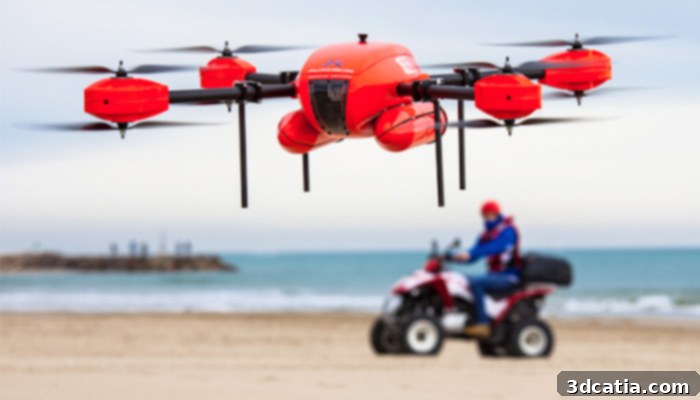
The physical construction of the Auxdron Lifeguard relied heavily on two high-performance 3D printers utilizing FDM (Fused Deposition Modeling) or FFF (Fused Filament Fabrication) technology. Specifically, the Colido X345 and the Tumaker BigFoot 500, both known for their large build volumes and reliability, were instrumental in this process. FDM/FFF works by extruding a thermoplastic filament layer by layer to build a three-dimensional object, making it a versatile and cost-effective method for producing functional prototypes and end-use parts. These printers were meticulously employed to manufacture several critical components of the drone, including the robust chassis and central housing, which form the structural core of the aircraft. They also produced the durable landing legs, designed to withstand varied terrains upon deployment, and the protective covers for the motors, safeguarding essential propulsion systems from water and sand. Furthermore, various lighting elements, crucial for visibility during dusk or night operations, were also 3D printed. The choice of these particular FDM printers allowed for rapid iteration of designs, efficient material usage, and the creation of lightweight yet strong parts, all essential attributes for an effective aerial rescue platform. This tailored approach to manufacturing ensures that each Auxdron Lifeguard is built to precise specifications, guaranteeing optimal performance and reliability in real-world rescue missions.
The successful merger of expertise between General Drones and IT3D has undeniably given life to a pioneering project that holds immense promise. We can confidently anticipate seeing the Auxdron Lifeguard deployed on many more beaches in the foreseeable future, both nationally and potentially internationally. This innovative Spanish collaboration not only highlights the country’s growing prowess in advanced manufacturing and drone technology but also offers a compelling vision for safer recreational spaces. It is, without a doubt, a transformative proposal that will enable countless individuals to enjoy their summer holidays with significantly reduced worries about safety, knowing that cutting-edge technology is on hand to provide rapid assistance. The future of beach safety is here, and it’s flying high, thanks to the ingenuity of 3D printing and drone innovation.
For a closer look at the Auxdron Lifeguard in action, watch its official presentation:
What are your thoughts on the revolutionary use of 3D-printed drones to enhance public safety and save lives? We invite you to share your perspectives by dropping a comment below or joining the conversation on our Facebook and Twitter pages. And to ensure you stay ahead of the curve with all the latest developments in the exciting world of 3D printing and additive manufacturing, don’t forget to sign up for our free weekly Newsletter, delivering cutting-edge news straight to your inbox!