
Revolutionizing Manufacturing: An In-Depth Guide to Composite 3D Printing Materials
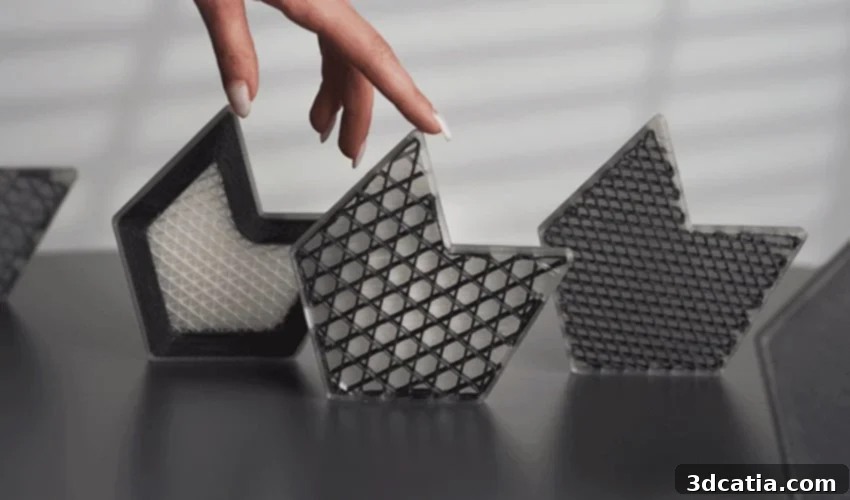
In recent years, composite 3D printing has emerged as one of the most transformative and rapidly growing branches of additive manufacturing. This innovative technology is increasingly adopted by leading players in the industry, such as Impossible Objects, a company renowned for its advancements in composite additive manufacturing. The widespread appeal of this technology is underscored by market projections, with some studies estimating the global composite 3D printing market to reach an impressive $1.73 billion by 2030. At its core, composite 3D printing relies on specialized composite printers and, crucially, high-performance composite materials. These materials are engineered by combining at least two distinct components, resulting in unique properties that make them exceptionally suited for a diverse range of industries utilizing 3D printing.
The fundamental principle behind manufacturing these advanced materials involves blending a plastic base, often referred to as the matrix, with reinforcing fibers. While various types of fibers exist, three stand out as the primary choices for composite 3D printing: carbon fiber, celebrated for its exceptional strength and lightweight characteristics; fiberglass, known for its cost-effectiveness and good mechanical properties; and PPD-T, more commonly recognized by its brand name, Kevlar, revered for its outstanding durability and impact resistance. The selection between short and long fibers depends on the specific application requirements. Short fibers are homogeneously integrated throughout the entire polymer matrix, reinforcing the entire part. This type of material is broadly compatible with a wide array of 3D printers, making it a versatile option for general reinforcement. In contrast, long fibers are strategically placed during the printing process itself and are not chopped into small pieces. This allows for localized reinforcement precisely where it is most needed, offering superior strength and stiffness in specific directions. However, due to their intricate placement and processing demands, long fibers are currently compatible with only a limited number of specialized 3D printing machines.
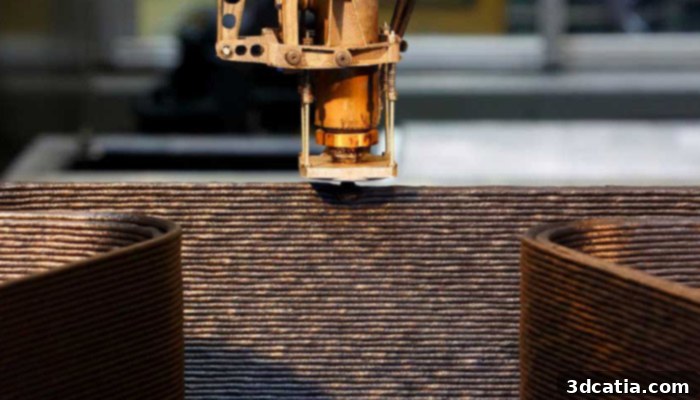
Printing a composite material (photo credits: SABIC)
The Power of Carbon Fiber Reinforced Materials in Additive Manufacturing
Carbon Fiber Reinforced Materials
Carbon fiber reinforcements are among the most prevalent and high-performance choices in the additive manufacturing of composite materials. The genesis of carbon fiber dates back to 1860, pioneered by chemist Joseph Swan. At its molecular level, carbon fiber is composed of interconnected carbon atoms that form a crystalline structure meticulously aligned in strong strands. This unique atomic arrangement is what grants carbon fiber its remarkable stability under tension and its exceptional strength-to-weight ratio, which is approximately twice that of aluminum. This makes it invaluable for creating lightweight yet incredibly sturdy end parts across various sectors. Beyond its outstanding strength and low weight, materials infused with carbon fiber also exhibit high stiffness, robust tensile strength, and excellent chemical resistance, broadening their applicability in demanding environments.
However, successfully employing carbon fibers in 3D printing necessitates adherence to specific considerations to achieve optimal results. For example, due to the abrasive nature of carbon fibers, using a hardened steel print nozzle is absolutely crucial to prevent premature wear and ensure the production of high-quality, precise parts. Similar guidelines apply to the selection of the matrix material that is integrated with the carbon fiber reinforcement. A wide variety of matrices, including common thermoplastics like PLA, PETG, nylon, ABS, or polycarbonate, can be significantly enhanced in terms of strength, stiffness, and lightness with the strategic addition of carbon fibers. These versatile fibers not only integrate seamlessly with thermoplastics but can also be effectively blended with ceramics and other advanced materials, thereby facilitating the creation of novel and high-performance applications across diverse sectors. Industries ranging from aerospace, where lightweight yet robust components are critical, to automotive for structural parts and chassis, and even construction for durable fixtures, extensively benefit from carbon fiber-based composites, harnessing their unparalleled mechanical properties to push the boundaries of design and performance.
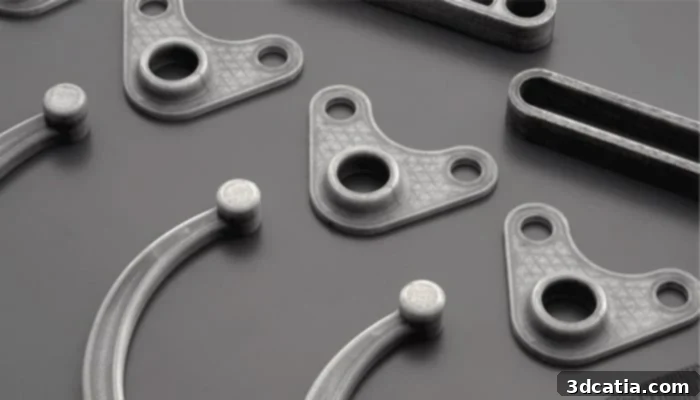
Photo credit: Anisoprint
Fiberglass Reinforced Composite Materials: Balancing Performance and Cost
Fiberglass Reinforced Composite Materials
First introduced in the 1930s, fiberglass material has established itself as a reliable and cost-effective reinforcement for numerous thermoplastic polymers in 3D printing. When judiciously applied to an appropriate base material, fiberglass can yield parts that boast mechanical strength up to ten times greater than standard ABS components. In stark contrast to materials integrated with carbon fiber, fiberglass composites typically exhibit less rigidity and brittleness, offering a degree of flexibility that is beneficial in certain applications. These characteristics, combined with their inherent cost-effectiveness, are key differentiators for fiberglass composites. Glass fibers possess commendable mechanical properties, making them suitable for structural applications where a balance of strength and flexibility is required. Furthermore, they act as effective electrical insulators and feature low thermal conductivity, expanding their utility in electronic and thermal management contexts. The material is readily available in various colors, providing aesthetic versatility, and crucially, boasts low shrinkage, which significantly minimizes the risk of common 3D printing issues like warping during the cooling process. Similar to carbon fibers, filaments reinforced with glass fibers are abrasive, thereby necessitating the use of a print nozzle specifically designed for such hard-wearing composite materials to ensure print quality and longevity of equipment.
Fiberglass-reinforced 3D printing filaments prove invaluable for producing engineering prototypes that demand robust mechanical and thermal resilience, as well as for end-use parts in various challenging environments. From the construction industry, where durable and weather-resistant components are essential, to marine applications requiring corrosion resistance and strength, and even in sports equipment demanding lightweight yet sturdy designs, this composite material has gained widespread acceptance. Noteworthy instances of its application include the groundbreaking project by Moi Composites, in collaboration with industry giants Autodesk, Catmarine, Micad, and Owens Corning, where they successfully created the MAMBO boat through 3D printing using fiberglass. This ambitious project showcased the potential for large-scale composite additive manufacturing. Additionally, the innovative Dutch company MX3D famously employed this robust material to 3D print a structurally reinforced bridge in Amsterdam, further demonstrating the capacity of fiberglass composites to tackle complex and demanding engineering challenges in public infrastructure.
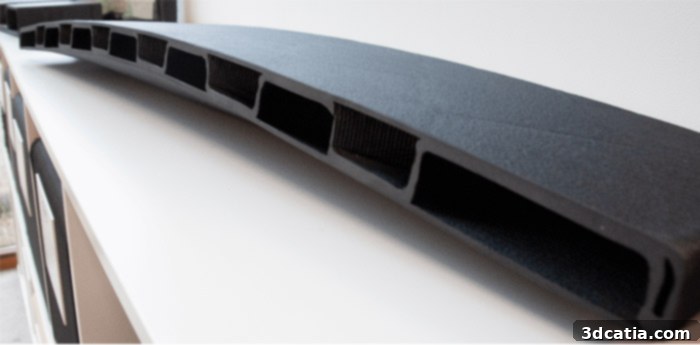
Prototype of a bridge part printed using fiberglass (photo credits: CEAM)
Kevlar Reinforced Materials: Unmatched Durability and Resilience
Kevlar Reinforced Materials
Kevlar, a widely recognized trademark owned by DuPont de Nemours, was first introduced in 1971, thanks to the pioneering work of chemist Stephanie Kwolek. Classified within the distinguished aramid fibers category, Kevlar stands as one of the most exceptionally durable and high-performance materials available for advanced applications. This remarkable material is achieved through a meticulous polymerization process, which involves the linking of long chains of molecules into highly ordered structures. The Kevlar fibers themselves are intricately arranged in parallel rows, a precise alignment that significantly contributes to their robust and unique properties. Similar to other reinforcing fibers, Kevlar is frequently combined with diverse plastics to create composite materials that leverage its specific advantages. Demonstrating commendable mechanical traits in both tensile and fatigue strength, Kevlar is primarily employed for crafting components designed to endure intense vibrations, high impact, and requiring superior abrasion resistance. Notably, it surpasses steel with an astounding fivefold strength-to-weight ratio and boasts exceptional heat resistance, capable of withstanding temperatures up to 400°C, making it suitable for extreme environments.
Beyond its impressive mechanical and thermal properties, Kevlar also offers attributes like low density, facilitating lightweight component design, and versatile applications across numerous industries. Its uniform molecular structure is a critical advantage for 3D printing, enabling the production of exceptionally polished and high-caliber parts with excellent surface finish and dimensional accuracy. Numerous industries wholeheartedly embrace additive manufacturing with Kevlar-reinforced composites due to these compelling advantages. The automotive sector, in particular, finds immense value in its application for manufacturing a wide range of components, from robust engine parts to protective chassis elements, where durability and light weight are paramount. A compelling instance that highlights the potential of reinforced materials in contemporary manufacturing is US-based Aptera Motors, which has utilized this advanced composite material to 3D print critical car segments for its innovative self-charging electric vehicles. This application not only underscores Kevlar’s superior performance but also its role in pushing the boundaries of sustainable and high-efficiency automotive design.
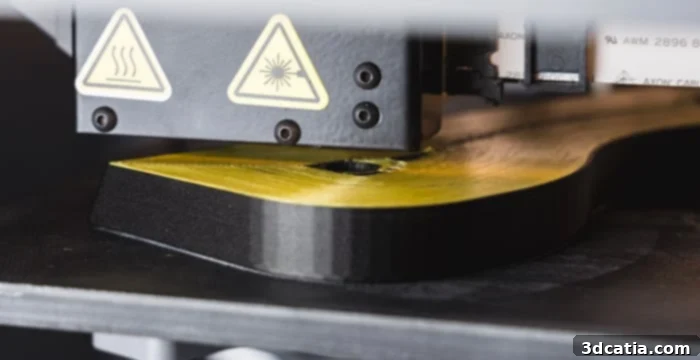
3D printing of a Kevlar composite material (photo credit: Markforged)
The Transformative Benefits of Composite 3D Printing
The rapid growth of composite 3D printing is driven by its ability to deliver a multitude of benefits across various sectors. One of the primary advantages is the creation of parts with an exceptionally high strength-to-weight ratio, allowing for the design of lighter, yet equally or even stronger, components compared to traditionally manufactured items. This is particularly crucial in industries like aerospace and automotive, where every gram saved translates into increased efficiency and performance. Furthermore, composite 3D printing offers unparalleled design freedom. Engineers are no longer constrained by conventional manufacturing limitations and can create intricate geometries and complex internal structures that were previously impossible to achieve, optimizing parts for specific loads and functionalities. This capability also enables the production of functional prototypes that accurately reflect the mechanical properties of final products, significantly accelerating product development cycles. Beyond prototyping, it facilitates the creation of custom tooling, jigs, and fixtures precisely tailored to specific manufacturing needs, reducing costs and lead times. The on-demand manufacturing aspect of 3D printing, combined with the superior properties of composites, allows companies to produce parts only when needed, minimizing waste and inventory, and enabling rapid iteration and customization for diverse applications.
Challenges and the Exciting Future of Composite 3D Printing
While composite 3D printing offers immense potential, it also faces certain challenges. The cost of high-performance composite filaments, particularly those with continuous fibers, can be significantly higher than standard thermoplastics. The complexity of specialized composite 3D printers and the required expertise for optimal processing can also be barriers to entry for some businesses. Furthermore, achieving consistent material properties and predicting part performance accurately requires sophisticated simulation tools and rigorous quality control measures. However, the future of composite 3D printing is incredibly promising. Ongoing research and development are continuously pushing the boundaries of what’s possible, leading to the emergence of new material combinations, improved printer capabilities, and more user-friendly software. Advances in AI-driven design optimization and generative design will further unlock the potential for highly optimized, customized composite parts. As the technology matures and becomes more accessible, we can expect composite 3D printing to play an even more critical role in revolutionizing manufacturing across an ever-expanding array of industries, enabling innovations that were once considered futuristic.
What do you think of these advanced composite materials and their impact on additive manufacturing? We invite you to share your thoughts and insights in a comment below or join the conversation on our LinkedIn, Facebook, and Twitter pages! Don’t forget to sign up for our free weekly Newsletter here to receive the latest 3D printing news straight to your inbox! You can also find all our informative videos and tutorials on our YouTube channel.
*Cover photo credits: Anisoprint