
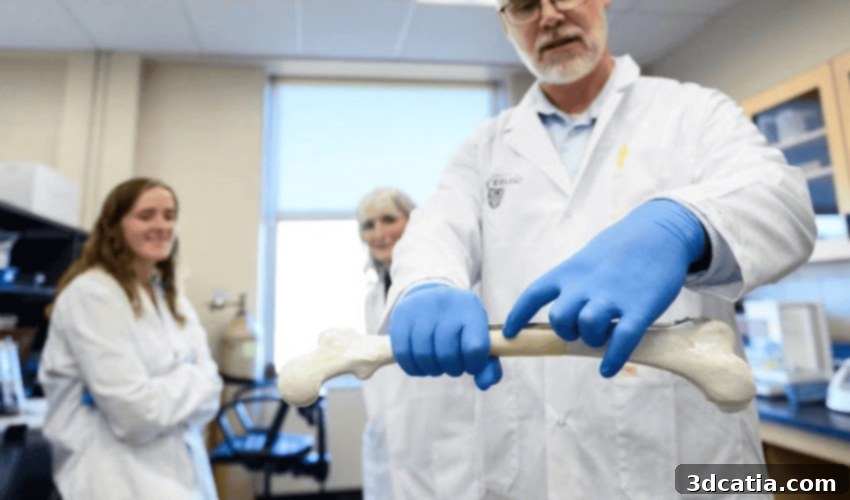
Revolutionizing Bone Repair: How 3D Printing and Advanced Nanomaterials Create Personalized Bone Grafts
The landscape of modern medicine is continually being reshaped by technological innovation, and few advancements hold as much promise as 3D printing in the medical field. This transformative technology is increasingly offering sophisticated solutions, especially in regenerative medicine and reconstructive surgery. Most recently, a dedicated team of researchers at the prestigious University of Waterloo has achieved a significant breakthrough: the development of a novel material that meticulously replicates the complex mechanical characteristics of human bone. This pioneering material, distinguished by its ability to be precisely 3D printed, stands poised to revolutionize orthopedic treatments. In the near future, it could facilitate the design and production of custom-fit bone grafts, delivering truly personalized and highly effective treatment options to patients worldwide.
The inspiration behind this groundbreaking research stems from direct clinical insights. Professor Thomas Willett, a distinguished systems design specialist, gained a profound understanding of the inherent complexities and challenges associated with conventional bone reconstruction techniques through his invaluable collaborations with orthopedic surgeons at Toronto’s Mount Sinai Hospital. Confronted with the often cumbersome, technically demanding, and sometimes less-than-ideal outcomes of existing procedures, Professor Willett envisioned a radically new paradigm. His vision centered on harnessing the immense potential of advanced 3D printing technology to forge bone substitutes that are not only more accessible and precise but also exquisitely customizable to each individual patient’s unique anatomical requirements. This innovative approach promises to usher in an era of more efficient and patient-centric orthopedic care.
Addressing the Challenges of Traditional Bone Grafting Techniques
For countless patients suffering from trauma, disease, or congenital defects, reconstructive surgery often necessitates the restoration of damaged or missing bone segments. Historically, this critical task has primarily relied on a limited set of traditional methods, each presenting its own set of significant hurdles. These methods typically involve the use of rigid metal parts, which can lead to complications such as stress shielding or the need for subsequent removal surgeries, or grafts harvested from human donors (allografts) or from the patient’s own body (autografts). While these techniques aim to promote bone regeneration, they often pose a major, overarching challenge: the complex, and sometimes impossible, task of finding a bone fragment that is perfectly compatible with the patient’s existing bone, both in terms of intricate shape and underlying structural integrity. This lack of perfect fit can severely compromise the long-term effectiveness of the treatment, leading to prolonged recovery times, potential complications, and less than optimal functional outcomes.
Autografts, though biologically ideal as they come from the patient’s own body, involve a secondary surgical site, leading to additional pain, potential infection, and limited donor bone availability. Allografts, sourced from deceased donors, face challenges related to immune rejection, disease transmission risks, and the need for extensive processing that can diminish their regenerative capacity. Both approaches often result in grafts that are not precisely contoured to the specific defect, requiring surgeons to meticulously shape them during operation, which adds to surgical time and can impact the structural integrity of the final implant. This traditional reliance on “one-size-fits-all” or poorly matched solutions underscores the urgent need for more advanced, patient-specific alternatives in orthopedic surgery.
The Promise of an Innovative, Patient-Specific Material for 3D Printed Bone Grafts
The advent of novel biomaterials specifically designed to be compatible with the human body and perfectly suited for advanced 3D printing represents a pivotal moment, opening up entirely new and exciting perspectives in the field of bone surgery. This revolutionary capability allows medical practitioners to precisely design and fabricate implants that are meticulously tailored to each individual patient’s unique anatomy, thereby significantly simplifying complex surgical operations. This tailor-made approach promises a dramatic reduction in post-operative complications, such as infections, immune rejection, and the discomfort associated with ill-fitting implants. As Professor Willett profoundly states, “This would remove the need for the metal screws and plates that surgeons would normally use.” This sentiment highlights a future where bone repair is not just about replacing damaged tissue, but about fostering natural healing and integration without the long-term presence of foreign, non-degradable materials.
A Nanocomposite Breakthrough Mimicking Natural Bone
The core of this innovation lies in the ground-breaking material developed by the dedicated researchers at the University of Waterloo. They have engineered a new nanocomposite material by ingeniously combining a triglyceride-like fat with tiny, yet powerful, particles of hydroxyapatite. This unique composition is crucial to its success. According to Dr. Willett, hydroxyapatite plays an absolutely essential dual role within this composite structure: firstly, it significantly reinforces the material, endowing it with superior strength and durability that can withstand the biomechanical stresses of the human body; and secondly, it creates an ideal, highly biocompatible surface that actively promotes integration with surrounding bone cells. As the natural healing process progresses, this intelligently designed material facilitates the seamless integration of the graft with the surrounding native bone tissue, progressively enabling the natural regeneration and remodeling of the damaged bone. This means the graft doesn’t just fill a void; it actively encourages the body’s own regenerative capabilities. The researchers are tirelessly refining their material, ensuring it is not only exquisitely compatible with the human body but also perfectly optimized for the precision and versatility offered by advanced 3D printing technologies.
The scientific rationale behind this material’s design is profound. Natural bone is a complex composite of collagen and hydroxyapatite, providing both flexibility and rigidity. By incorporating a triglyceride-like fat as a biodegradable matrix and hydroxyapatite nanoparticles, the Waterloo team has created a scaffold that can structurally support the body while slowly degrading, much like a natural healing process. This gradual degradation is critical, as it allows the patient’s own osteoblasts (bone-forming cells) to colonize the scaffold, lay down new bone tissue, and eventually replace the implanted material with healthy, living bone. This sophisticated interplay between the material and the body’s biological processes is what distinguishes this research from previous attempts at synthetic bone substitutes.
Future Vision: Biocompatibility, Strength, and Advanced Manufacturing
The overarching ambition of the researchers is multifaceted: to design a material that possesses the robust mechanical properties necessary to withstand the continuous physical stresses exerted by the human body during daily activities, while simultaneously undergoing a controlled, gradual degradation process that actively stimulates and promotes natural bone regeneration. Their vision extends beyond mere structural support; they aim for a material that encourages the body to heal itself, resulting in a fully integrated, living bone structure rather than a permanent synthetic implant. Furthermore, their ambition is to ensure that this revolutionary material is fully compatible with the most advanced and precise 3D printers available today. This crucial compatibility guarantees the production of bone grafts that are not only perfectly adapted in terms of shape and size but also exhibit the internal architectural intricacies required for optimal integration with each patient’s unique anatomical structure. This capability represents a significant leap forward in personalized medicine, promising unprecedented levels of surgical precision and improved patient outcomes.
The potential impact of this research extends to numerous clinical scenarios. Patients suffering from large bone defects due to trauma, tumor resection, or congenital conditions could benefit immensely from custom-designed grafts that integrate seamlessly and promote natural healing. The elimination of donor site morbidity (in autografts) and the risks associated with allografts would drastically improve patient comfort and reduce complications. Moreover, the ability to rapidly produce these custom implants could significantly shorten waiting times for critical surgeries, ultimately improving the quality of life for countless individuals. This is not just about bone repair; it’s about restoring full function and empowering patients with robust, naturally regenerated bone.
You can discover more detailed insights and the latest updates directly from the University of Waterloo HERE.
What are your thoughts on the groundbreaking use of 3D printing for personalized bone grafts and its potential to transform orthopedic surgery? We invite you to share your valuable perspectives and comments below, or engage with us on our vibrant LinkedIn, dynamic Facebook, and insightful Twitter pages! Don’t miss out on the latest advancements and news in additive manufacturing – remember to sign up for our completely free weekly Newsletter here, delivering the most current 3D printing news directly to your inbox every week! Additionally, you can explore all our engaging videos and in-depth content on our dedicated YouTube channel. If you are particularly interested in delving deeper into more 3D printing news within the rapidly evolving medical and dental sectors, we encourage you to click HERE for further comprehensive articles and updates.