
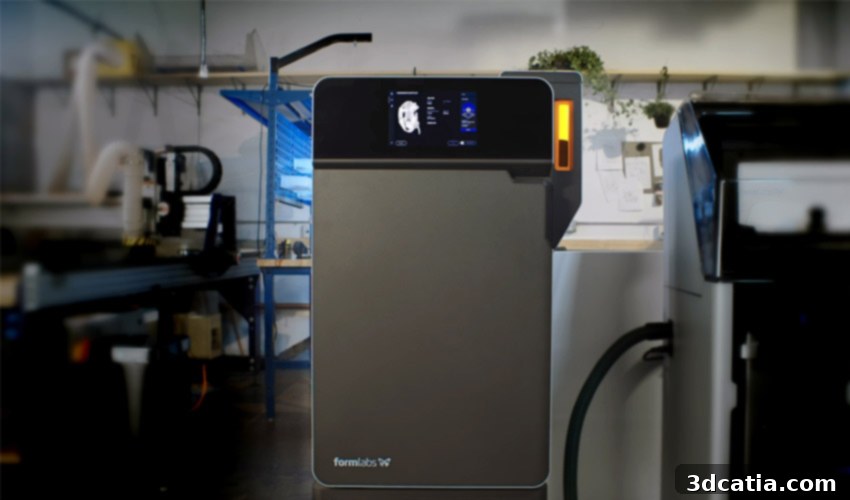
Formlabs Fuse 1: Democratizing Industrial SLS 3D Printing for Unprecedented Accessibility
Formlabs, a name synonymous with accessible resin 3D printing, made waves in June 2017 when they announced their ambitious plan to enter the selective laser sintering (SLS) market with a groundbreaking desktop machine, the Fuse 1. This bold move signaled a paradigm shift, promising to bring industrial-grade powder-bed fusion technology within reach of a broader audience. After years of meticulous development, iterative prototyping, and rigorous testing, Formlabs officially launched the Fuse 1, now available from $18,499. The grand unveiling took place at our virtual event ADDITIV médical France, underscoring the machine’s potential impact across various sectors, particularly medical applications. At its core, the Fuse 1 leverages innovative Surface Armor technology to produce robust, functional parts from nylon powder, specifically PA12, boasting an efficient 70% powder refresh rate. This represents a significant leap forward in making SLS technology not just more affordable, but also more practical and sustainable for diverse manufacturing needs, from rapid prototyping to end-use part production.
Understanding Selective Laser Sintering (SLS) Technology
Selective Laser Sintering (SLS) technology stands as one of the most transformative and widely adopted additive manufacturing methods in the industrial landscape. Unlike Fused Deposition Modeling (FDM) or Stereolithography (SLA), SLS utilizes a high-powered laser to selectively sinter polymer powder particles, fusing them together layer by layer to form a solid object. A key advantage of SLS is its inherent ability to produce highly functional, complex parts with exceptional mechanical properties, eliminating the need for external support structures. The surrounding un-sintered powder acts as natural support, allowing for the creation of intricate internal geometries, interlocking components, and highly optimized designs that would be impossible or exceedingly difficult with other manufacturing techniques. This process results in isotropic parts, meaning their strength and mechanical properties are consistent in all directions, making them ideal for demanding end-use applications in engineering, aerospace, automotive, and medical fields.
Historically, however, the prohibitive cost, large physical footprint, and operational complexities of industrial SLS systems confined this powerful technology primarily to large corporations, specialized research institutions, and service bureaus. These significant barriers prevented widespread adoption, limiting innovation for smaller businesses, startups, and academic institutions. Formlabs recognized this critical gap in the market and embarked on a mission to democratize SLS, striving to bring its unparalleled capabilities to a much wider array of users without compromising on performance, part quality, or reliability. Their vision was to bridge the divide between expensive industrial solutions and less capable desktop technologies, offering a true production-ready SLS system that was genuinely accessible.
Formlabs’ Vision: Bridging the Gap in 3D Printing Accessibility
Formlabs’ commitment to making advanced manufacturing technologies accessible has been a driving force since its inception. The journey to develop the Fuse 1 began in 2014, rooted in the belief that industrial-grade 3D printing should not be an exclusive domain. Over six years, the printer underwent extensive development, with no less than ten different prototypes meticulously crafted, tested, and refined until the manufacturer achieved their exacting standards for performance, reliability, and user-friendliness. This rigorous iterative process ensured that the final product was not just a scaled-down version of an industrial machine, but a thoughtfully engineered system designed from the ground up for a new category of users.
Max Lobovsky, CEO and co-founder of Formlabs, eloquently articulated this vision, stating, “SLS 3D printing shouldn’t be solely for those with big budgets, it needs to be accessible so all companies — from startup to big manufacturer — can benefit from the design freedom and high productivity SLS 3D printing provides.” This statement encapsulates Formlabs’ strategic intent: to dismantle the financial and operational barriers that have historically bottlenecked SLS adoption. By offering a solution that is not only significantly more affordable but also designed for ease of use and reliability, Formlabs aims to empower a new generation of innovators, engineers, and designers. The Fuse 1 is engineered to deliver industrial-quality output, thereby expanding the possibilities for rapid prototyping, functional part production, and bespoke manufacturing across countless industries, enabling businesses of all sizes to leverage the advantages of powder-bed fusion technology.

The Fuse 1 3D printer (photo credits: Formlabs)
The Formlabs Fuse 1: Engineering for Performance and Efficiency
Innovative Design and Core Technologies
The Formlabs Fuse 1 stands out as a testament to thoughtful engineering, integrating several key innovations designed to optimize performance, reliability, and user experience. At its heart, the Fuse 1 features a modular print chamber, a critical design choice aimed at maximizing uptime and ensuring continuous printing operations. This modularity allows users to easily swap out print chambers once a print job is complete and the parts are cooling, enabling them to initiate a new print almost immediately. This significantly reduces downtime, boosts overall throughput, and makes the Fuse 1 an exceptionally productive system for high-volume or sequential manufacturing tasks. With a generous maximum build volume of 165 x 165 x 320mm, the Fuse 1 offers ample space for producing a wide range of parts, from small intricate components to larger functional prototypes, making it versatile for diverse industrial applications.
A cornerstone of the Fuse 1’s advanced capabilities is its patent-pending Surface Armor technology. This proprietary innovation actively creates a semi-sintered, protective shell around the printed part during the sintering process. This intelligent barrier shields the core of the part from excessive heat and stress, leading to a host of tangible benefits. Users can expect to achieve superior surface quality, reduced porosity, enhanced dimensional accuracy, and greater overall reliability in their printed components. The Surface Armor technology ensures that parts not only look better but also possess optimal mechanical properties, consistent with industrial standards. This focus on intricate detail and robust performance underscores Formlabs’ commitment to delivering a truly professional desktop SLS solution that meets the rigorous demands of engineering and manufacturing environments.
Advanced Material Capabilities with Nylon 12 Powder
Material compatibility is another crucial aspect where the Fuse 1 excels, launching with support for PA12, specifically Nylon 12 Powder. This material is renowned in additive manufacturing for its exceptional mechanical properties, including high strength, stiffness, impact resistance, and excellent long-term stability. PA12 is widely used across various industries for producing functional prototypes, durable end-use parts, jigs, fixtures, and even certain medical applications due to its proven biocompatibility (where certified grades are used). What truly differentiates the Fuse 1’s material handling is its impressive powder refresh rate of 30%, which translates into the ability to print a part with up to 70% recycled powder. This intelligent powder management system leads directly to significant cost savings per part and considerably reduced material waste, making SLS printing more economically viable and environmentally sustainable. The PA12 Nylon 12 Powder exhibits a respectable 11% elongation at break, indicating good ductility and resistance to fracture under stress, further enhancing its suitability for demanding applications where flexibility and toughness are required.
Demonstrating its ongoing commitment to innovation and expanding the versatility of the Fuse 1, Formlabs has already announced plans for the development and introduction of Nylon 11 and other advanced materials. Nylon 11, known for its superior ductility, impact strength, and flexibility compared to PA12, will unlock even more application possibilities, particularly in sectors requiring high resilience and robust performance in challenging environments, such as automotive components or wearable devices. This continuous expansion of the material library will ensure the Fuse 1 remains a versatile and future-proof investment for businesses seeking to leverage the full potential of accessible SLS technology across an ever-growing array of applications.
Streamlined Workflow: Introducing the Fuse Sift
Recognizing that a complete additive manufacturing solution extends beyond just the printer, Formlabs has also introduced the Fuse Sift, an integral post-processing unit designed specifically to complement the Fuse 1. The Fuse Sift provides a comprehensive, all-in-one system for efficient powder recovery, cleaning, and material mixing, essential steps in the SLS workflow. Post-processing in SLS printing involves the crucial step of depowdering, where unfused powder is meticulously removed from around the printed parts. This process can be messy, labor-intensive, and time-consuming if not handled properly, often requiring specialized equipment or manual labor in less integrated systems. The Fuse Sift addresses these challenges directly, creating a contained environment that simplifies powder removal, significantly improves workplace cleanliness, and enhances operational safety for users.
While the exact pricing for this post-treatment machine has not been explicitly stated in the original announcement, its value proposition is clear: it streamlines the entire SLS workflow from start to finish. Beyond just automated depowdering, the Fuse Sift plays a pivotal role in optimizing material usage. It intelligently sifts and reclaims unused powder, automatically mixing it with fresh powder at the optimal refresh ratio (as highlighted by the Fuse 1’s 70% refresh rate capability). This intelligent powder management system not only extends the lifespan of the printing material but also dramatically reduces operational costs and environmental impact by minimizing waste, reinforcing Formlabs’ commitment to efficient and sustainable manufacturing practices. The integrated solution of the Fuse 1 and Fuse Sift transforms what was once a complex, multi-step process into a remarkably user-friendly and efficient workflow, making high-quality SLS production accessible even for those new to the technology, and allowing businesses to focus more on innovation and less on manual labor.
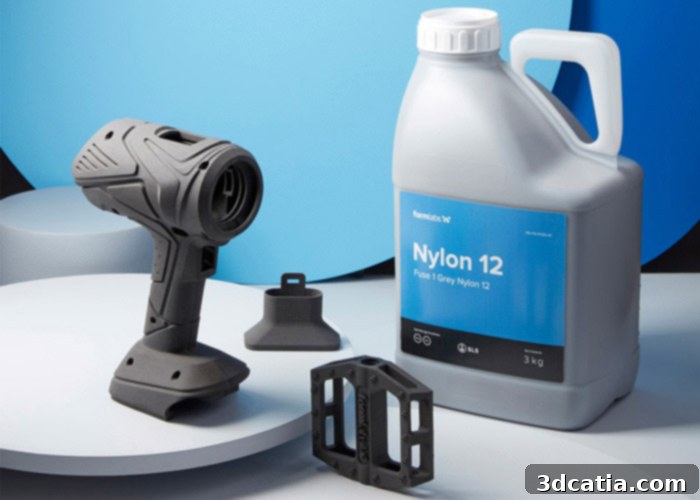
The Fuse 1 is currently compatible with PA12 (photo credits: Formlabs)
Real-World Impact: Early Adopter Success Stories
The true measure of any revolutionary technology lies in its real-world application and the tangible benefits it delivers to users. The American company Partial Hand Solutions serves as a compelling example of the Formlabs Fuse 1’s transformative power, being one of the first beta users to integrate the system into their operations. Partial Hand Solutions specializes in designing and producing prosthetic fingers for individuals with partial hand amputations, a field where customization, precision, and rapid iteration are paramount for patient well-being and mobility. Historically, the company relied on conventional manufacturing methods like outsourced injection molding to produce their prosthetic devices. While functional, this traditional workflow presented significant limitations, particularly in addressing the highly individualized needs of each patient.
Matthew Mikosz, founder of Partial Hand Solutions and an early Fuse 1 beta user, elaborated on these challenges: “We previously used an outsourced injection-molding workflow to deliver prosthetic fingers to patients young and old, helping them improve mobility and increase functionality; but this process was extremely slow and did not allow for the personalisation needed for each patient.” The inherent inflexibility of injection molding meant lengthy lead times for design modifications, high tooling costs, and a critical inability to create truly bespoke solutions tailored to each patient’s unique anatomy and evolving needs. This often resulted in compromises in comfort and functionality for the end-user. The adoption of the Fuse 1 fundamentally changed their approach, empowering them to embrace a direct digital manufacturing strategy.
Mikosz continued, “Fuse 1 gives us the design freedom needed to truly customise our prosthetics and the high productivity and throughput necessary to quickly get this solution to our patients.” The agility and precision of SLS 3D printing allows Partial Hand Solutions to design, print, and iterate on prosthetic fingers with unprecedented speed and accuracy. This capability enables them to craft prosthetics that perfectly conform to a patient’s hand, enhancing comfort, functionality, and overall quality of life. The ability to rapidly produce highly customized parts on demand empowers them to shorten patient wait times, reduce costs associated with traditional manufacturing, and respond more effectively to individual requirements. This compelling case study unequivocally showcases the Fuse 1’s immense potential, particularly in critical sectors like medical devices, where personalization and speed of delivery can have a profound positive impact on individuals’ lives.
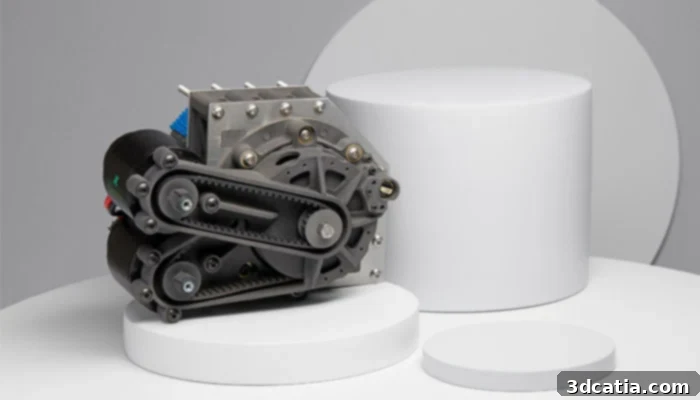
Part 3D printed on the Fuse 1 (photo credits: Formlabs)
A New Era for Additive Manufacturing and Call to Action
The official launch of Formlabs’ SLS machine at ADDITIV médical France, a virtual event specifically dedicated to medical 3D printing, was a deliberate and strategic choice. It highlighted the immediate and profound impact this accessible SLS technology can have in critical sectors like healthcare, where custom prosthetics, surgical guides, and patient-specific medical devices are becoming increasingly vital for improved patient outcomes. Formlabs’ dedicated French team actively participated in this unique event, ready to engage with participants and answer their questions, further emphasizing the company’s commitment to supporting users and fostering adoption in key markets. For those interested in delving deeper, you can still register for free HERE to access event content and discover more about these innovations.
The availability of the Fuse 1 for order now, priced from $18,499 HERE, marks a significant milestone in the additive manufacturing industry. This highly competitive price point, combined with its robust features, integrated workflow solutions like the Fuse Sift, and a focus on industrial-grade quality, positions the Fuse 1 as a disruptive force. It is poised to accelerate the adoption of industrial 3D printing among a much wider demographic, from small and medium-sized enterprises to larger manufacturers seeking to decentralize production or enhance their prototyping capabilities. Will Formlabs succeed in truly democratizing SLS technology and making it a staple in every design studio and manufacturing floor, much like they did with SLA? We invite you to share your thoughts and predictions on Formlabs’ innovative solution. Join the conversation by leaving a comment below or engaging with us on our Facebook and Twitter pages! For those eager to stay abreast of the latest developments in 3D printing, make sure to sign up for our free weekly Newsletter here. Don’t miss out on the groundbreaking news and essential industry insights delivered straight to your inbox!
*Thumbnail photo credits: Formlabs