
Navigating the Future of 3D Printing: From Corporate Shifts to Groundbreaking Applications and Festive Tools
As the festive season twinkles with holiday lights, the dynamic world of additive manufacturing continues its relentless pace, far from a peaceful slumber. This week’s roundup of 3D printing news brings a compelling mix of corporate drama, significant technological breakthroughs, and delightful consumer-centric innovations. We delve into the challenging corporate landscapes faced by industry stalwarts like Nano Dimension and Nexa3D, exploring the internal and external pressures shaping their futures in what promises to be a turbulent 2024. Amidst these corporate shifts, we celebrate monumental engineering achievements, highlighted by Ursa Major’s successful test of a 3D-printed rocket engine, underscoring additive manufacturing’s critical role in advancing aerospace and defense capabilities. Furthermore, the strategic moves of Shapeways, including its recent acquisition, signal a robust path towards revitalization and community engagement. Finally, embracing the holiday spirit, Bambu Lab has unveiled a charming online tool designed to empower users to easily create personalized Christmas decorations, proving that 3D printing is not just for industrial giants but also for creative individuals looking to deck their halls. Join us as we unpack these pivotal developments, offering insights into the evolving landscape of 3D printing.
Nano Dimension Navigates Significant Corporate Turbulence
Nano Dimension, a name synonymous with cutting-edge additively manufactured electronics (AME) and a significant player in the additive manufacturing sector, has recently found itself at the epicenter of considerable corporate upheaval. For those closely following industry developments, the company’s bold acquisition attempts and innovative product lines have often made headlines. However, the past few weeks have painted a different picture, marked by significant internal strife and leadership changes that have sent ripples through the market and raised questions about its future trajectory.
The initial signs of trouble emerged with the news that CEO Yoav Stern, while retaining his chief executive position, lost his seat on the board of directors. This move alone was noteworthy, signaling a potential disconnect or power struggle within the company’s upper echelons. The situation escalated dramatically this week with the immediate resignation of six board directors, leaving a significantly reduced management team of four members. Crucially, all remaining board members have expressed support for Murchinson, one of Nano Dimension’s principal shareholders. Murchinson has a documented history of challenging the company’s management and strategic decisions over several years, advocating for a different direction for the firm. This prolonged battle between a major shareholder and the company’s leadership underscores deep-seated disagreements over corporate strategy and financial allocation.
The immediate implications of these resignations and the shift in board composition are substantial. Such dramatic changes typically lead to increased investor uncertainty and can significantly impact a company’s strategic planning and operational stability. One of the most critical aspects of this internal conflict revolves around previous discussions regarding potential acquisitions. The Board of Directors had reportedly expressed strong reservations about the proposed mergers with Markforged Holding Corporation and Desktop Metal – two other prominent players in the additive manufacturing space. These acquisitions, if they had proceeded, would have dramatically reshaped Nano Dimension’s market position, expanding its portfolio beyond AME into broader industrial 3D printing technologies.
With the current restructuring of the board, the likelihood of these high-profile mergers proceeding as previously envisioned appears increasingly uncertain. A board aligned with Murchinson’s objectives may prioritize different strategic avenues, potentially focusing on internal growth, efficiency improvements, or alternative partnership models rather than large-scale acquisitions. The ongoing situation casts a shadow over Nano Dimension’s immediate future, leaving the industry to speculate on how these internal power dynamics will influence its innovative endeavors and market presence in the coming year. Only time will reveal whether these changes will lead to renewed strategic clarity or continued instability for the additive manufacturing pioneer.

Yoav Stern CEO of Nano Dimension (photo credits: SME)
Nexa3D Scales Back Operations Amid Funding Challenges
In a parallel development echoing the financial pressures prevalent in various sectors of the tech industry, Nexa3D, a company renowned for its high-speed resin 3D printing solutions, has also announced significant operational adjustments this week. Following closely on the heels of the Nano Dimension news, Nexa3D released an “important message” to its community, candidly confirming that it is grappling with substantial funding challenges. This revelation has necessitated a strategic decision to scale back its operations, as the company acknowledges its inability to continue functioning in its current form.
Nexa3D has carved a niche in the additive manufacturing market with its ultrafast 3D printers, which promise significant advantages in productivity and throughput for industrial applications. The news of their financial difficulties highlights the persistent capital demands inherent in developing and commercializing advanced manufacturing technologies, particularly in a market that has seen both rapid growth and increased competition. Significant funding challenges can stem from a variety of factors, including a tighter venture capital market, slower-than-anticipated market adoption, intense competition, or unforeseen operational costs. Regardless of the specific triggers, such challenges require swift and decisive action to ensure the company’s long-term viability.
In its communication, the Nexa3D team conveyed a message that, despite the grim news, sought to inspire optimism regarding the broader future of 3D printing innovation. The statement read, “While this chapter is incredibly difficult, we remain optimistic about the future of innovation and collaboration in the 3D printing industry, and we look forward to seeing the continued impact of the work we began together.” This phrasing suggests a hopeful outlook beyond the immediate difficulties, perhaps hinting at future collaborations or a restructured business model that leverages their technological advancements. Scaling back operations typically involves a range of measures, which could include workforce reductions, a refocus on core product lines, reduction in R&D spending, or the consolidation of facilities. These steps, while painful in the short term, are often necessary to streamline costs and extend a company’s runway in challenging economic environments.
Crucially, Nexa3D has committed to ensuring a smooth transition for its existing customer base and partners. The company confirmed its intention to provide clear guidance on next steps and continued support availability. This commitment to customer continuity is vital for maintaining trust and minimizing disruption for businesses that rely on Nexa3D’s technology for their operations. The challenges faced by both Nano Dimension and Nexa3D in quick succession serve as a stark reminder of the dynamic and sometimes volatile nature of the additive manufacturing industry, where innovation must continually be balanced with robust financial strategies and adaptable business models.
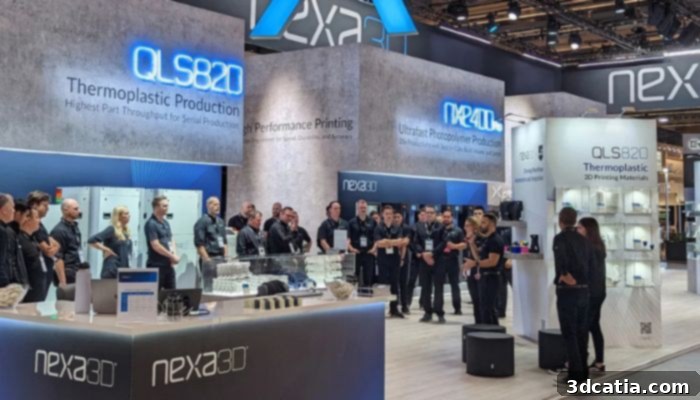
Nexa3D’s booth at Formnext (photo credits: Nexa3D)
Ursa Major Propels Defense with Successful 3D Printed Rocket Engine Test
Shifting from corporate challenges to groundbreaking technological triumphs, Ursa Major, a leading American aerospace company focused on propulsion, has once again underscored the transformative power of additive manufacturing in the defense and aerospace sectors. The company recently announced the highly successful test of its solid rocket motor on a missile for the US Army, a significant milestone that further solidifies 3D printing’s indispensable role in advancing national security capabilities.
Ursa Major is known for its innovative approach to designing and manufacturing rocket engines, leveraging advanced techniques to produce high-performance, cost-effective propulsion systems. At the heart of this success is the company’s proprietary Lynx method. This sophisticated approach intricately combines advanced 3D metal printing with other conventional manufacturing techniques. The synergy of these methods allows Ursa Major to design and produce multiple engine variants on a single, streamlined production line, dramatically reducing the need for costly and time-consuming traditional tooling. Furthermore, this integrated process optimizes manpower requirements, leading to significant reductions in overall manufacturing costs. The Lynx method offers unparalleled flexibility, enabling rapid iteration and customization of rocket components, and considerably accelerates the production timeline, which is crucial for meeting urgent defense needs.
The successful test carried out by the US Army serves as compelling evidence of 3D printing’s maturity and reliability within the rigorous demands of the defense sector. The ability to rapidly prototype, test, and manufacture complex rocket engine components with precision and consistency through additive manufacturing translates into numerous strategic advantages. For the military, this means faster development cycles for new missile systems, the ability to quickly integrate design improvements based on field data, and enhanced supply chain resilience. Traditional manufacturing processes for such complex parts often involve extensive lead times and high initial investments, making rapid innovation challenging.
Ursa Major’s technology, by streamlining these processes, is poised to give the US Army and other defense entities a major advantage on the battlefield. It enables the development of advanced missile technology with greater agility, improved performance, and reduced logistical burdens. This breakthrough is not merely a technical achievement; it represents a strategic shift in how defense hardware can be conceived, developed, and deployed, ensuring that military forces can adapt more swiftly to evolving threats and maintain a technological edge. The integration of 3D printing into critical defense applications like rocket propulsion firmly establishes additive manufacturing as a cornerstone of modern military innovation.

Testing the 3D printed engine (photo credits: Ursa Major)
Shapeways Forges Ahead with Strategic Relaunch, Acquires Thangs
Shapeways, a pioneering force in the online 3D printing services industry, is making significant strides in its strategic relaunch, signaling a robust recovery after navigating what it described as “gloomy months.” The Dutch company, which has long been a go-to platform for designers and businesses seeking on-demand 3D printing and digital manufacturing solutions, faced considerable financial and market pressures in recent times, leading to speculation about its future. However, recent developments, most notably the acquisition of the Thangs platform, indicate a determined path towards revitalization and a renewed focus on its core community.
For those who recall, Thangs burst onto the scene in 2020 as an innovative 3D file finder and a rapidly growing online community for 3D model creators and enthusiasts. Its advanced search technology, powered by Physna, allowed users to locate precise 3D models with unprecedented accuracy, making it a valuable resource for digital designers and engineers. The acquisition of such a platform by Shapeways is a clear strategic move, designed to bolster its ecosystem, enhance its service offerings, and reconnect with the vibrant creator community that has always been central to its identity.
This takeover is a cornerstone of Shapeways’ broader recovery strategy, aimed at reinforcing its position in the competitive digital manufacturing landscape. Marleen Vogelaar, CEO of Shapeways, articulated the synergy behind this acquisition with a compelling statement: “The team behind Thangs really love their creators and community — and they take good care of them: which is exactly in line with the original spirit of Shapeways. Equally importantly their 3D search technology powered by Physna protects the IP of their creators which is incredibly important to me and the rest of the management team.”
Vogelaar’s comments highlight two crucial aspects of this acquisition. Firstly, it underscores a shared ethos of nurturing and supporting the creative community, a principle that underpinned Shapeways’ initial success. By integrating Thangs, Shapeways is not just acquiring technology but also a dedicated community and a team that understands its needs. Secondly, and perhaps even more critically in the digital age, is the emphasis on intellectual property (IP) protection. The Physna-powered 3D search technology offers robust mechanisms to safeguard the original designs of creators, a paramount concern in an era where digital assets can be easily replicated or misappropriated. This commitment to IP protection is a significant value proposition for designers and engineers who rely on platforms to host and share their innovative work.
The acquisition of Thangs represents more than just a business transaction; it’s a strategic investment in the future of Shapeways, demonstrating its renewed commitment to innovation, community engagement, and secure digital manufacturing services. This move aligns with a broader industry trend where consolidation and the creation of comprehensive digital platforms are becoming key to long-term success, offering end-to-end solutions from design to production while fostering a thriving ecosystem for creators.
Bambu Lab Spreads Holiday Cheer with Online Christmas Ornament Maker
As December 24th rapidly approaches and the pressure to complete holiday preparations mounts, Bambu Lab, a manufacturer that has profoundly impacted the consumer 3D printing market with its accessible and high-performance printers, has arrived with a delightful solution. Demonstrating its commitment to both innovation and user-centric design, Bambu Lab has launched the “Christmas Ornament Maker” online tool just in time for the holiday season. This intuitive tool empowers users to effortlessly design and subsequently 3D print a variety of personalized Christmas ornaments, ensuring that even last-minute decorators can add a unique touch to their festivities.
Bambu Lab has quickly gained a reputation for making advanced 3D printing capabilities, such as multi-color printing and high-speed operation, more accessible to a wider audience. The Christmas Ornament Maker tool extends this philosophy by simplifying the design process for bespoke decorations. The workflow is remarkably straightforward and user-friendly, catering to both seasoned 3D printing enthusiasts and complete beginners. Users begin by selecting a basic ornament pattern from a curated collection of festive shapes. Once a base is chosen, the real fun begins with extensive personalization options. Users can add intricate details such as delicate snowflakes, cheerful Santas, elegant lettering, or even custom text to commemorate a special year or family name. This level of customization allows for truly unique creations that reflect individual tastes and holiday themes.
Once the design is complete, the tool provides the flexibility to export the creation in widely compatible formats such as STL (Stereolithography) or 3MF (3D Manufacturing Format). These files can then be imported into virtually any 3D printer’s slicing software, ready for fabrication. The most commendable aspect of this initiative from Bambu Lab is its universal accessibility: it is explicitly stated that users do not need a Bambu Lab printer to utilize the tool and print these last-minute Christmas ornaments. This open-source approach fosters goodwill within the broader 3D printing community and encourages wider adoption, regardless of brand allegiance.
The launch of the Christmas Ornament Maker tool not only highlights Bambu Lab’s innovative spirit but also underscores the growing mainstream appeal of 3D printing for personal creative expression and home decoration. It transforms what might have once been a complex technical process into an enjoyable and accessible craft, allowing individuals and families to engage directly with digital manufacturing to create tangible, personalized holiday keepsakes. This initiative perfectly encapsulates how 3D printing is continuously evolving to meet everyday needs, bringing advanced technology into homes for festive fun and practical creativity.

Christmas Decorations from Bambu Lab’s new tool (photo credits: Bambu Lab)
This week in additive manufacturing has presented a compelling narrative of contrast and dynamism. From the internal power struggles and financial headwinds impacting industry giants like Nano Dimension and Nexa3D, which underscore the volatile nature of technological innovation and corporate governance, to the monumental achievements in defense with Ursa Major’s 3D printed rocket engine, proving the technology’s strategic importance. Simultaneously, Shapeways’ strategic acquisition of Thangs illustrates a revitalized focus on community and IP protection, shaping the future of online digital manufacturing services. Finally, Bambu Lab’s delightful Christmas Ornament Maker reminds us of the profound impact 3D printing has on personal creativity and accessibility, making advanced technology a part of our everyday lives and holiday traditions. The additive manufacturing sector remains a vibrant and essential frontier, constantly pushing the boundaries of what’s possible, even amidst its challenges.
What are your thoughts on these significant developments concerning Nano Dimension and Nexa3D? How do you see the role of 3D printing evolving in both high-stakes defense applications and consumer-friendly creative tools? Let us know in a comment below or join the conversation on our LinkedIn, Facebook, and Twitter pages! Don’t forget to sign up for our free weekly Newsletter here to receive the latest 3D printing news straight to your inbox! You can also find all our videos and in-depth analyses on our YouTube channel.