
ARCHIBIOFOAM: Pioneering Sustainable Construction with Adaptive 4D Printed Biomaterials
The global construction industry stands at a pivotal moment, constantly seeking innovative solutions to address its significant environmental footprint and persistent challenges. A relentless pursuit of sustainable practices drives ongoing research and development, with new technologies and advanced materials being rigorously tested and refined. Among these transformative innovations, additive manufacturing, commonly known as 3D printing, has emerged as a particularly promising field. This technology empowers architects and engineers to reimagine building designs and utilize materials that were previously unattainable or impractical with conventional construction methods. Across Europe, and specifically in Italy, numerous groundbreaking projects exemplify this trend. Initiatives like the European ConstructAdd project, benefiting from the involvement of the esteemed Milan Polytechnic, and the advancements championed by WASP and D-shape technology around the world, showcase the immense potential of 3D printing to revolutionize how we build and interact with our environment. These efforts are not merely about creating new structures but about fostering a paradigm shift towards greener, more efficient, and more resilient urban landscapes.
Building upon this spirit of innovation, the European project ARCHIBIOFOAM is poised to make a significant impact. With the vital participation of the University of Milan, this ambitious endeavor has successfully secured a substantial €3.5 million grant from the European Innovation Council (EIC). This prestigious funding will fuel the development of a groundbreaking material: an expanded, 3D-printed biomaterial capable of dynamic shape-shifting and reacting autonomously to its surrounding environment. Such a material holds the key to unlocking truly adaptive architecture, promising to redefine energy efficiency, resource utilization, and overall building performance. Let’s delve deeper into the specifics of this revolutionary project and explore its potential to reshape the future of construction.
The ARCHIBIOFOAM Project: Driving Sustainable Construction Forward
The ARCHIBIOFOAM project was conceptualized to address one of the most pressing challenges of our time: the enormous environmental impact of the construction sector. Astonishingly, this industry is currently responsible for a staggering 40 percent of annual global emissions, making it a critical area for sustainable intervention. ARCHIBIOFOAM proposes a radical solution by leveraging the power of 4D printing technology and an innovative, organic, and fully biodegradable biofoam. This approach aims to drastically reduce the carbon footprint associated with building construction, from material sourcing to end-of-life disposal.
The success of such an ambitious undertaking relies on a collaborative effort from leading institutions. The project partners bring together a diverse range of expertise: the Center for Complexity and Biosystems at the University of Milan, Finland’s renowned Aalto University, its cutting-edge spin-off company Woamy, and the esteemed University of Stuttgart. Each partner contributes unique strengths, seamlessly integrating bio-based materials science with advanced computational design of metamaterials and state-of-the-art robotic additive manufacturing techniques. This multidisciplinary synergy is crucial for transforming theoretical concepts into tangible, deployable solutions for the built environment.
The long-term vision articulated by the project’s designers is truly transformative: to enable the construction of passively ventilated buildings utilizing bio-derived foams expertly extruded from wood cellulose. This natural, abundant, and renewable resource offers an unparalleled opportunity to move away from fossil-fuel-intensive materials. Over the next three years, the immediate and ambitious goal of the ARCHIBIOFOAM project is to successfully print this advanced biomaterial to create exterior building facades. These facades will feature innovative, porthole-like openings designed to dynamically open and close in precise response to environmental stimuli such as temperature, humidity, and airflow. This inherent adaptability promises to revolutionize thermal comfort and air quality within buildings, significantly reducing the need for active heating, ventilation, and air conditioning (HVAC) systems, thereby saving vast amounts of energy.
According to the dedicated partners involved, these novel load-bearing expanded biomaterials possess the potential to fundamentally replace typical polluting and non-renewable building materials. Traditional staples like concrete, steel, and glass, while robust, carry a heavy environmental cost due to their production processes and non-biodegradable nature. In stark contrast, the ARCHIBIOFOAM biofoam offers comparable structural strength and durability, despite being remarkably composed of 90 percent air. This high air content provides excellent insulation properties, while its organic composition ensures it is fully biodegradable and adheres strictly to the principles of a circular economy. This means that at the end of a building’s life cycle, these materials can be returned to nature without leaving behind harmful residues, thus closing the loop on material usage and drastically minimizing waste.
4D Printing: The Dawn of Adaptive Architecture
At the heart of ARCHIBIOFOAM’s innovative approach lies 4D printing, a groundbreaking evolution of traditional additive manufacturing. This technology introduces an additional dimension – time – allowing printed objects to transform their shape, properties, or functions in response to external stimuli after fabrication. This inherent “programmability” is what enables truly adaptive architecture. The University of Milan plays a crucial role in realizing this vision, specifically through the work of Stefano Zapperi, a distinguished professor of matter physics and a leading expert in the automatic generation of 3D digital models. Professor Zapperi’s team is spearheading the development of proprietary software, a critical component that will allow for the algorithmic optimization of design parameters. This sophisticated software will precisely control how the biofoam material reacts to environmental cues, including its sensitivity to changes in heat and moisture, ensuring that the architectural elements perform as intended in dynamic conditions.
“We are currently witnessing a revolution in structural design thanks to algorithms that can find the most effective geometry for a desired function, such as programming shape changes under external stimuli,” commented Professor Zapperi, highlighting the profound shift occurring in the field. “During the ARCHIBIOFOAM project, we intend to expand the capabilities of our software and adapt it to the unique physical characteristics of biofoam and the exacting needs of the building industry. My vision is to create a seamless pipeline where an architect specifies only their requirements in terms of desired shape, critical mechanical properties, and responsive functions, and the computer then autonomously provides a meticulously optimized 3D digital model ready to be fabricated on a large scale. This level of automation and precision will unlock unprecedented design freedom and efficiency.”
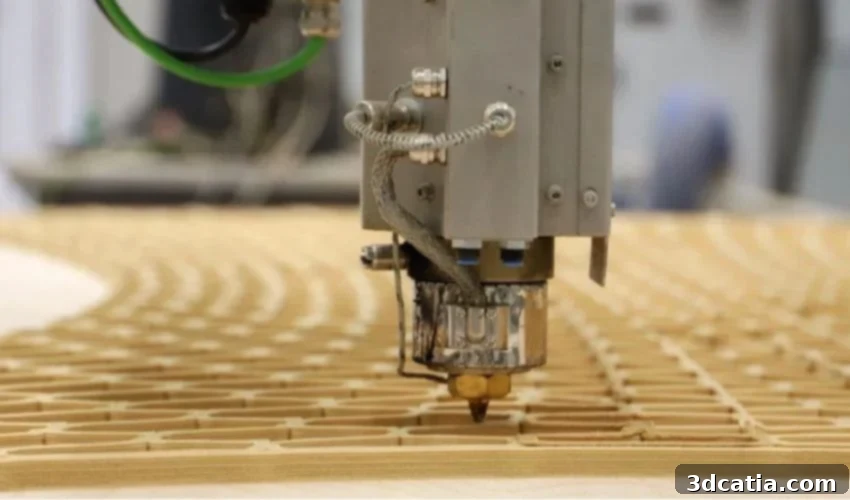
The successful implementation of large-scale 4D printing is equally vital, and this is where the University of Stuttgart, under the expert leadership of Dr. Tiffany Cheng, takes center stage. Dr. Cheng’s team is responsible for the development and operation of the specialized large-scale 4D printer necessary for manufacturing building components from the biofoam. 4D printing, as applied here, offers an unprecedented ability to program printed objects to transform autonomously, making buildings inherently more responsive and resilient. By combining intelligent digital design with advanced robotic production of this innovative biofoam, ARCHIBIOFOAM offers a compelling pathway to creating truly adaptive architecture. This integration will dramatically reduce the carbon footprint across the entire building’s life cycle, from construction through operation and eventual decommissioning.

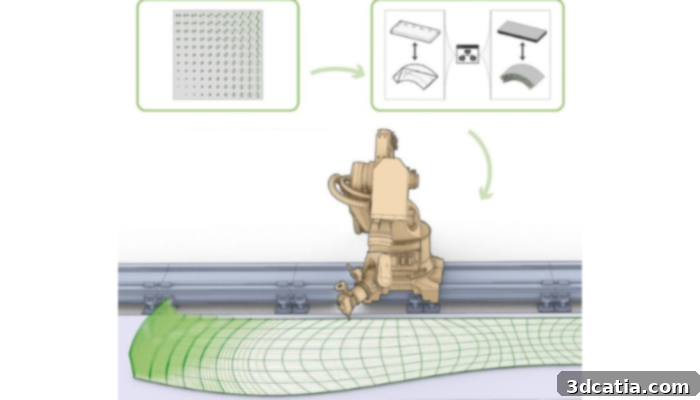
The LFAM platform, developed by the University of Stuttgart, represents a significant technological achievement, consisting of a 6-axle KUKA Fortec KR420 R3080 robotic arm mounted on an impressive 12-meter linear track, enabling large-scale, high-precision manufacturing.
“Robotic additive manufacturing is particularly suitable for structuring materials at high resolution, thus unlocking the performance potential of bio-foam on a large scale,” Cheng emphasized, highlighting the precision and scalability of their approach. “By intelligently adapting a single-material system through our sophisticated manufacturing process, we aim to effectively meet the multiple functional requirements of complex building components. This includes robust loading capacity for structural integrity and precise shape change capabilities essential for adaptive ventilation. Our work is pushing the boundaries of what is possible in sustainable architectural design and material engineering.”
Commercialization and Coordination for Global Impact
The strategic contributions of the remaining partners are equally critical to the overall success and future impact of ARCHIBIOFOAM. Woamy, a spin-off from Aalto University, is focused on advancing the expanded biomaterial technology with a clear objective: to successfully bring the innovative biofoam to market. This involves navigating the complexities of scaling production, ensuring regulatory compliance, and establishing effective supply chains for a completely novel building material. Their expertise in commercialization will be instrumental in translating cutting-edge research into real-world applications. Concurrently, Aalto University itself takes on the vital role of coordinating the entire ARCHIBIOFOAM project. This encompasses overseeing the diverse research streams, managing inter-partner communication, ensuring adherence to timelines, and facilitating the seamless integration of all technical and scientific advancements. Effective coordination is paramount for such a multi-faceted international research effort to achieve its ambitious goals. For those interested in delving deeper into the technical specifics and ongoing research, further details can be found here.
The Future of Green Buildings and Beyond
The ARCHIBIOFOAM project transcends merely creating a new building material; it represents a significant leap forward in our collective quest for truly sustainable and responsive architecture. By demonstrating the viability of 4D printed, bio-derived materials that adapt to their environment, the project lays the groundwork for a new generation of buildings that are inherently more energy-efficient, environmentally friendly, and comfortable for occupants. The potential implications extend beyond individual structures, hinting at a future where entire urban environments could be constructed from intelligent, biodegradable components. This initiative not only tackles the formidable challenge of reducing construction’s carbon footprint but also champions the principles of a circular economy, promoting resource regeneration and minimizing waste. As the project progresses, its findings could inspire widespread adoption of similar technologies, fostering a global shift towards green building practices and innovative material science. The successful commercialization of ARCHIBIOFOAM’s biofoam by Woamy could pave the way for a new market segment entirely, offering a genuinely sustainable alternative to conventional, resource-intensive construction materials. This is an exciting step towards a more harmonious relationship between the built and natural environments.
What are your thoughts on the revolutionary ARCHIBIOFOAM project and its potential to transform sustainable construction? We invite you to share your insights and comments below, or engage with us on our Facebook and Twitter pages! Don’t forget to sign up for our free weekly Newsletter to receive all the latest news in 3D printing delivered straight to your inbox, ensuring you stay at the forefront of this rapidly evolving field!
*All Photo Credits: ICD/IntCDC, University of Stuttgart